A Guide to Hiring Transformation Talent
TL;DR
Most sponsors interview transformation leads for what they have done. The deeper question is who they are inside ambiguity, failure, and their own ego.
This issue covers what to test for, who they are when things go wrong, whether they can hold the breadth the role demands, who they are as humans, and how to listen across the whole conversation. Written for sponsors. Useful read for practitioners who want to know what good looks like from the other side of the table.
Sections:
Testing their capability
Who they are when things go wrong
Whether they can hold the breadth of the role demands
Who they are as a human, not as a candidate
How to listen across the whole conversation
Hello,
Welcome to this edition.
This issue is for sponsors, C-Levels, and accountable leaders responsible for hiring senior transformation talent. It is a practical guide on what to look for, what to ask, and what to watch for when assessing a transformation lead.
If you are a change or transformation lead, this is also for you, so you know what hiring managers are looking for.
🎧 If you prefer to listen to this newsletter instead, check out the link below to an AI-generated audio podcast as a deep dive
Testing the capability
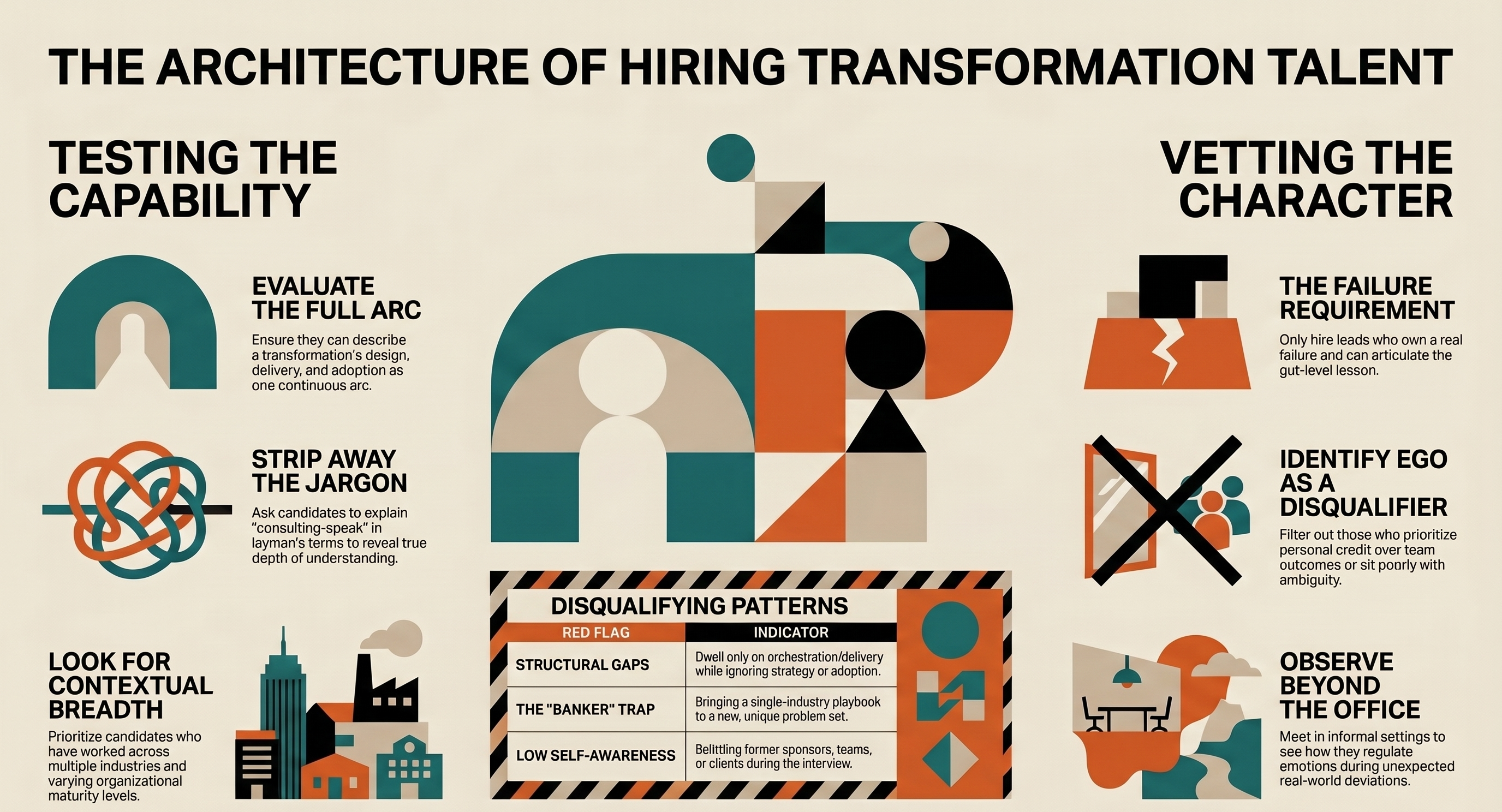
If they cannot describe a transformation as one arc with their fingerprints across all of it, you are hiring a project manager, not a transformation lead.
Capability is end-to-end.The opening question I run is this. "Tell me about an end-to-end transformation you were part of, and how you pulled it together."
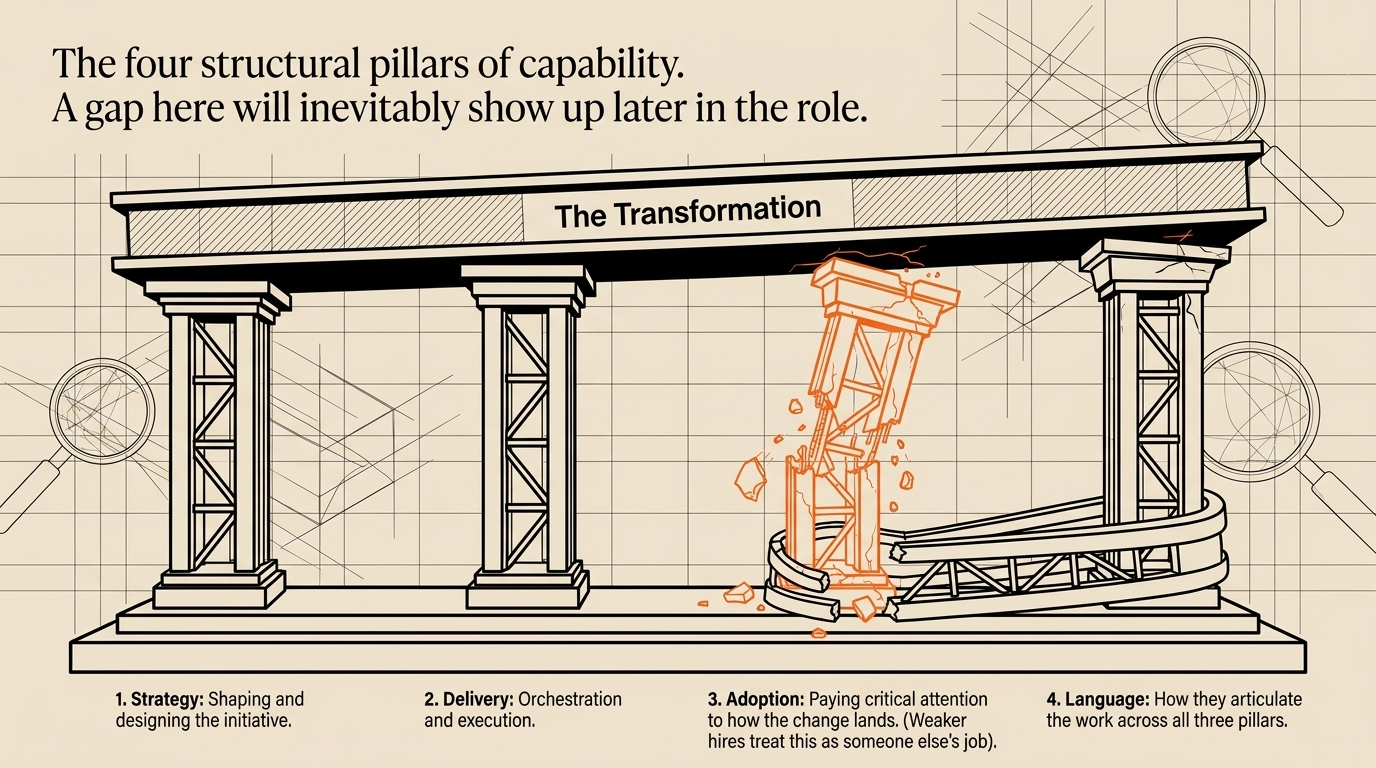
Then I listen for four things:
How muchstrategicwork they did shaping and designing the initiative.
How much were theyinvolved in delivery and orchestration?
How much attention did they pay tochange adoption?
Thelanguagethey use across all of it.
Strong transformation leads have worked acrossall four. They name them in their own words without being prompted. The weaker hires dwell on one (usually delivery or orchestration) and treat the others as someone else's job. That gap is structural, and it shows up later in the role.
The second move is to interrupt every fashionable consulting jargon. "Leadership alignment." "Change enablement." "Change resistance." "Psychological safety." "High-performing teams." When I encounter any of these, I stop and ask: " Can you explain that in layman's terms? How does it manifest? What would you actually do about it?
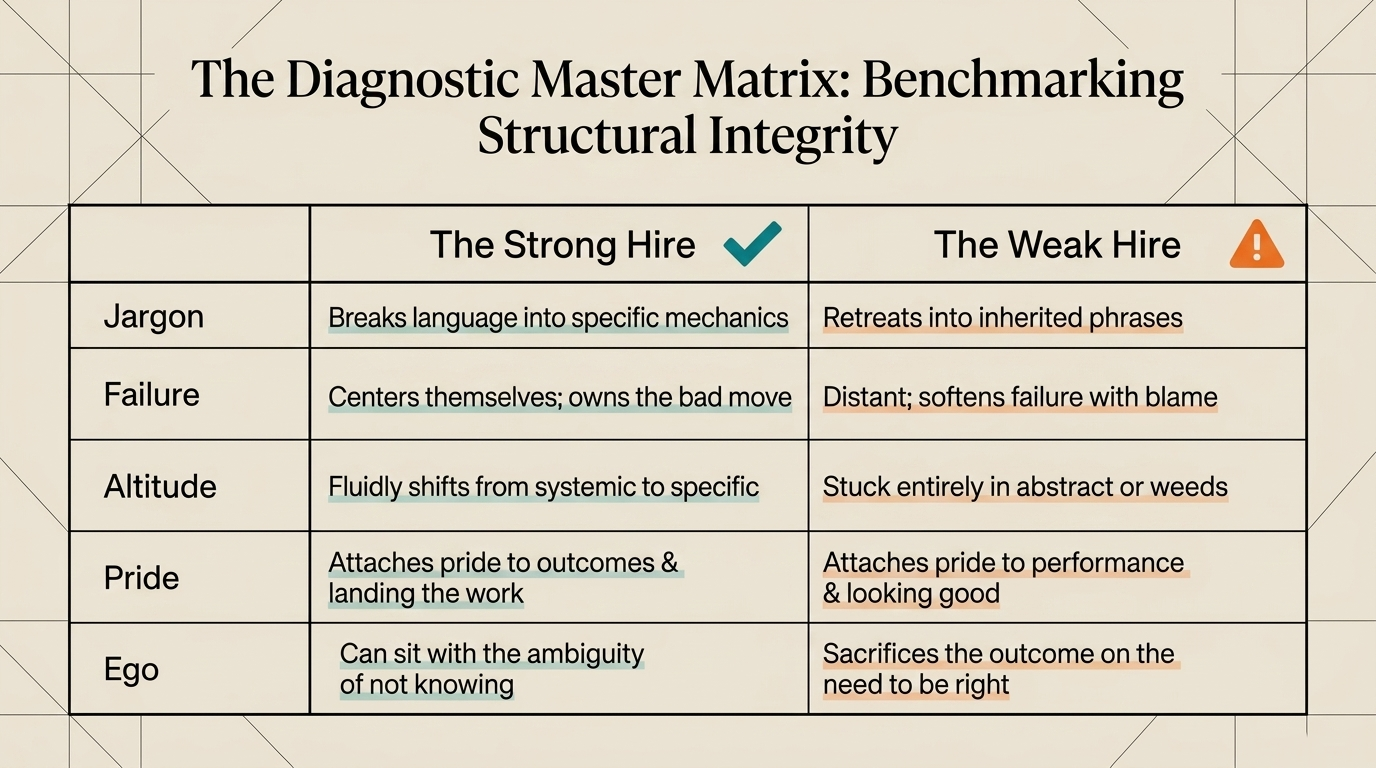
The strong candidates can break the language down into specifics and the moves they would actually make. The weaker candidates reach for more jargon, or pause and realise they have been speaking in inherited phrases without ever testing what was underneath them.
The third question is about the work itself. "What traits and characteristics are needed to create a transformation, not just deliver a project?What is required to embed a transformation so it delivers the outcome it was set up for?" The answer tells you whether they have thought about transformation as a discipline or whether they have been executing other people's frameworks for the last decade.
Who they are when things go wrong
The candidates without a real failure are not the lucky ones. They are the ones who have not been near the centre of the work.
Every successful transformation lead I have known, read about, hired, or worked alongsidehas at least one real failure they own.
The most important question in any transformation interview sits here. "Tell me about a transformation you led that failed. A point in time when you messed up. How have you recovered? What have you learnt?"
It is the most important question because it is a pattern interrupt. The script the candidate has rehearsed for the rest of the interview does not cover it.
What I am listening for is whether they take responsibility. The weak ones describe failure as something distant, a misjudgment based on someone else's input, a team member who let them down. They do not put themselves in the centre of the story.
The strong ones say, "I did this. It was a bad move. It was on me." They speak with confidence, not shame. They do not soften it with blame. They will sometimes say, "We did the best we could, and it still did not work." Then, often, they will tell you what they only realised years later, after the wound healed enough for the lesson to surface.
A lesson from a Hollywood movie that resonated
There is a film from back in 2003 calledThe Core. The premise is that Earth's core has stopped spinning, and a mission must be assembled to drill down and restart it. The selection of the crew is the most ruthless process you can imagine. They are choosing the best of the best of the best, the most exceptional minds and the most accomplished operators on the planet, for a mission with no precedent and no second attempt.
There is a young woman (Hillary Swank) in the selection process who is extraordinary on every measurable dimension. Outstanding intelligence. Exceptional under pressure. At the top of every class she has ever sat in. Awards across the board. Hardworking in a way that nobody around her can match. By every standard interview metric, she is the obvious lead pilot.
She does NOT get the role.
Later in the film, she asks her captain why. His answer has stayed with me for twenty years.
"Because you have not failed before." - not exact word, but that was the main message
That is leadership in one line. You have to have felt the punch in the gut. It has to have changed something in you. The moment you have lived inside a real failure, you carry something the high performer who has never failed cannot carry, an instinct for the difference between recoverable and unrecoverable, a willingness to call your own mistakes early, a steadiness that is not arrogance because it is built on knowing that brilliance does not protect you.
Until the candidate has that, they have potential. They are not yet ready for the level of responsibility a transformation lead carries.
The next two readings I run after the failure question:
Courage. "Tell me about a time you put your foot down and went against a sponsor or the prevailing direction. What happened?" People without this instinct will not protect your transformation when it is structurally challenged.
Ego. Ego is the single biggest disqualifier I have ever encountered in transformation hiring, and the hardest to detect from a CV. You feel it. The candidate who needs the room to know how senior they were. The candidate who steers every story back to their personal strategic insight. The candidate who has opinions about every former client and former colleague. The candidate who is too full of themselves to sit with the ambiguity of not knowing.
No matter how much they know, ego is a no. The cost is paid by the team they are about to lead, the sponsor who has to manage them, and the transformation outcome that gets sacrificed on the altar of their need to be right.
This is a gut feeling, not science. After enough hires, the gutfeel becomes more reliable.
Whether they can hold the breadth of the role demands
The question is not "have they done this exact thing before?" It is: what range of contexts have they done it across?
Diversity of experience is the variable that determines whether the candidate can recognise patterns across contexts or will reproduce the patterns they have been steeped in.
A strong transformation lead has worked across multiple industries, multiple cultures, multiple problem sets, and organisations at very different levels of maturity.
3 patterns to watch for in the CV:
A candidate who has only ever worked in say banks brings the bank's playbook into your transformation.
A candidate who has only ever worked in digital brings a digital lens to a problem that may not be primarily digital.
A candidate who has only ever worked in highly mature organisations will find it really challenging to operate when the structures and resources around them are not there.
Four readings I run after the CV check:
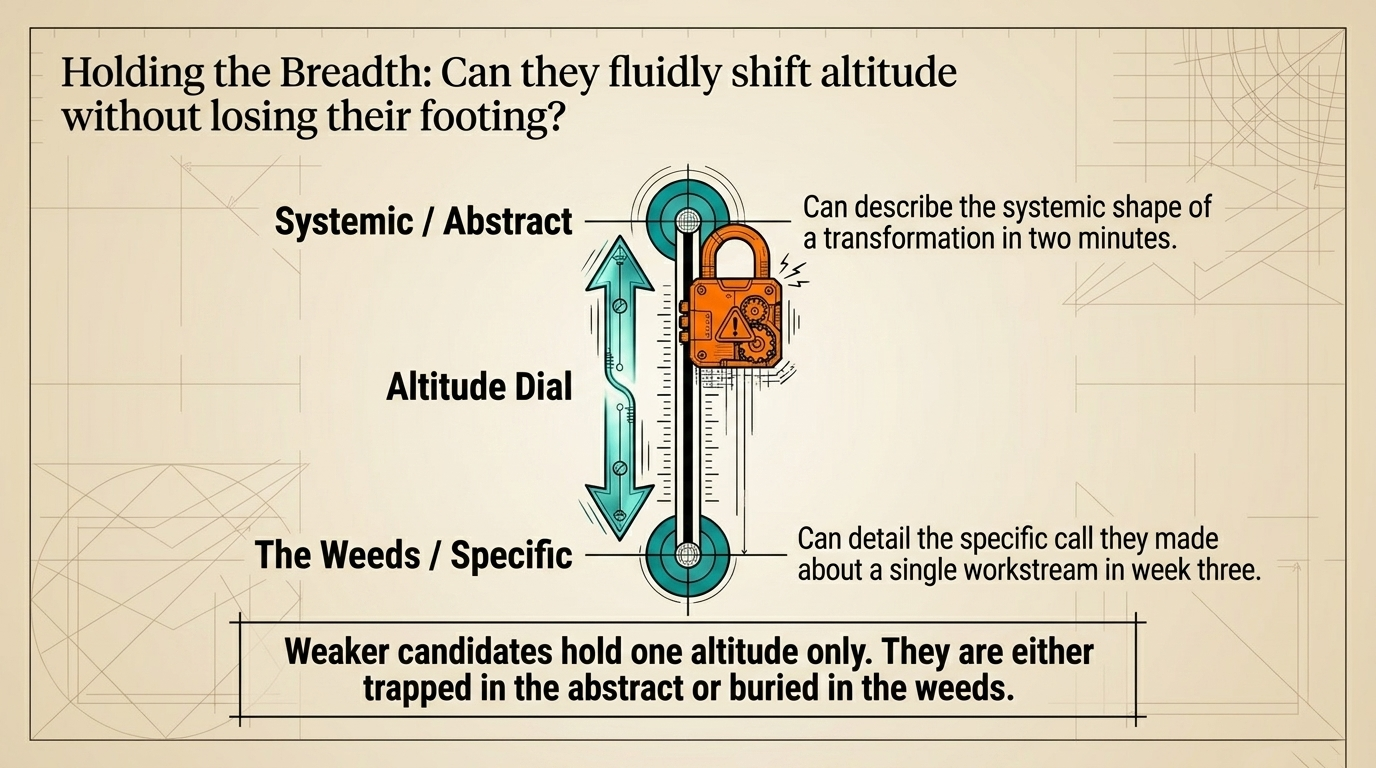
Altitude. Watch how they switch between high-level and detailed thinking when you press them. Strong transformation leads can hold both at the same time. They can describe the systemic shape of a transformation in two minutes, and they can also tell you the specific call they made about a single workstream in week three. The weaker candidates can hold one altitude only. They are either in the abstract or in the weeds, but they cannot move between the two without losing their footing.
Pride. "Describe a moment you are absolutely proud of." The answer tells you what they value, what they consider their best work, and whether their pride attaches to outcomes (the work landed) or to performance (they looked good).
Emotional range. The spread of emotional response across different topics. Can they shift register from professional to personal and back without losing themselves?
Emotional regulation. Can they sit with discomfort without deflecting? Can they hold strong feelings without performing them or suppressing them?
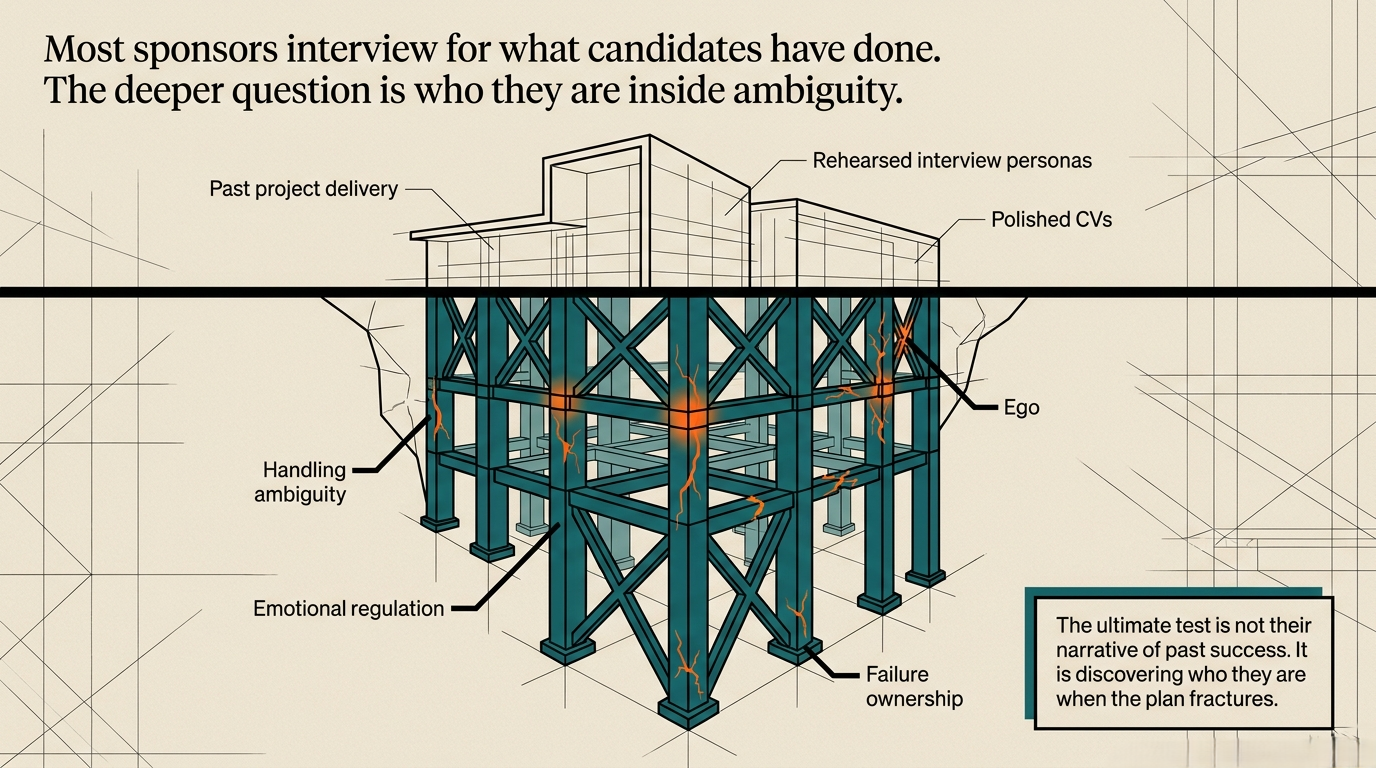
The fourth reading is the one most often skipped. You cannot read it in a 60-minute interview. It surfaces only in longer, off-site, uninterrupted conversations. A walk. A lunch. A half-day informal session where the candidate has time to drop the interview persona and respond to whatever shows up emotionally. A candidate who cannot regulate themselves under steady-state interview conditions will not regulate themselves in week thirty of a hard program.
Who they are as a human, not as a candidate
Hiring for transformation is hiring for who someone is when something does not go to plan.
The interview tests their narrative and expertise. The unexpected tests them.
I never meet senior transformation hires in offices. The office tells you nothing. It is the candidate's home turf, lit for the role they are auditioning for.
I take them to a café. We walk. I watch how they handle small things, an unexpected order, a moment of waiting, a noisy room. I have, on more than one occasion, asked the barista to bring the candidate the wrong drink on purpose, and watched what happened next. The plan is the part of the role that matters the least. The deviation from it is where the entire job lives.
Toward the end of the conversation, I ask three questions that sit between the personal and the professional:
What would they tell their future self?
What would their younger self be saying to them now?
If it were up to them, how would they have done the last transformation differently?
These questions surface self-awareness. The ones who answer with substance have done internal work. They know themselves. They are not running a persona.
There is also one disqualifier I watch for throughout the entire conversation. Candidates who belittle others or speak badly about their previous transformation, sponsor, team, or client. Once is enough. The way they speak about the people who came before them is the way they will speak about you later.
How to listen across the whole conversation
Experienced people-readers form a working view inside the first 15 minutes. They spend the next 45 trying to prove themselves WRONG, not right.
This is the meta-frame underneath every section above.
Most experienced senior leaders can form a working assessment of a candidate within the first 15 minutes of a conversation. The instinct is real and reliable.
The trap is what happens next. It is very easy to spend the rest of the time confirming the read. Looking for evidence that supports the assessment already formed. Allowing assumptions and biases to flood in unchecked.The discipline is to spend the remaining time trying to prove your initial read wrong, not right.
This means:
Looking actively for evidence that contradicts the working view.
Asking the questions that would surface a different picture.
Watching for the moment that would change your mind, and being open to the change.
This is what presence in an interview actually looks like. Not asking better questions. Staying available to be wrong about the human in front of you.
Do this, and you end up with a balanced read. You can stand behind the hire because you have seen the candidate from multiple angles, including the ones that worked against your initial impression. Skip it, and you hire your first 15-minute read, which is sometimes right and sometimes catastrophically wrong.
Two notes before you act on this
None of what is in this edition needs to be asked by one hiring manager. The questions, readings, and observations can span multiple stakeholders and touchpoints. The architecture is what matters.
This is also written for transformation hiring, but the same architecture applies to senior change leaders and other senior leadership roles that involve complexity, ambiguity, and people. Tailor the questions to the role.
Two paths from here
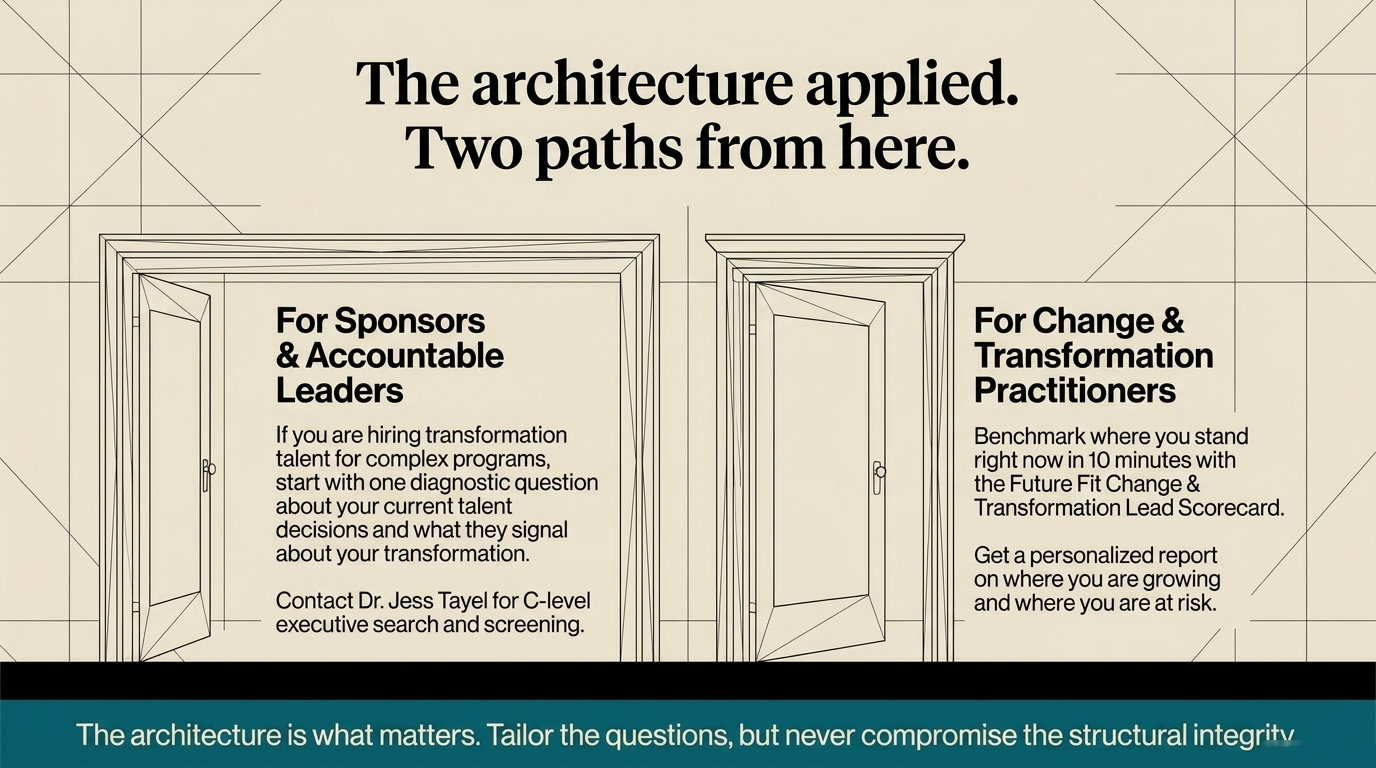
1️⃣ If you are a sponsor or accountable leader, hiring the right transformation lead is what I do day in and day out. I help with C-level executive search, screening services, and the placement of transformation leads inside complex programs. I bring this lens because I have watched it across multiple industries, intensities, and transformation problems, from high-stakes board-level programs to enterprise-wide rollouts to niche digital and operating-model work. The conversation usually starts with one diagnostic question about your current talent decisions and what they are signaling about your transformation.
Reply to this email and tell me what you are seeing.
2️⃣ If you are a change and transformation professional reading this from the other side of the table, the same body of work sits behind everything I teach inside the TLI program and the TLI Elevate program. Members operate with the inside view of what good looks like from the sponsor's seat, which is why they stand out when the next role opens.
Benchmark where you stand right now in 10 minutes with the Future Fit Change & Transformation Lead Scorecard. Not a red-amber-green score. You get a personalised, actionable report on where you are growing, where you are stagnant, where you are at risk, and what to focus on next. It draws on the same body of work that informs every paragraph of this email.
https://www.futurefitleader.com/relevance-quiz