Are You Buying AI or Building It?
The gap between what AI can do and what organisations can actually implement is growing.
TL;DR
Want to maximise your AI ROI? This is for you.
Most organisations are purchasing AI tools. Very few are building AI capability. These are not the same thing.
The technology is not the constraint. Implementation and adoption are.
Whatever transformation gaps existed before AI will be amplified by AI. What was strong gets stronger. What was weak gets worse.
The talent shortage in AI is not technical. It is leadership.
Category One AI (Copilot, chatbots) saves time. Category Two AI (agents, automation) changes what is possible. Most organisations are stuck in Category One with no clear path forward.
The organisations winning with AI share one thing: they treated it as a business transformation from day one, not a technology project.
In this article:
Introduction: Three years at the forefront, and what I keep seeing
Section 1: What AI actually is and what it is not
Section 2: The implementation problem nobody is talking about loudly enough
Section 3: The talent gap
Section 4: Why is so much AI investment not delivering its promise
Section 5: Where to go from here
Section 6: My Invitation to you to become the go-to in solving the most expensive problem
Hi,
Welcome to another edition of the Connect Newsletter.
Introduction:
Three Years at the Forefront
Over the last three years, I have been embedded in AI transformation programmes. Not observing. Not advising from a slide deck. On the ground, working with leadership teams and delivery teams at the same time, across some of the world's most complex organisations.
In that time, something has shifted. Boards are asking questions they were not asking two years ago. C-suites are allocating budget at a pace that would have seemed extraordinary in 2022. The energy is real. The investment is real. The urgency is real.
But so is the confusion. And so is the waste.
What I want to share here is not a technology briefing. There are plenty of those. This is a practitioner's view from inside the implementations. What is actually working, what is quietly failing, and what the organisations getting it right understand that the others do not yet.
The short answer:
The organisations winning with AI are not the ones with the most advanced technology.
They were the first to understand that AI is a business transformation challenge. Not a technology one.
And they built accordingly.
"The technology is ready. Most organisations are not. And the gap is not what most people think it is."
Section 1:
What AI Actually Is. And What It Is Not.
Let me start with a distinction that sounds simple but changes everything about how you approach this.
AI is not:
A piece of technology you purchase, deploy, and tick off a list
A cost reduction exercise dressed up in a new language
Copilot. A chatbot. A productivity tool. Those are entry points, not destinations.
AI is:
An extension of existing business capabilities. Not an add-on. Not something bolted onto infrastructure that was never designed to receive it.
Valuable when it is woven into how the business already creates value. How decisions get made. How work gets done. How customers are served.
A multiplier of what already exists. Which is both good news and sobering news.
The organisations I have seen use AI well did not ask where to use it. They asked a different question entirely:
What capability gaps are limiting our performance right now?
Could AI close any of them?
Do we have the foundations in place to let it?
That is a fundamentally different starting point. It begins with the business, not the technology.
A Copilot deployment can be a genuinely valuable first step. If the data is governed. If staff understand what it is for. If there is a roadmap connecting it to something bigger. Without those foundations, it is noise. A shiny object with a 90-day enthusiasm curve that fades when the real work of embedding AI into daily operations becomes apparent.
"AI placed on top of average foundations does not fix them. It amplifies them. What was slow gets slower. What works gets extraordinary."
Section 2
The Implementation Problem Nobody Is Talking About Loudly Enough
Here is what I can tell you from the implementations I have been part of, particularly in Europe, where several organisations are operating years ahead of the global average in AI maturity:
The technology is not the constraint. It has not been for some time.
The models are powerful. The platforms are mature. The cloud infrastructure is enterprise-grade.
The gap between what the technology can do and what organisations can actually implement is wide. And it is growing wider every month.
This is an implementation problem. A specific kind that the industry has not yet named precisely enough.
Many organisations have been approached, in some cases bombarded, by AI vendors carrying large promises and compelling demonstrations. The demos are impressive. The business cases are optimistic. And the failure rate at scale remains high. Not because vendors are dishonest. Because the implementation model behind most AI deployments is borrowed from traditional software. And AI is not traditional software.
Traditional implementation: define requirements, build, test, deploy, and train users. Linear. Predictable.
AI implementation works differently:
It starts with human and AI use cases. Not technology selection. What does a specific person in a specific role need to do differently?
It moves through multiple iterations before anything is finalised. Build, test, learn, adjust. Repeat.
Each iteration is matched against business capability gaps. Are we solving something that actually limits performance? Or something technically interesting that nobody was waiting for?
Only then does responsible implementation take the full picture into account. Data privacy. Data sovereignty. Responsible AI. System readiness. Organisational readiness.
That process is thorough. It takes longer than a vendor demo implies. And it produces results that last.
I have observed something else repeatedly. It matters enormously, and it rarely gets said directly:
Whatever capability gaps an organisation had before AI, those gaps do not disappear when AI arrives. They are amplified.
Gaps in change management, leadership alignment, strategy execution, and adoption. All of it gets louder and more expensive.
Organisations with strong transformational muscles found that AI accelerated everything.
The organisations that always struggled with adoption found that AI made those struggles faster and costlier.
AI is a multiplier. Full stop.
"The organisations succeeding with AI did not succeed because of the technology. They succeeded because they had already built the foundations that AI requires."
Section 3
The Talent Gap
There is no shortage of AI talent in the technical sense. The pipeline is growing. AI can now assist in building AI. Agents check other agents' work. The meta-layer is here and developing fast.
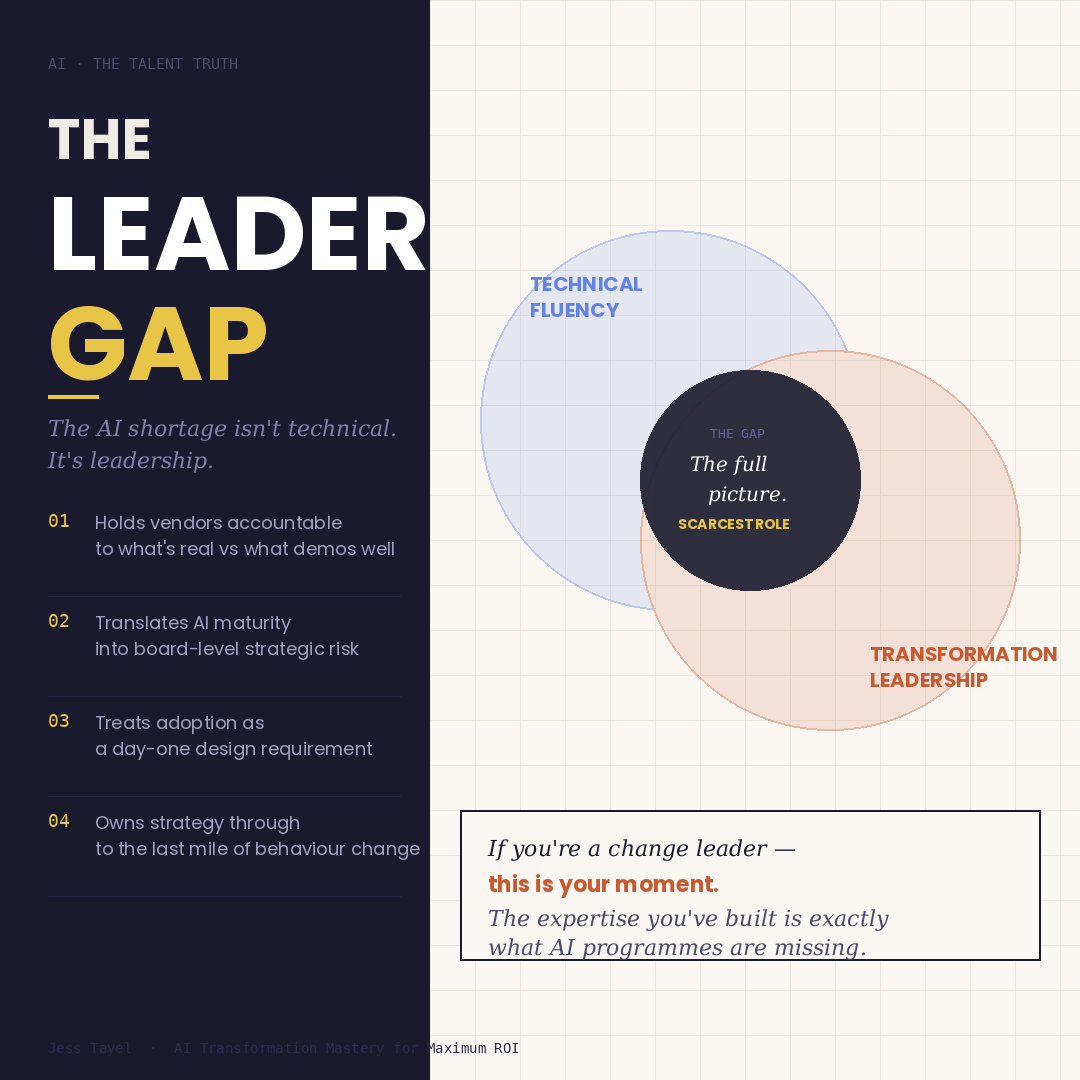
The talent shortage that is genuinely constraining the value of enterprise AI is not technical. It is leadership.
Most AI programmes are led from one of two positions:
A technically capable leader who understands models, platforms, and architecture but does not have deep experience driving adoption and behaviour change at scale.
A general transformation leader who is fluent in change and programme management but cannot hold a vendor accountable or guide a technology decision with real confidence.
Both are valuable. Neither alone is sufficient.
The AI programme leader of an enterprise actually needs to hold all of this simultaneously:
Understands what is happening under the hood without needing to build it
Can sit with a data engineering team and ask the questions that surface the real constraints
Can sit with a board and translate AI maturity into strategic risk and opportunity without over-simplifying or overwhelming
Treats change adoption as a day-one design requirement. Not a phase at the end.
Understands that AI implementation spans technology, data, process, culture, governance, and capability simultaneously. Siloed thinking is the enemy of value.
What makes this genuinely hard to find is the end-to-end view. From strategic intent all the way to the moment a real person in a real role uses AI differently because of the work done. That last mile is where value either materialises or evaporates. It requires a different kind of leadership than every mile before it.
AI can build AI. What it cannot do is lead the human transformation that makes AI worth building. That remains irreducibly human work.
"The scarcest capability in enterprise AI right now is not technical. It is the leader who can hold the full picture from strategy through to the moment someone's daily work actually changes."
SECTION 4
Why So Much AI Investment Is Not Delivering Its Promise
I see a pattern consistently. The investment went in. The tools were deployed. Some productivity gains were claimed. And yet the transformational value promised in the business case has not arrived. The frustration is real, and it is legitimate.
The reason comes down to one distinction most organisations have not yet made clearly enough.
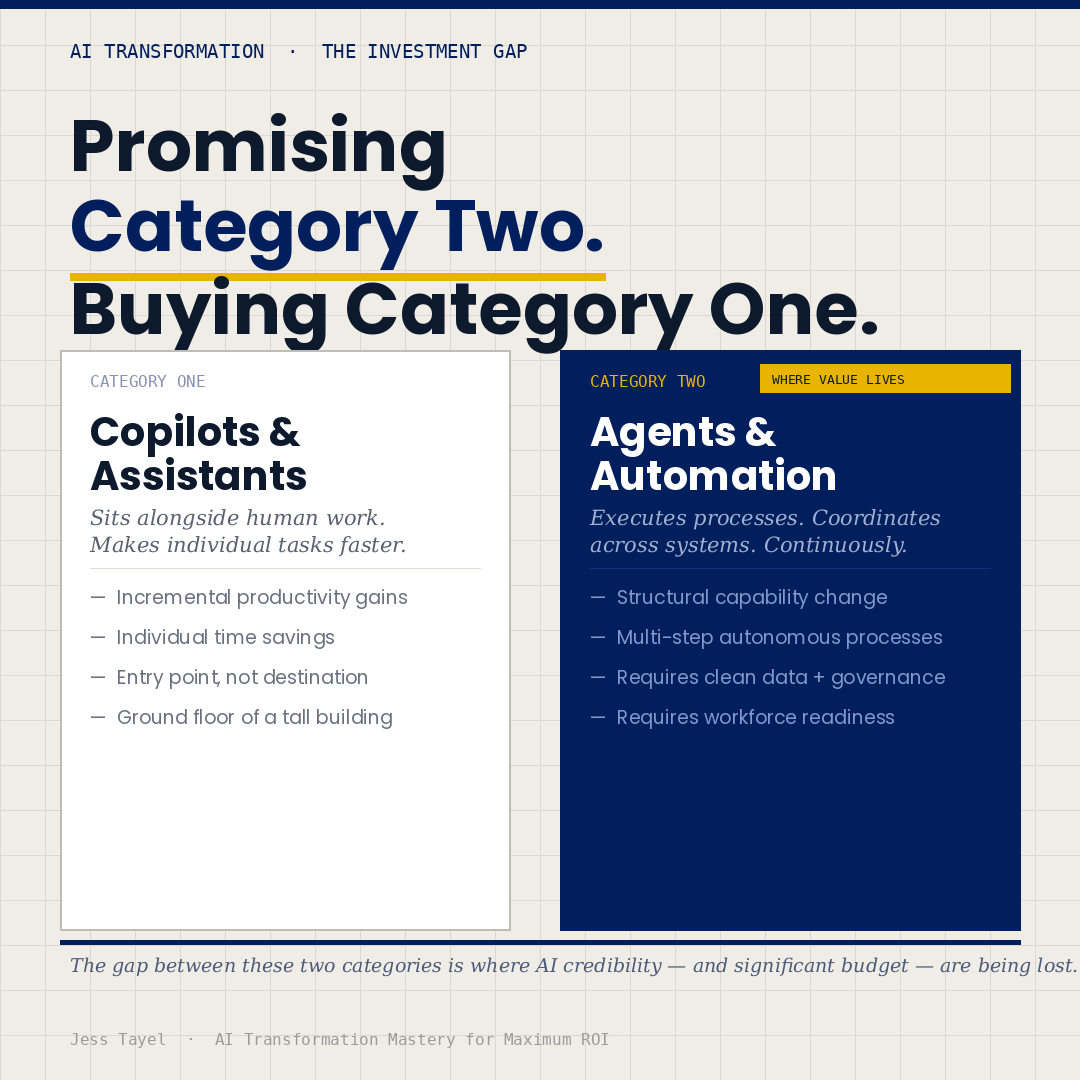
Category One AI:
Generative AI, AI assistants, Copilot tools
Sits alongside human work and makes individual tasks faster or easier
Genuinely useful. A legitimate starting point.
The ground floor of a very tall building.
Category Two AI:
AI agents, chained agent ecosystems, and autonomous AI within defined guardrails
Does not assist with tasks. It executes multi-step processes, coordinates across systems, adapts to context, and operates continuously.
The productivity and capability uplift are not incremental. It is structural.
This is where transformational value lives.
Most organisations are stuck between these two categories. Not because of the technology. Because they entered Category One without building the foundations that Category Two requires:
Clean connected data that AI can act on, not just read
System integrations that allow agents to take action across platforms
Governance frameworks designed for autonomous action, not just AI outputs
Monitoring infrastructure that provides visibility without requiring supervision of every step
A workforce with enough experience working alongside AI that they know when to trust it and when to question it
Category One done well is not the problem. Category One done without a deliberate roadmap to Category Two is where ROI evaporates. Organisations end up with a portfolio of AI tools that save individual time but change nothing fundamental about how the business competes.
The implementations I have seen fail shared a common pattern:
Driven by tool selection rather than use-case design
Governed by IT rather than a business-owned programme
Measured on deployment metrics rather than outcome metrics
No clear architecture connecting Category One investments to a Category Two future
The implementations that succeeded shared something different. A clear enterprise AI architecture. Equal investment in data and governance as in models. And leadership that understood the journey is measured in years, not quarters.
"Category One AI saves time. Category Two AI changes what is possible. Most organisations are investing in the former while promising the latter. That gap is where AI credibility and significant budget are being lost."
Section 5
Where to Go From Here
If there is one idea to carry from this newsletter, it is this:
The organisations that will look back in five years and say AI genuinely transformed their business will not be the ones that moved fastest. They will be the ones who moved most deliberately.
What they will have done:
Started by asking the right question. Not what AI should we use, but what capabilities do we need to build, and what role can AI play?
Invested in data foundations and governance at the same time as they invested in tools. Not after.
Treated change adoption as a design requirement from day one. Not a communication campaign at the end.
Built a roadmap connecting Category One to Category Two with clear foundations required at each stage.
Found or built leadership that could hold the full picture simultaneously.
None of that is easy. All of it is achievable. And the gap between the organisations doing it properly and those circling the ground floor is widening every month.
The window to build the right foundations is still open. The organisations that use this moment to build properly rather than move quickly will be the ones that compound the value of every AI investment that follows.
I have spent the last three years building those foundations with some extraordinary organisations across Europe and globally. The lessons are hard-won, the patterns are consistent, and the path is clearer than the current market noise suggests.
If any of this resonates with where your organisation is, or where it is trying to get to, I would welcome the conversation.
"You are not behind because you lack AI tools. You are behind if you lack the foundations to make AI tools matter. That is still fixable. But the window is shorter than most Boards realise."
Section 6: An invitation
My invitation: Master how to bring Clarity to strategy, outcomes, and the gap between the two.
The most expensive problem in transformation isn't the one you're tracking.
It's not the budget. It's not technology. It's not resistance to change.
It's the absence of clarity on what you're actually trying to achieve, and the cost compounds quietly, buried inside every rework cycle, every misaligned decision, every team that built the right thing for the wrong outcome.
Here's what makes clarity particularly dangerous: it's not a yes-or-no question. Most leaders believe they have it. Most programs proceed as if they do. And most of them discover, somewhere in the middle of delivery, that what looked like clarity at the start was actually an assumption in disguise.
That gap, between where strategy points and where outcomes actually land, is where transformation programs lose their way.
The Clarity Advantagewas built to close it.
Built for executives, change and transformation leaders, and strategy practitioners who need more than inspiration, they need a method.
You'll walk away with:
A clear framework and practical tools to define outcomes with precision
The ability to articulate what true success looks like — for your customers and your organisation
A path from a high-level strategic north star to something your team can actually build toward and measure
And because learning without implementation is just theory,I've built proprietary AI tools directly onto the course frameworks, so you're not just developing capability, you're applying it in real time, on real programs, at speed.
If clarity has been the missing piece, this is where you find it.
The same frameworks I have taught to senior leaders and independent consultants across more than 17 transformation programs and 11 organisations are now available to you in a structured, self-paced format.
→ Get immediate access to The Clarity Advantage Course*, AI tools and a Live Q&A
https://docs.google.com/document/d/1HHdsQaAP1HSawWnRLjRdojouXOFuz3lh0Icnt_Lg6Ek/edit?usp=sharing
*Available to TLI Elevate and Inner Circle Mastermind members.