Communicating Change Series Part 2 of 4: Communication Doesn't Lie
I lead and advise on large-scale transformations and world-class programs, and on smaller but critical programs that exist to shift an organisation's trajectory. In that work I am frequently asked to form a view on a culture quickly, often within days, and always with far less access than a proper diagnostic would require.
Engagement surveys are months old and heavily mediated. Culture decks describe intent rather than behaviour. Interviews give me what people are willing to say to an outsider in a recorded room.
The material I get then is the organisation's own change communication.
TL;DR. How an organisation communicates change is the most honest account of that organisation available to you. It is produced under pressure, to a deadline, by people managing something difficult, which means it carries instincts rather than intentions.
Read a handful of them and you can see how an organisation sees itself, what it protects when something has to give, where power actually sits, and how far it trusts its own people.
Where this sits in the series. This is Part Two of four, and it stands on its own. Part One argued that communication sits downstream of the decisions that produced it, which makes the message evidence rather than cause. This part takes the obvious next step and asks what it is evidence of. Part Three goes underneath both to look at capacity, and Part Four turns the argument into what it asks of a leader.
Here's a link to part 1: https://www.linkedin.com/pulse/communicating-change-series-part-1-4-problem-never-jess-tayel-dr--i2sre/
🎧 I highly recommend you to listen to this audio podcast as a deep dive which is AI-generated based on this edition and Jess' intellectual property:
What an announcement actually reveals
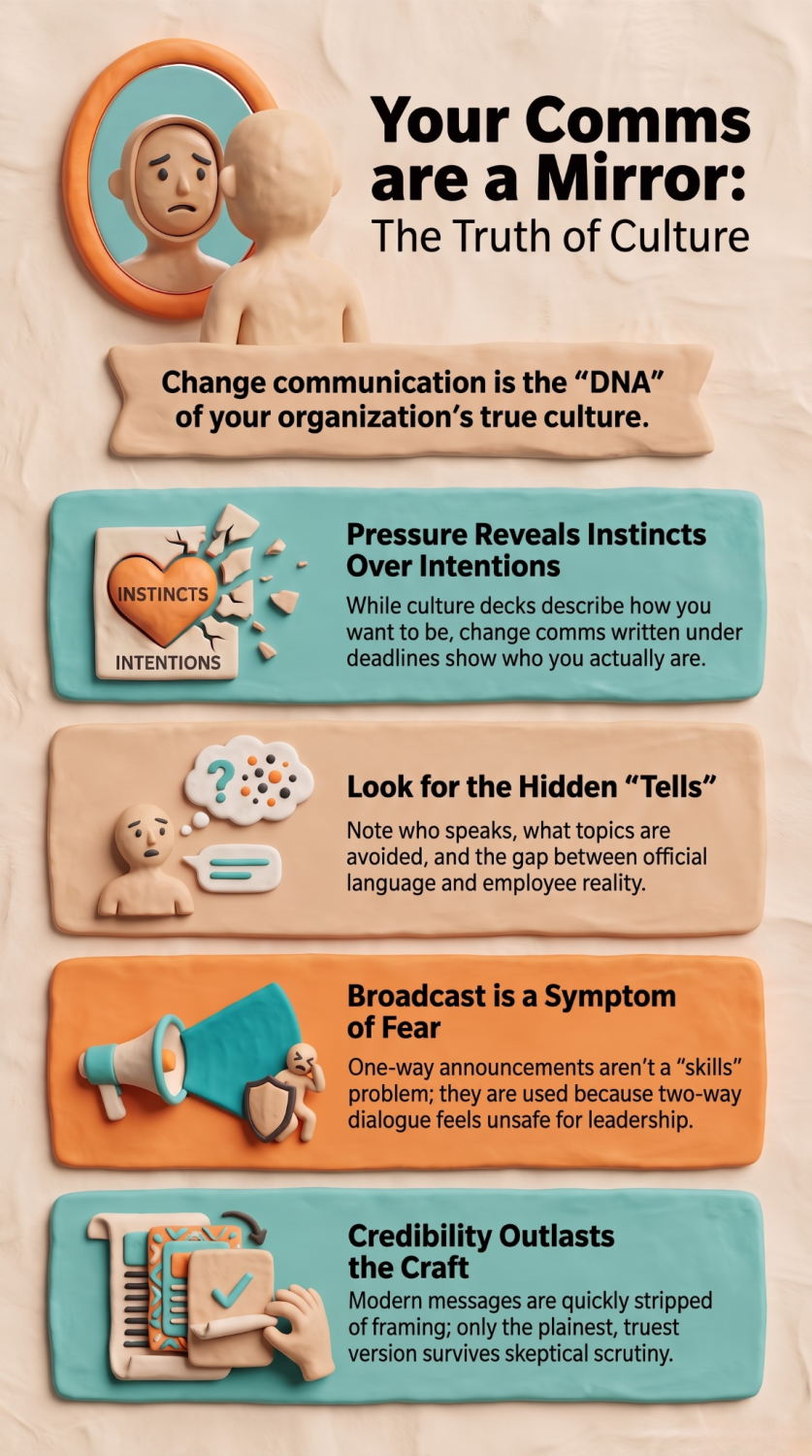
Change communication is written under pressure, which is precisely why it tells the truth about the organisation that produced it.
Culture statements are written carefully, by people who know they are being read. Change communication is written to a deadline, in the middle of something difficult, by people trying to manage a real problem. It carries the organisation's instincts rather than its intentions, and instincts are what govern behaviour when a transformation puts a system under load.
Some of the specific tells:
What gets named and what gets avoided. An organisation that cannot say plainly what people are losing is telling you something about its relationship with difficulty.
Who speaks. The seniority and identity of the voice reveals where authority actually sits, regardless of the org chart.
Whether questions are invited, and what happens to the answers. An invitation with no visible consequence is a stronger statement than no invitation at all.
How much of the message is devoted to justification. Heavy justification usually indicates a leadership team convincing itself as much as its people.
The gap between the language of the announcement and the language people use about it afterwards. That gap is the trust deficit, measured.
🔧 In practice. Take the last three significant change communications your organisation issued. Read them in sequence, and against each one answer: what did this assume about our people, and would that assumption survive being said out loud in a room with them? The pattern across three is more reliable than any single message.
Broadcast is a response to low trust, not a lack of technique
Organisations do not default to one-way communication because they have forgotten how to do dialogue. They default to it because dialogue feels unsafe.
The standard diagnosis of poor change communication is a skills and process problem. Leaders have not been taught, or the plan did not include the right activities. That diagnosis is comfortable because it comes with an obvious remedy.
It is also, in my experience, not the best way forward most of the time. Most senior leaders know perfectly well that dialogue produces better outcomes than announcements. They choose the announcement anyway, and they choose it under conditions of exposure.
Broadcast is what an organisation reaches for when it does not trust what will happen if it opens the conversation. That distrust runs in every direction. Leaders who fear they cannot answer the questions. Executives who suspect the plan will not survive scrutiny. Organisations where raising a genuine concern has historically been career-limiting, which is a failure of psychological safety long before it is a failure of communication.
This is why so much change communications improves briefly after training and then returns to what it was before. The behaviour was never the cause, it was the visible expression of what the culture permits under pressure, and pressure is exactly when the training stops being available.
🔧 In practice. When you find yourself defaulting to the announcement, the diagnostic question is not what channel to use. It is what you are protecting. Two questions surface it quickly:
What question am I hoping nobody asks, and what does it mean that I am hoping that?
If I opened this for genuine discussion, what would I be unable to defend?
The answers point at the actual work, and it is rarely communication work.
Reading the mirror is a leadership capability
Most leaders would rather improve the reflection than examine the room/situation it is reflecting.
There is an uncomfortable move available to any leader willing to make it. Instead of asking how to communicate the next change better, ask what the last one revealed, and treat that as data about the organisation rather than about the comms function.
Very few leaders do this, for an understandable reason. Improving a message is a task that can be delegated, completed and closed. Examining what the message revealed about trust, power and honesty opens something that cannot be closed quickly, and it usually implicates the people doing the examining.
The leaders who read their own communication honestly gain an advantage that no framework provides, because they are diagnosing the system while everyone else is editing its output.
This is also where the two conversations separate. Improving change communication is a craft question with craft answers. Understanding what your change communication reveals is a leadership question, and it belongs to the people accountable for the outcome rather than to the people writing the words.
🔧 In practice. Build a short review into your program governance, separate from any communications effectiveness measure. After each significant communication, the accountable leader answers three questions in writing:
What did we avoid saying, and why did we avoid it?
What did the response tell us about how safe people feel here?
What would we need to change about how we decide, so that the next message is easier to write honestly?
Keep the answers and read them across a whole program. The pattern that emerges is your culture, described by itself.
Why this reads differently now
The background conversation was always there. What has changed is its speed and its permanence.
The informal conversation that goes with any change has always existed. What is different now is that it moves faster than the formal channel, it leaves a record, and it increasingly involves tools that will summarise, reframe and circulate a message without any of the context leadership assumed would travel with it.
Two consequences matter for anyone running a program.
The first is that the gap between what you announce and what people conclude now closes within hours (if not less). There is no longer a period of grace in which the official version holds while the organisation catches up.
The second is subtler and more serious. As artificial intelligence AI makes competent communication cheap and universally available, polishing messages stops being a differentiator.
When every organisation can produce a well-crafted message, the only thing that distinguishes them is whether the message is true and whether the organisation behind it is trusted.
Craft is being commoditised but credibility is not.
🔧 In practice. Assume that anything you send will be summarised, stripped of framing and interpreted without you present. The test is no longer whether the message reads well. It is whether it survives being reduced to its plainest form by someone who is sceptical. If it does not survive that, the problem is in the decision rather than the draft.
Where this leaves us
Reading your communication honestly is uncomfortable, which is most of why it is valuable. It tells you what your organisation actually is when it is under load, as opposed to what it says about itself when it is not.
An organisation's change communication is its culture, written down under pressure.
There is one more layer beneath this. A great deal of what organisations experience as resistance is not a communication failure and not opposition, and Part 3 of this series takes that apart.
If you want to test this, read your last significant change communication as though someone else wrote it, and ask what you would conclude about that organisation.
Thanks for taking the time to read through this
Till next time
Jess
Where you sit as a leader in shaping the conditions a change is realised into is what the Future Fit Leader Scorecard measures, across the 5 pillars of a Go To Leader (GTL). It takes 10 minutes and your results report will be in your inbox for you to digest. Link to the quiz is below 👇