Communicating Change Series Part 3 of 4: Most Resistance Isn't Resistance; It is Capacity as Resistance
There is a reframe gaining ground at the moment, and it is a good one. It holds that much of what we call resistance is a by-product of how badly we communicated, so the question stops being what do we do about these people and becomes how well did we design this. That is a fairer question and a more useful one, and I agree with it as far as it goes.
But…. It stops one level short.
I lead and advise on large-scale transformations and world-class programs, and on smaller programs that exist to shift an organisation's trajectory. Across that work, capacity is the most consistently underestimated variable in whether a transformation lands.
TL;DR. A significant proportion of what organisations experience as resistance is neither opposition nor a communication failure. It is depletion.
People with nothing left to give look identical to people who do not want to give it, and the two require completely different responses. The standard resistance playbook makes depletion worse, because every intervention in it asks for more of the resource that has already run out.
Where this sits in the series. This is Part 3 of 4, and it stands on its own.
📍Part One argued that communication sits downstream of the decisions that produced it.
📍Part Two showed that what it reveals about an organisation is more honest than what that organisation says about itself. Both point to the same place: the problem is rarely where we are looking for it.
📍This part applies that to the most misdiagnosed phenomenon in change and transformation. Part 4 turns the whole argument into what it asks of a leader.
📍Check out the invitation to work with me 1:1 at the bottom
🎧 I highly recommend you to listen to this audio podcast as a deep dive which is AI-generated based on this edition and Jess' intellectual property:
https://gotoleader.s.gy/Your-team-is-too-depleted-to-change
The resistance that is actually exhaustion
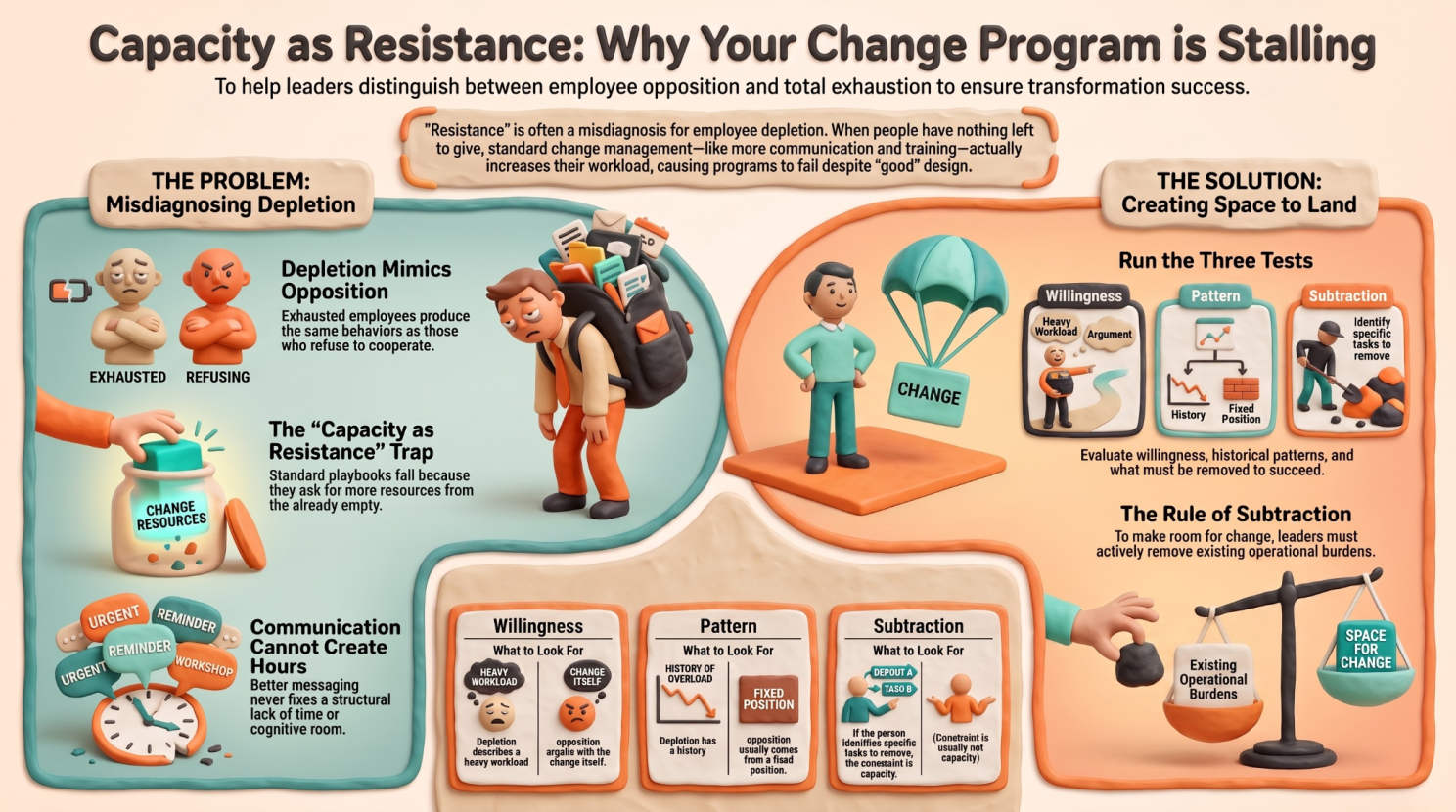
A person with no capacity left and a person with no intention of cooperating produce the same behaviour on a stakeholder map.
The behavioural signature of depletion is almost indistinguishable from the signature of opposition. Meetings get declined, actions sit uncompleted, enthusiasm goes missing, and questions start to sound obstructive. Adoption stalls despite training, sponsorship and a well-run communication plan.
Faced with that pattern, most programs reach for the resistance playbook. More engagement, more communication, more visible sponsorship, sometimes more pressure. Every one of those responses adds load.
When the underlying problem is capacity, the standard resistance response makes it worse, because every intervention in the playbook asks for more of the resource that has already run out.
This is what I call capacity as resistance, and once you have seen it you cannot unsee it in a stalled program. The people you have labelled resistant are frequently the people carrying the most, who have been asked to absorb four changes this year alongside a full operational load, and who have quietly reached the end of what they have.
🔧 In practice. Three tests separate depletion from opposition, and they take a single conversation:
The willingness test. Ask what they would need in order to do this well. Opposition argues with the change. Depletion describes a workload.
The pattern test. Look at whether the same person or team was engaged and capable 18 months ago. Depletion has a history. Opposition usually has a position.
The subtraction test. Ask what you would have to take away for this to be possible. If the answer is immediate and specific, you are looking at capacity.
Why the communication reframe stops short
Better sequencing of a message does not create hours that do not exist.
Reframing resistance as a design problem is a genuine advancement from blaming individuals, and I would rather the field held that view than the one it replaced. It still contains an assumption worth surfacing: that the barrier is comprehension, ownership or trust, and that the right communicative approach can therefore reach it.
Depletion does not respond to that. A person at the end of their capacity understands the change perfectly, may well agree with it, and still cannot act on it. No amount of dialogue creates the hours. No amount of listening creates the cognitive room to learn a new system while running the old one at full volume.
Communication can build understanding and ownership. It cannot manufacture capacity, and where capacity is the constraint, communication is being asked to solve something structurally out of its reach.
There is a second-order effect worth naming. When a program keeps communicating at a depleted population, the communication itself becomes evidence that leadership is not paying attention. That is how a well-designed campaign actively erodes trust.
🔧 In practice. Before you commission more engagement for a stalling change, run a simple audit that most programs skip:
List every change currently landing on the affected population, including changes owned by other parts of the organisation.
Identify what has been removed from their workload to make room for any of it. In most organisations, the honest answer is nothing.
Ask what proportion of the group is carrying an operational role at full load alongside the change.
Now the important bit: make the case for what needs to be true for the change to be realised given the above. What needs to be taken off their plate, what can improve, what might need some improvements as BAU-type improvement (not another project), what decision fatigue can be sorted out…etc. This point is very important. Because many change and transformation practitioners and leaders conceptually know of the above, but haven't officially put the case to their sponsor with CLEAR costs and ADEQUATE options.
If nothing has been subtracted, the constraint is capacity and no communication plan will move it.
The depleted leader broadcasts
Dialogue is the most expensive form of communication a leader can choose, and depleted leaders cannot afford it.
The capacity problem does not stop at the front line. It reaches the people running the change, and it shapes their behaviour in a way that is rarely connected back to its cause.
Holding a genuine two-way conversation about a difficult change is demanding work. It requires presence, the ability to absorb other people's anxiety without deflecting it, and the composure to sit with questions you cannot fully answer. That is a substantial draw on a leader's reserves.
A depleted leader will default to the announcement and long emails. Not because they do not know better, and not because they lack the skill.
Broadcast is what remains available when a leader no longer has the capacity for anything more demanding, which means much of what we diagnose as poor communication practice is actually leadership depletion made visible.
This closes a loop that runs through this whole series. Communication is downstream. What it reveals is the state of the organisation. And one of the most consistent things it reveals is how much is left in the people leading the change.
🔧 In practice. If you are leading a change and your own communication has become thinner, more one-directional and more scheduled, treat that as information about your capacity rather than your technique. Two questions are worth answering honestly:
Am I choosing the announcement because it is right for this message, or because it is what I can manage this week?
What would I need to put down in order to lead this conversation properly?
The second question is uncomfortable in most organisations, which is a reasonable indicator of how necessary it is.
Note: the dialogue is also not your regular 1:1 that speaks to business priorities and progress updates. A dialogue is something a lot deeper and more humane, with coaching woven into it. The kind of conversation where parties don’t go into it well-prepared, reading from an agenda, where the parties' heart rate is not elevated, and the breathing is not shallow. They both sink into a space of care, common ground, and how can we make this happen for us both. If you want me to double-click on that for you, feel free to reply back / or message me with some of your context, and I can help draw the picture and clarify.
Why the pressure is compounding
Continuous change with no subtraction produces a permanent capacity deficit, and most organisations are now running one.
The traditional model assumed change arrived as a discrete event with a recovery period on either side. That model no longer describes anything. Change now arrives continuously, in overlapping waves, with each initiative planned as though it were the only one.
Two forces are accelerating this.
The first is the sheer volume of concurrent transformation. Most organisations are running several material changes at once, each with its own governance and its own communication plan, none of which account for the others in any real way.
The second is artificial intelligence, which is generating a category of change that is unusually expensive in capacity terms. Adopting these tools requires people to relearn how they work while continuing to work, and it arrives with an urgency that discourages the subtraction that would make it feasible.
The organisations that will adopt AI successfully are not the ones with the best change communication. They are the ones that create the capacity for people to learn, and that will show up as an advantage long before it appears in any adoption metric.
🔧 In practice. Add one line to your program's status reporting: what have we removed to make room for this. If it stays blank across successive reports, you have identified your delivery risk, and it is not communication.
Where this leaves us
Reframing resistance as a design problem was an important correction to a discipline that spent years treating people as obstacles. The next correction is to recognise that some resistance is neither obstruction nor a design flaw.
Before you treat resistance as a communication problem, establish whether the people in front of you have anything left to give.
That question sits with leadership rather than with a communications plan, which is where Part Four of this series goes.
If a change you are leading has stalled and the engagement plan is not moving it, the more useful question is what your people are carrying.
Capacity, and the leadership judgement to protect it, is one of the five pillars measured in the Future Fit Leader Scorecard. Here is the link if you want to see how you score
https://www.futurefitleader.com/relevance-quiz
Invitation to work with me 1:1
Are you in job search mode?
The change and transformation market is hot right now, and you don't want to lose the opportunity to get that next role because of how you have packaged your expertise, misalignment on what the role is really about and what will get you over the line, or the positioning that you gave it… rather than what you can actually do.
That gap is usually smaller than it feels, and it is very fixable.
I also know that some of you are not in a position to spend money, time, and energy on a long-term coaching program or a big investment right now. That does not mean you should go without the guidance. It means you scramble, you work it out on your own, and you miss opportunities where the fix was far simpler than it looked from the inside.
So starting this week, I am running the Career Game Plan.
Short, practical, accessible, with access to me 1:1 so we can increase your chances of winning (internally or externally)
6 weeks, direct 1:1 with me, on what is actually in front of you. We name the blind spots, what to stop, what to double down on, how to stand out, and how to dominate the interview.
Total 7 spots only (2 are already taken as of today - Friday 7 Aug 2026), because each one gets my 1:1 time and a game plan built for their situation.
Details in the link below 👇
📌 https://transformationleadership.institute/career-game-plan