Communicating Change Series Part 4 of 4: A Message Is Not a Capability
There are two conversations available about change communication, and the field has been having only one of them.
The first is about quality. What makes a good change message, how to structure it, when to send it, which channels, which sequence. It is a legitimate craft conversation with real expertise behind it, and the current thinking on it is better than what came before.
The second is about capability. What makes an organisation reliably able to communicate change well, under pressure, across many programs, without depending on whether the right individual happened to be available. That is a completely different question, and it belongs to leadership rather than to the communications craft.
I lead and advise on large-scale transformations and world-class programs, and on smaller programs that exist to shift an organisation's trajectory. The difference between organisations that have this capability and organisations that produce good messages occasionally is one of the clearest predictors I know of whether a transformation will land.
TL;DR. Good change communication is a craft. Communicating change is an organisational capability, and only the second one survives a restructure, a bad quarter or the departure of your best communicator. That capability rests on three things, none of which is a communication activity: decisions that can be explained honestly, a culture where difficulty can be discussed, and capacity that is actually governed. Now that AI has made the message close to free, the capability is the only part still worth investing in.
Where this sits in the series.
Part 1 argued that communication sits downstream of the decisions that produced it.
Link: https://gotoleader.s.gy/The-Problem-Was-Never-the-Message
Part 2 showed that what it reveals about an organisation is more honest than what that organisation says about itself.
Link: https://gotoleader.s.gy/Communication-Doesn't-Lie
Part 3 established that much of what we label resistance is depletion rather than opposition. Each moves the problem further from the message and closer to the organisation producing it. This part follows that to its conclusion.
Link: https://gotoleader.s.gy/Most-Resistance-Isnt-Resistance
And today is about the final article in this series, part 4.
🎧 I highly recommend you to listen to this audio podcast as a deep dive which is AI-generated based on this edition and Jess' intellectual property:
https://gotoleader.s.gy/polished-emails-cant-fix-broken-systems
The difference between a deliverable and a capability
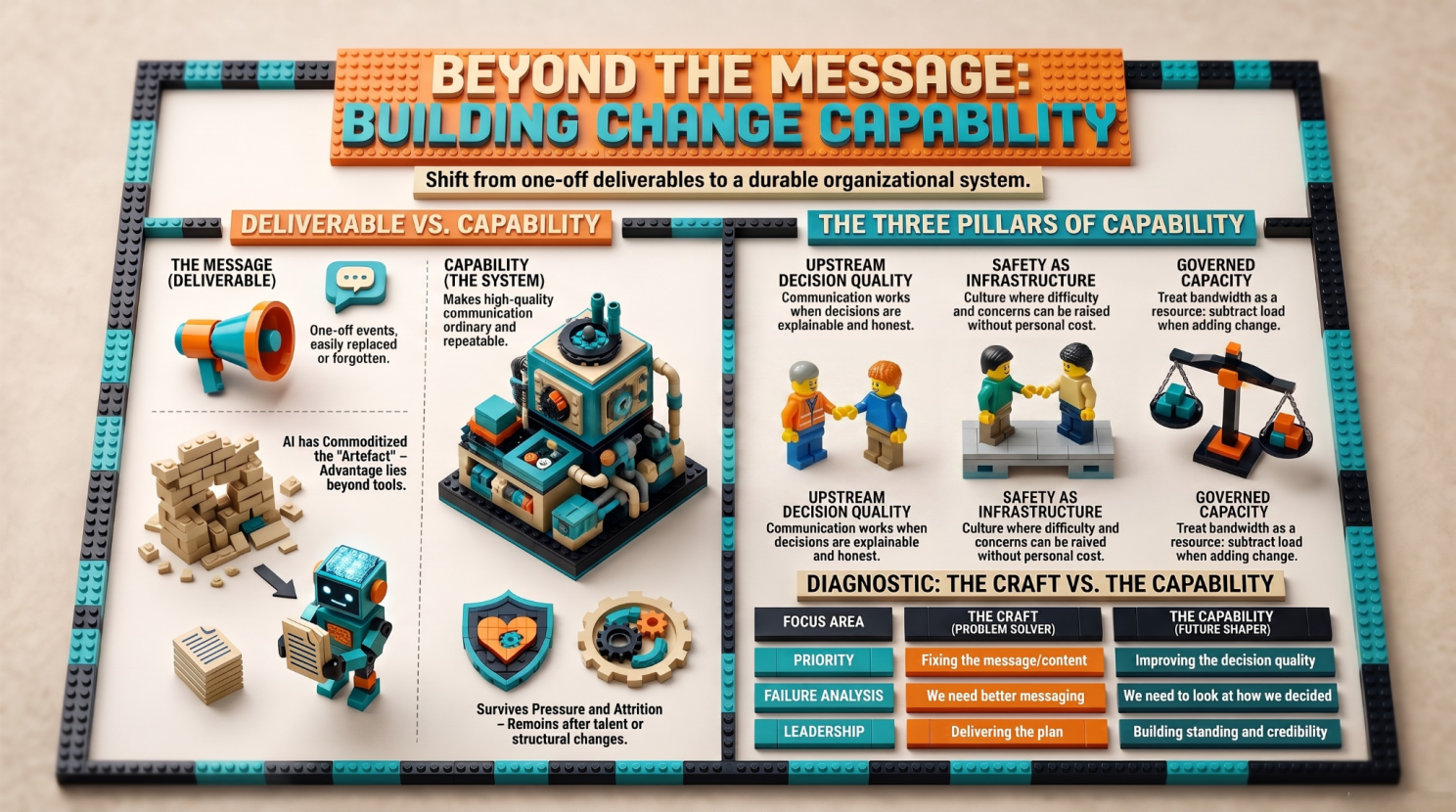
A good message is an event. A capability is what makes good messages ordinary.
Most organisations treat change communication as a series of deliverables. Each program produces its own plan, its own materials, its own approach, usually shaped by whoever happens to be running it. Quality varies enormously between programs and often within them.
A capability behaves differently. It is present regardless of who is available, it holds under pressure, and it improves across programs rather than resetting with each one.
Three things distinguish an organisation that has it:
Decisions are made in a way that can be explained. The upstream work is done well enough that honest communication is possible, which is the point Part One rested on.
Difficulty can be discussed openly. People can raise a real concern without cost, and leaders can acknowledge what they do not know. This is psychological safety functioning as infrastructure rather than as a value on a wall.
Capacity is treated as a governed resource. The organisation knows what it is asking of people and subtracts accordingly, which is what Part Three argued.
None of those three is a communication activity. All three determine whether communication works.
🔧 In practice. Assess your own organisation against a straightforward question: if the three most capable communicators in your business left tomorrow, would the quality of your change communication hold? If the answer is no, you have talented individuals rather than a capability, and talented individuals do not survive a restructure.
Why the artefact is the wrong place to invest
Every organisation can now produce a competent message, which means competent messages have stopped being an advantage.
For most of this discipline's history, producing clear, well-structured communication at pace was genuinely difficult. It required skill that was unevenly distributed, which made it a real differentiator.
That has changed in the last two years. AI, Artificial intelligence, has made competent drafting available to everyone, instantly, at almost no cost. The artefact has been commoditised.
This is the strategic point of the entire series. When the message becomes free, the advantage moves entirely to the things that remain expensive: the quality of the decision, the trust available in the culture, the capacity of the people receiving the change, and the standing of the leader asking for it.
An organisation investing heavily in improving its messages right now is investing in the one part of the system that has just become abundant. The parts that remain scarce are exactly the parts no tool can generate.
🔧 In practice. Look at where your change and transformation investment actually goes. If the majority sits in materials, channels, campaigns and content, you are funding the commoditised layer. The questions worth funding instead:
How do we improve the quality and honesty of the decisions that generate our communication?
What would it take for people here to raise a genuine concern without cost?
Who governs the total change load on our people, and what authority do they have to subtract?
Standing decides whether any of it lands
A method is only as good as the standing of the person asking others to follow it.
There is a factor that runs underneath every model in this field and is almost never discussed, because it is uncomfortable and because it cannot be productised.
Two leaders can deliver identical messages, built on the same framework, to the same audience, with entirely different results. The variable is standing: whether people believe this leader tells the truth, whether previous commitments were honoured, whether they are seen as someone who shapes the change or merely relays it.
Standing is what determines whether a message is received as information or as noise, and no framework substitutes for it.
This is why capability work is ultimately leadership work. An organisation with excellent communication practice and leaders without standing will produce well-crafted messages that nobody acts on. An organisation with leaders who have standing can communicate imperfectly and still move, because people extend them the benefit of the doubt that credibility buys.
🔧 In practice. Standing is built in the space between changes rather than during them. Three things build it faster than anything in a communication plan:
Say what you do not know, before you are asked.
Name what people are losing, without softening it into something it is not.
Honour a small commitment visibly, especially one that costs you something.
The shift this asks of you
The move is from running the message to shaping what is worth saying.
Everything in this series describes the same progression, seen from various angles.
A leader who treats communication as a deliverable is solving the problem in front of them. That is valuable work, and most careers in this discipline begin there.
A leader who reads communication as evidence, who can tell depletion from opposition, and who builds the conditions that make good communication possible, is doing something different.
They are working on the system that generates the problem rather than the problem itself.
That is the difference between being the person who runs the change and being the person the organisation turns to when it needs to know what the change actually requires. In the GO TO Leader (GTL) model I develop and use in my work and with my members and clients, it is the movement from Problem Solver, through Opportunity Creator, to Future Shaper, and it is learnable rather than innate.
The organisations that will handle the next decade well are not the ones with better change communication. They are the ones with leaders who understand what communication is downstream of, and who have the standing to do something about it.
🔧 In practice. One question, asked at the start of your next change, will tell you which conversation you are in. If this communication fails, what will we conclude? An organisation that answers we need better messaging is in the first conversation. An organisation that answers we need to look at how we decided, what we asked of people, and whether they believe us, is in the second.
Where this series leaves us
Communication deserves the attention it is getting, and the current thinking on it is a genuine improvement. My argument across these four parts is that it is not sufficient, and that treating it as sufficient is what keeps this discipline solving the visible problem instead of the real one.
The message is downstream, and it reveals the culture that produced it. Much of the resistance around it is capacity. And the capability to communicate change well is a property of the organisation and its leaders rather than of any method.
Good change communication is a craft. Communicating change is a capability, and capability is a leadership responsibility that cannot be delegated to a plan.
If this series has been useful, the question to sit with is a simple one. In the changes you lead, are you improving the message, or building the conditions that make the message unnecessary to fix?
The Future Fit Leader Scorecard maps where you stand across the five pillars of a Go To Leader, including the standing and capacity that decide whether anything you communicate actually lands.