
Don’t tell me how to make coffee
TL;DR
A pitch goes really well, then someone senior asks "OK, but how?" and the answer quietly falls apart. It is a pattern I keep seeing, and it is quietly costing change and transformation professionals real work, real roles and real money left on the table, while the leaders on the other side of the table keep hiring the wrong way. This issue is about what that question is really asking, why the neat step-by-step reply lands so flat, and where the real value sits for whoever has to answer it. I've woven in 3 recent conversations I sat in on, and what they had in common.
🎧 If you prefer to listen to this edition instead, check out the link below to an audio podcast as a deep dive which is AI-generated based on this edition and Jess' intellectual property:
This issue is for the senior leaders who are after change and transformation talent or services, and for the practitioners who deliver it. Both live on either side of one question, and it usually decides everything.
You've probably sat through a version of this. The pitch is good, the framing is sharp, and you can feel the room warming to a compelling way of thinking about the problem. Then the most senior person leans in and asks the question that matters far more than the pitch did.
"OK, but how?"
And you can feel the room change while everyone waits for the answer.
The question after the pitch
A good pitch gets people interested. It's the answer to how that decides whether they'll trust you with the work.
It's worth watching the pause after that question. The people who are good at this lean into it, because that is where most of their value lives. Others reach for something safer, and what comes back is a tidy run of steps that are correct and completely beside the point.
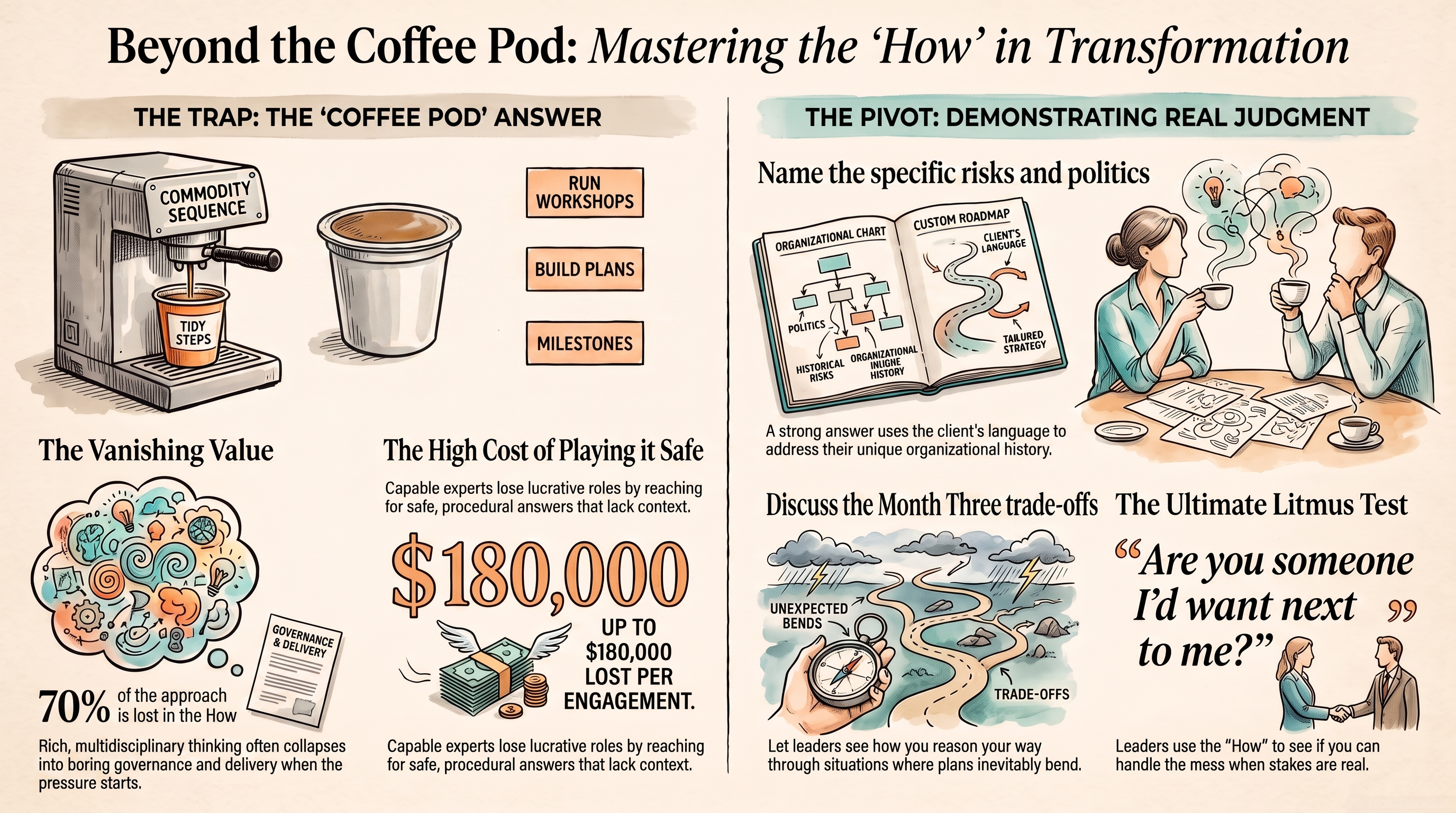
I've started calling it the how to make coffee answer. Imagine asking someone how to make a coffee and getting back: go to the kitchen, take a pod, put it in the machine, warm the milk, press the button, pour. Every bit of that is accurate, and everyone listening already knew all of it. The steps were never what they were asking about, and never the thing anyone was paying for.
For the leader listening, an answer like that confirms a worry they were already carrying. If the how is nothing more than the obvious sequence, they're left wondering what they're bringing in that their team couldn't have pulled together on any ordinary Tuesday.
Three recent conversations, the same turn
Three capable people, and each came unstuck at the very same point: the moment the conversation turned to how.
These three all happened recently, and between them they're the reason I wanted to write this. I was in the room for each one.
The Transformation Director
This was a C-suite decision I was part of. We were choosing someone internal to lead a global, large-scale transformation, and one candidate, a transformation director, made a genuinely strong case for how they'd approach it. The thinking was multidisciplinary, bringing change, business architecture, strategy, execution, adoption and culture together.
Then the CEO said, I like all of that, now tell me how. There was a pause, and when the answer came it had shrunk to delivery and governance:
get a clear charter and mandate in place
work out which teams we need and cascade the tasks down
build the plan, set the milestones, agree the schedule with the vendor
run the workshops, prioritise against scope, deliver by workstream
keep governance across it, run comms alongside, adapt once we go live
Every line is correct, and almost anyone could have said it. It let go of around seventy percent of the richer approach they'd just described. The role went to someone else, and with it a day rate of around $2,600, well above what they were already on.
The Change Adoption Consultant
This was an interview, three of us on the panel. An independent consultant was pitching to lead change adoption on a transformation program, and their case study was strong. Their argument was that this program didn't need change management in the usual sense, it needed real adoption, enablement and change leadership, and they made that case well.
Then we got to questions, and one of us asked: if I brought you in from day one, how would you actually make adoption happen here? The answer drifted straight back to the standard toolkit:
an impact assessment
a few engagement workshops
a change strategy
a comms plan
a training plan
A couple of framework names got dropped in, but it was more or less the exact approach they'd just told us wouldn't be enough. Half of what made the pitch land didn't survive that one question, and they weren't selected. It was a support contract worth between $120,000 and $150,000 for the year, working in and out to support the program on change adoption.
The Business Architect
This was a conversation I'd hoped would end in a yes. I wanted this deeply technical business architect on one of the most complex programs I had running, still at the strategy and execution stage, where getting business architecture and capability right could have shaped the whole direction. He knew his craft. I talked him through the context in detail and asked how he'd bring what he knew into that situation.
What I got back was five or six minutes of methodology at the deepest level of detail, thick with jargon, and almost entirely detached from the situation I'd just laid out. He understood business architecture inside out. What never came through was the context, or any sense of how he thought, and a six to seven month engagement worth around $180,000 went to someone else.
Here's what ties these three together. Every one of them was capable, with real experience and a track record behind them, so the pitch was never the weak spot. What opened up each time was the distance between the thinking they had and their ability to bring it into the room as the person answering for it. A few things showed up in all three:
none of them fully registered what the how was really asking for
the answer came out flattened, or overloaded, or disconnected from the real context
there was a genuine gap between the concept they held and their ability to make it live in the moment
The how is the point where an idea has to turn into judgment about this particular situation, in front of the people who'll live with how it plays out. That's where each of them reached for something safe, and the safe answer is what cost them the work and leaving money on the table.
Why the steps are the commodity
The sequence is the easy bit that anyone can recite. The judgment running underneath it is the part that's hard to find.
The broad steps of any transformation are fairly knowable: assess, align, mobilise, embed. That's the coffee-pod-in-the-machine level, and it really is the easy part to describe. It looks fine on a slide, gets through procurement without much friction, and commits you to almost nothing.
The real value sits in the layer underneath, in the questions a step list can never answer for you:
which move to make first, given this organisation's history and its real appetite for change
what to do when the sponsor goes quiet in week six and the business unit heads stop returning your calls
how to read a room that's nodding along while it quietly checks out
when to hold your line, and when to bend it
That's the real how: the sequencing under actual conditions, and the hundred small calls nobody can write down for you in advance. None of it can be handed over as a checklist, because it doesn't exist until the conditions are in front of you. It comes from having been in the middle of it before, more than once, and knowing how to read what a particular mess is telling you.
The answer a senior leader is actually waiting for
When someone senior asks how, they're really trying to find out whether you've done this in a mess that looks anything like theirs.
When a senior leader asks how, they're rarely after the manual, they're testing something. Have you done this when it was messy and the stakes were real? Can you make the calls nobody can write into a scope for you? When my plan meets my organisation and starts to bend, are you someone I'd want next to me? Here is what that looks like in practice on both sides of the table.
If you're the leader asking
Treat the how as the real test. The pitch tells you they can think it through, the how tells you whether they can do it inside your world.
Push past the tidy sequence. Ask what they would do first here, and why.
Listen for your context. A strong answer names your specific risks and your politics rather than reciting a generic method.
Watch what falls away. When a rich pitch collapses into delivery and governance, that gap is telling you something.
If you're the one answering
It's worth turning this on ourselves too. Every time we meet a How question with a clean process, we hand back the very thing that made us worth asking in the first place.
Name the specific risk sitting in their situation, in their language.
Talk about the trade-off they will hit around month three, and the call you would make.
Let them into your thinking, so they can see how you reason your way to it.
Resist the recitation of the safe list of activities or deliverables. The procedural answer is usually the one that costs you the work.
So the next time a room goes quiet and that question lands, treat it as the opening it is. The person asking isn't doubting that you know the steps. What they're reaching for is the judgment, context understanding, adaptability, the thinking and the approach those steps can never quite contain.
Where this sits
Reading between the lines, sequencing under pressure, working out which call to make when the plan starts to bend, this is the work we go deep on inside the Go-To Leader Program. We treat it as a practical system you can use, with real tools, coaching questions and case studies behind it. If answering the how with authority is what you want to get sharper at, that's the program built for it.
The Elevate program is not your regular teaching platform for change or transformation, it is the program designed for change and transformation (and adjacent disciplines: strategy, delivery, technology, CX, P&C, AI..) professionals to stand out, be in demand, and get paid what you're worth as a leader of change
Learn more about the Elevate program below: