
Fire The Toxic High Performer
TL;DR
That toxic high performer, you have one, and most senior leadership teams do. The person who consistently delivers and consistently corrodes. The numbers are good, and the behaviour is toxic. You have been told you cannot afford to lose them. The truth is, you cannot afford to keep them. This issue names the pattern, what toxic actually means here, the actual cost of keeping them, and what changes when the call gets made.
Sections:
The pattern you have been deferring
What does toxic actually mean here
The math you have not done
What changes when the call gets made
One question, and a reply
Hello,
This edition is for sponsors and accountable leaders. It is about one of the hardest calls in senior leadership, and the cost of having deferred it for as long as you have. It is also for change & transformation professionals who are dealing or surrounded with toxic leaders.
🎧 If you prefer to listen to this edition instead, check out the link below to an audio podcast as a deep dive which is AI-generated based on this edition and Jess' intellectual property:
The pattern you have been deferring
The call has been waiting on your desk for at least 18 months. The reasons not to make it have not changed. The cost of not making it has compounded without your noticing.
You know who this person is. The name surfaced before you finished reading the subject line. You have raised the conversation with a peer once or twice, in the careful way these things get raised, and each time the conversation ended with some version of "yes, but the numbers." You have put the call off at the last performance review, and the time before, and the time before that. You catch yourself defending the person in rooms where you would rather not be defending them. You hear yourself saying things you do not fully believe.
The deferral has its own shape, and you can feel it.Each cycle, the same conversation. Each cycle, the same conclusion. Each cycle, a slightly weaker version of the original reasoning that held the call back the first time. And each cycle, the cost of the deferral compounds in places you are not measuring. The people you have lost. The decisions that did not get made. The work that did not happen. The standard has quietly moved.
The reason this newsletter exists is that the deferral pattern is one of the most expensive patterns in senior leadership, and its not talked about much. It it certainly makes any change or transformation twice as hard.
What does toxic actually mean here
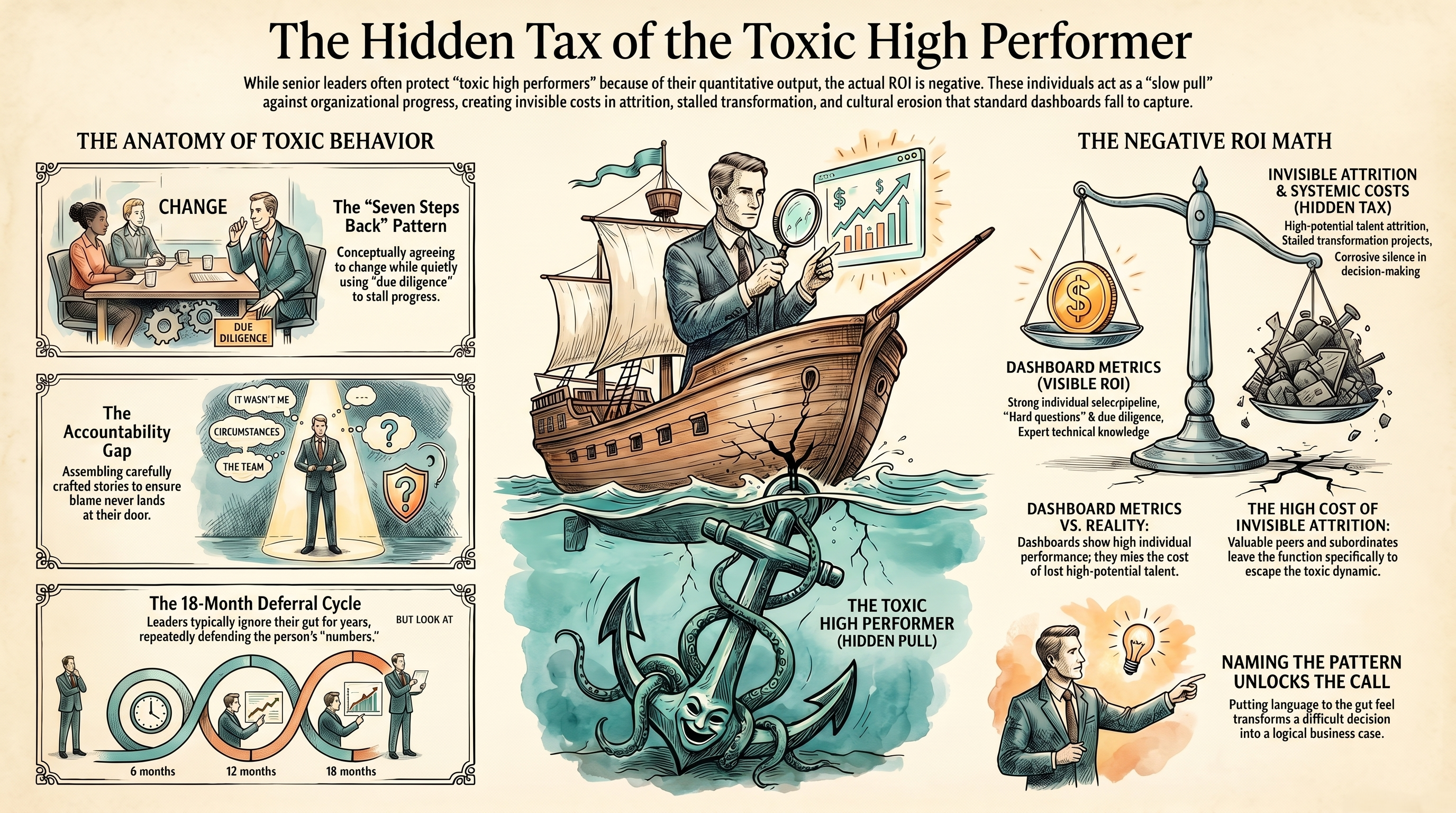
Toxic behaviour is not only in the room. Toxic is the slow, covert pull against every move the rest of the team is trying to make.
Most of the time, when senior leaders say "toxic", they reach for the obvious version. The person who is "direct" in a way that silences the room. The person whose team stops raising real issues in their presence. The person, other senior leaders are quietly leaving the function to get away from. That is the visible layer, and it is real.
The layer underneath is the harder to name and the more damaging of the two.
This person is the one who conceptually agrees with every change you propose, and then quietly makes every change take longer. The one who waits until decision time and surfaces questions that were supposed to be on the table three months ago. The one who shares the piece of information at the last possible moment, the piece that makes the room question the direction, when sharing it at the start would have been useful and sharing it at the end is corrosive. When the rest of the team has moved ten steps forward, this is the person who pulls the work seven steps back, and then describes the seven steps as "due diligence" or "asking the hard questions".
The other tell is what happens when something goes wrong. They cannot admit when their own work has been missed. They cannot sit inside the moment of "this is on me." The blame always lands somewhere else. The market shifted. The brief was unclear. The team underdelivered. The sponsor changed their mind. The story is always assembled with care, and the through-line is always the same. The accountability does not arrive at their door.
This is what your gut has been telling you for eighteen months and what your dashboard cannot show you.The behaviour in the room is the surface. The quiet opposition to change is the substance. The blame pattern is the proof.
The math you have not done
The actual ROI is usually negative. The metrics that would tell you this are not the ones you are tracking.
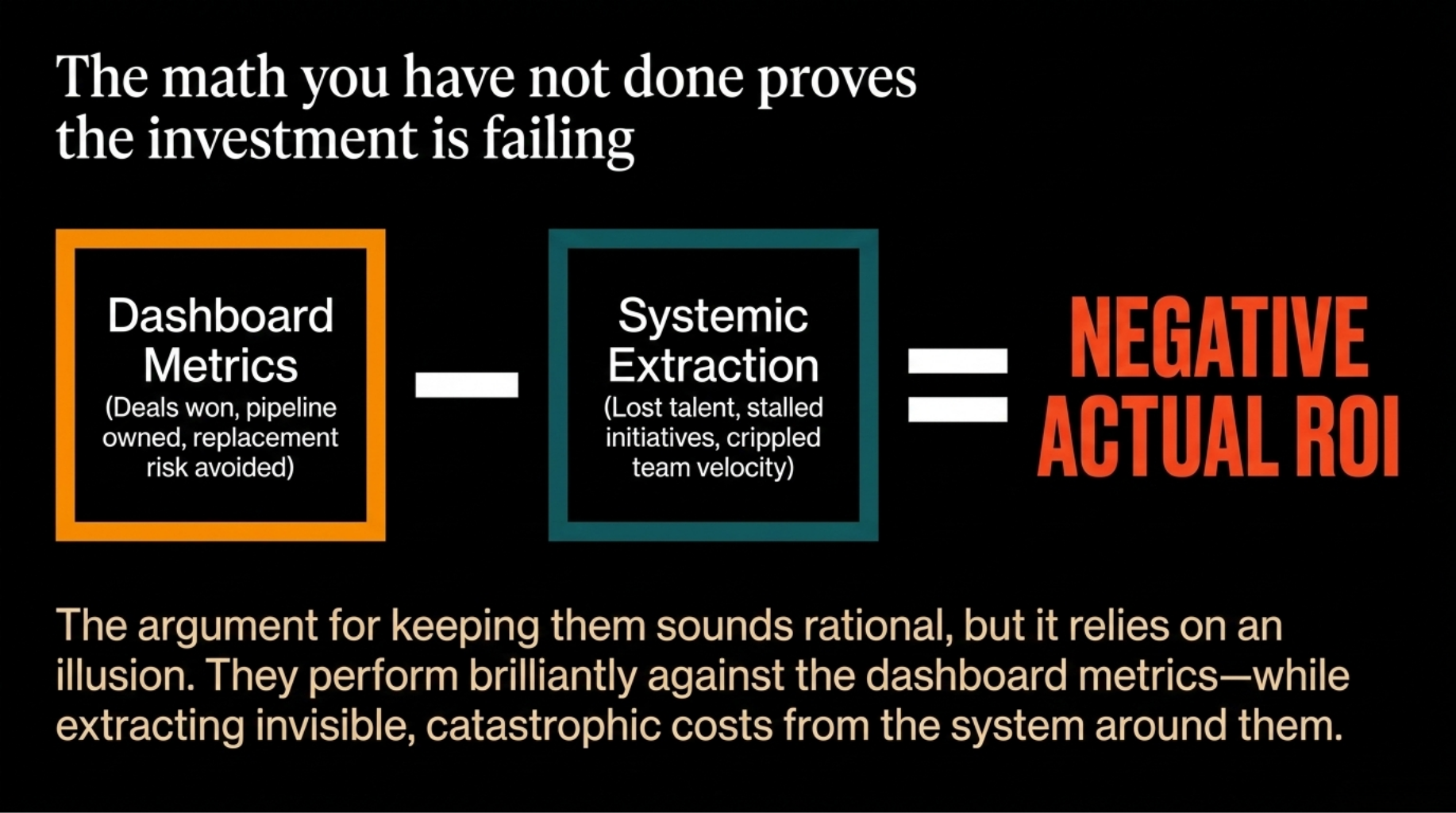
The argument for keeping this person is always the same. We cannot afford to lose them because the numbers they produce are too important, the replacement risk is too high, the clients they own would walk, and the deal pipeline would stall without them. Each argument sounds rational. None of them factor in the actual cost.
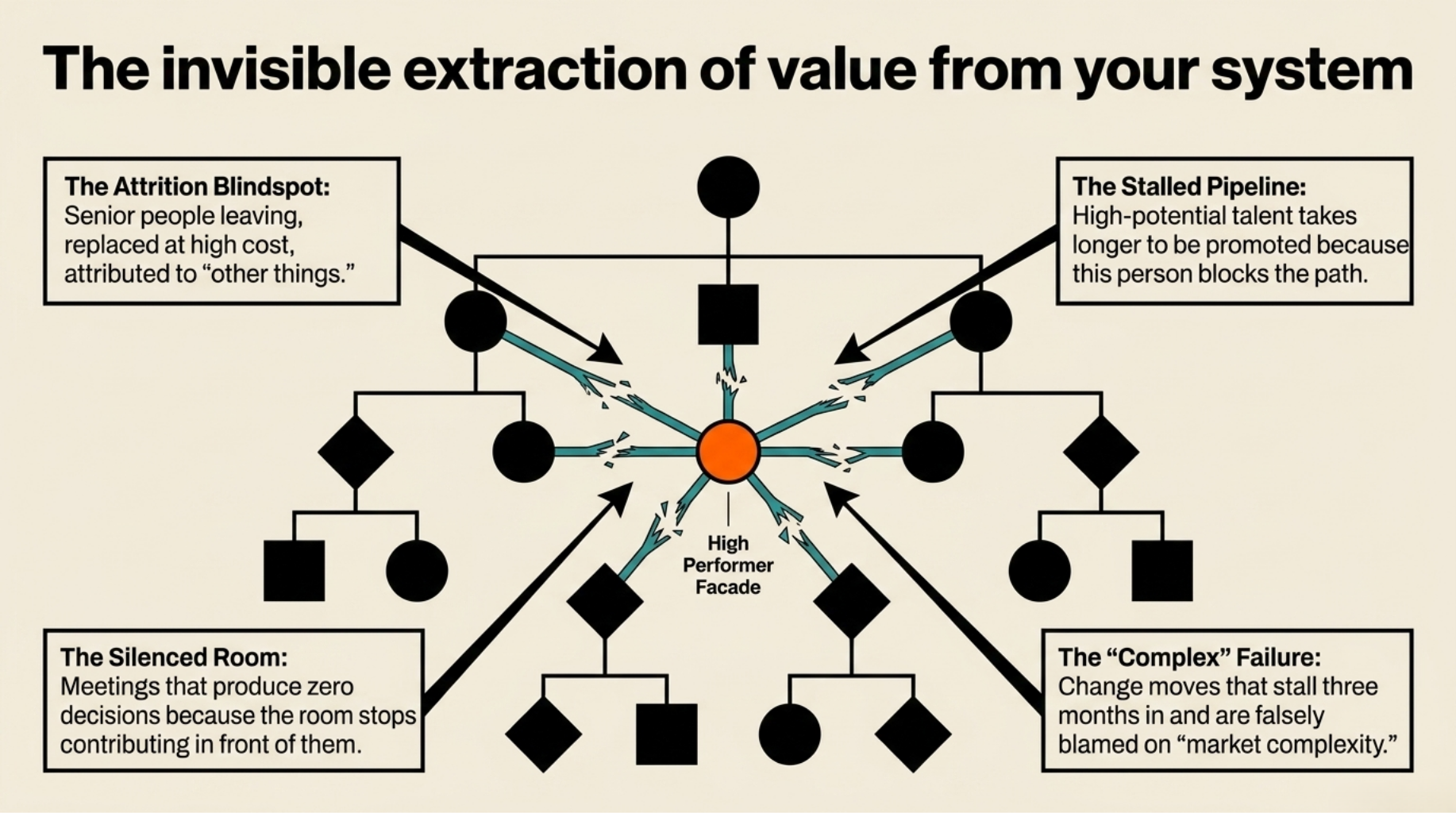
The actual cost is the value being extracted from the system around them, and that cost is invisible to standard metrics. It shows up in attrition you are attributing to other things, in the senior people who left and were replaced at high cost. In the high-potential team members who took longer than they should have to be promoted, because this person was in the way. In the projects that quietly failed because nobody wanted to push back. In the meetings that did not produce decisions because the room had stopped contributing in front of them. In the change moves that stalled three months in, and got blamed on "complexity", when the real cause was the seven steps back.
When you do the actual math, the ROI of keeping a high-performing toxic person is negative. The reason most senior leaders do not see this is that the metrics that would tell you are not the metrics on the dashboard. The metrics on the dashboard are the ones this person is performing well against. The metrics that would tell the real story are the ones nobody is looking at.
What changes when the call gets made
So how to navigate this? Making the case of removal … Navigating the toxic behaviour to continue to create momentum and step up.
A C-level I worked with had a long-standing gut feel about someone on her senior team. Heavy to deal with. Conceptually on board with every transformation move she made, and quietly slowing each one of them down. Until we sat down together, the thought of removing the person had not crossed her mind. We worked around putting language to the pattern she had been carrying in her gut for two years, and that language was the thing that unlocked the decision. Once the pattern was named, she could see the cost. Once she could see the cost, the business case for the exit wrote itself.
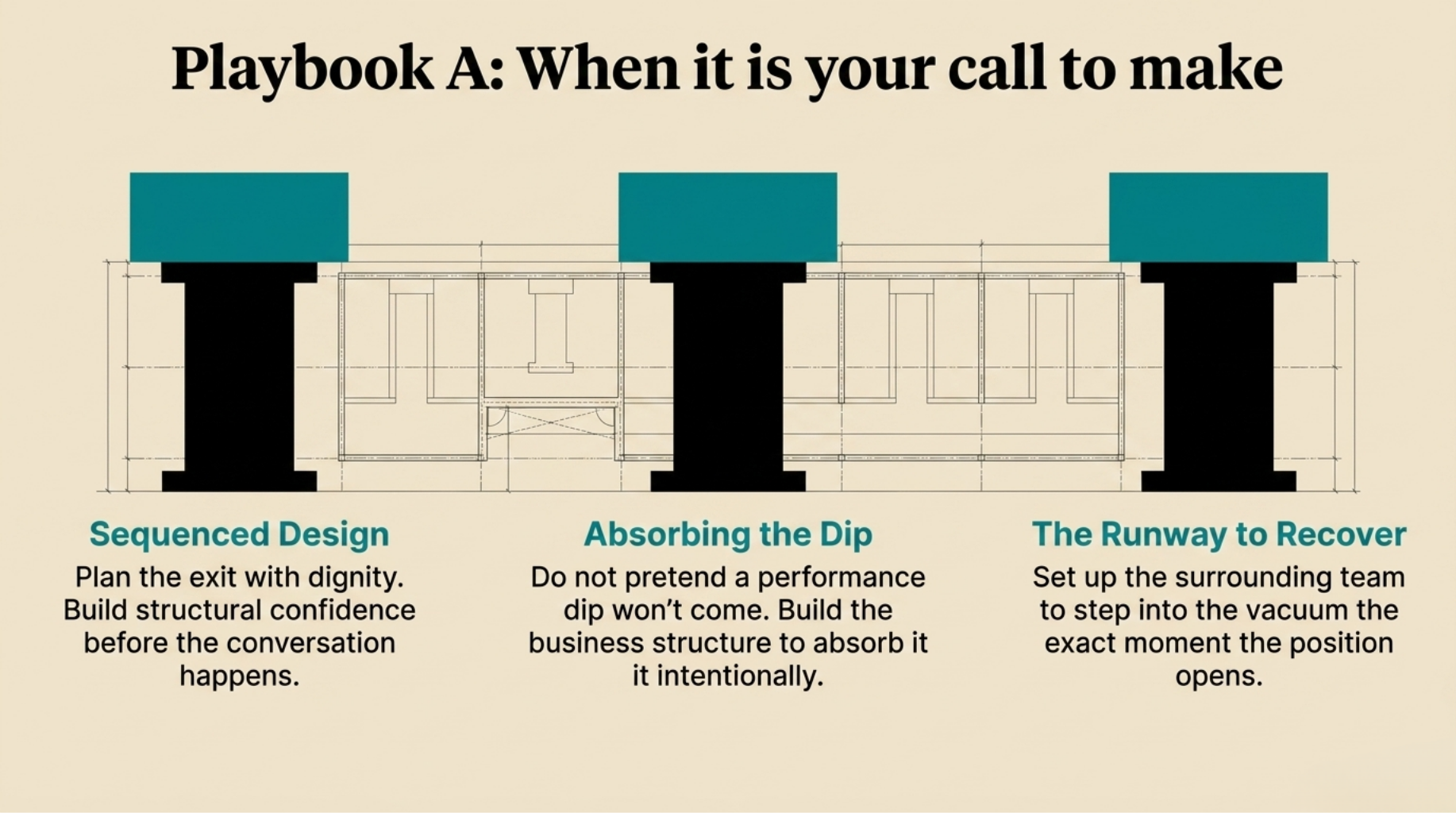
The work that followed was the design of how the exit would actually happen. Sequenced, planned, dignified. Built so the business absorbed the dip rather than pretending the dip would not come. Built so the team around the person was set up to step up the moment the position opened. By the time the conversation with the person actually happened, the leader had the structural confidence she had been missing for two years, and the function had the runway it needed to recover quickly.
The decision was not the hard part. Putting words around the gut feel was the hard part. The decision followed almost automatically once the pattern was named.
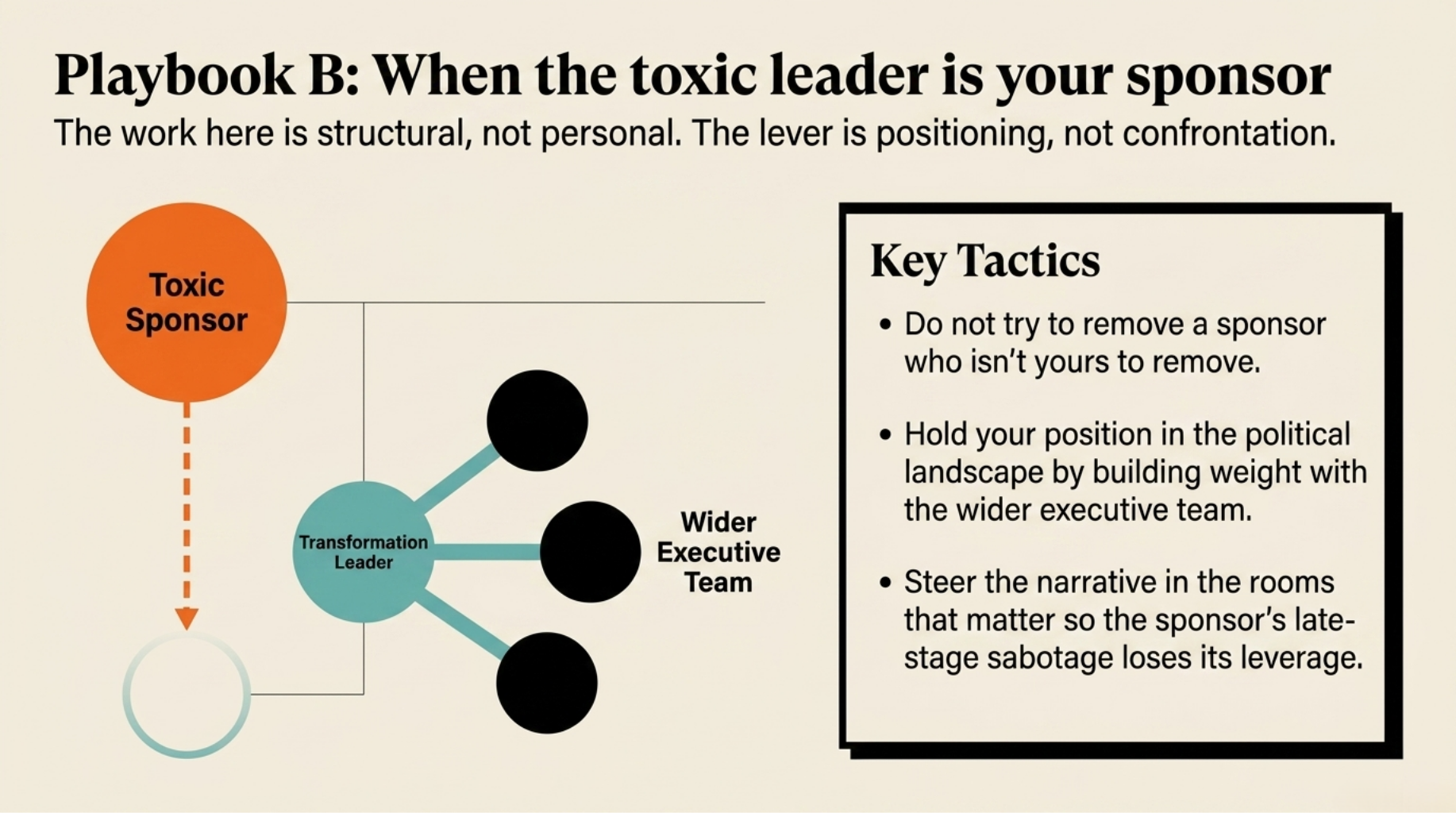
A separate piece of work, a senior transformation leader engaged me on a one-on-one private mentoring basis because the situation was both private and time-critical. He had a toxic sponsor on his program. Conceptually backing the transformation in every executive meeting, and quietly undermining it in the rooms he was not in. Surfacing concerns at the eleventh hour. Withholding context until it was strategically convenient. Defaulting to blame the moment anything looked uncertain.
The work was not about removing the sponsor. The sponsor was not his to remove. The work was about how he held his position in the political landscape with the sponsor still in the room. How he kept the transformation on track when the person nominally backing it was the person quietly pulling it back. How to maintain a seat at the table without being swallowed by the toxic behaviour. How he positioned himself with the wider executive team so his voice held weight in the rooms that mattered, including the rooms the sponsor was in.
Inside 3 weeks, the dynamic had shifted. The transformation kept moving. His voice was back at the table. The sponsor was still there, but no longer steering the narrative. The work was structural, not personal. The lever was positioning, not confrontation.
The pattern across both engagements were consistent.When toxic high performers are removed cleanly, capable people step up. When senior leaders learn to navigate a toxic dynamic above them, their voice and their function step back up in parallel. Instead of the change or transformation professionals questioning themselves, working too hard and still feel distant from leading and shaping
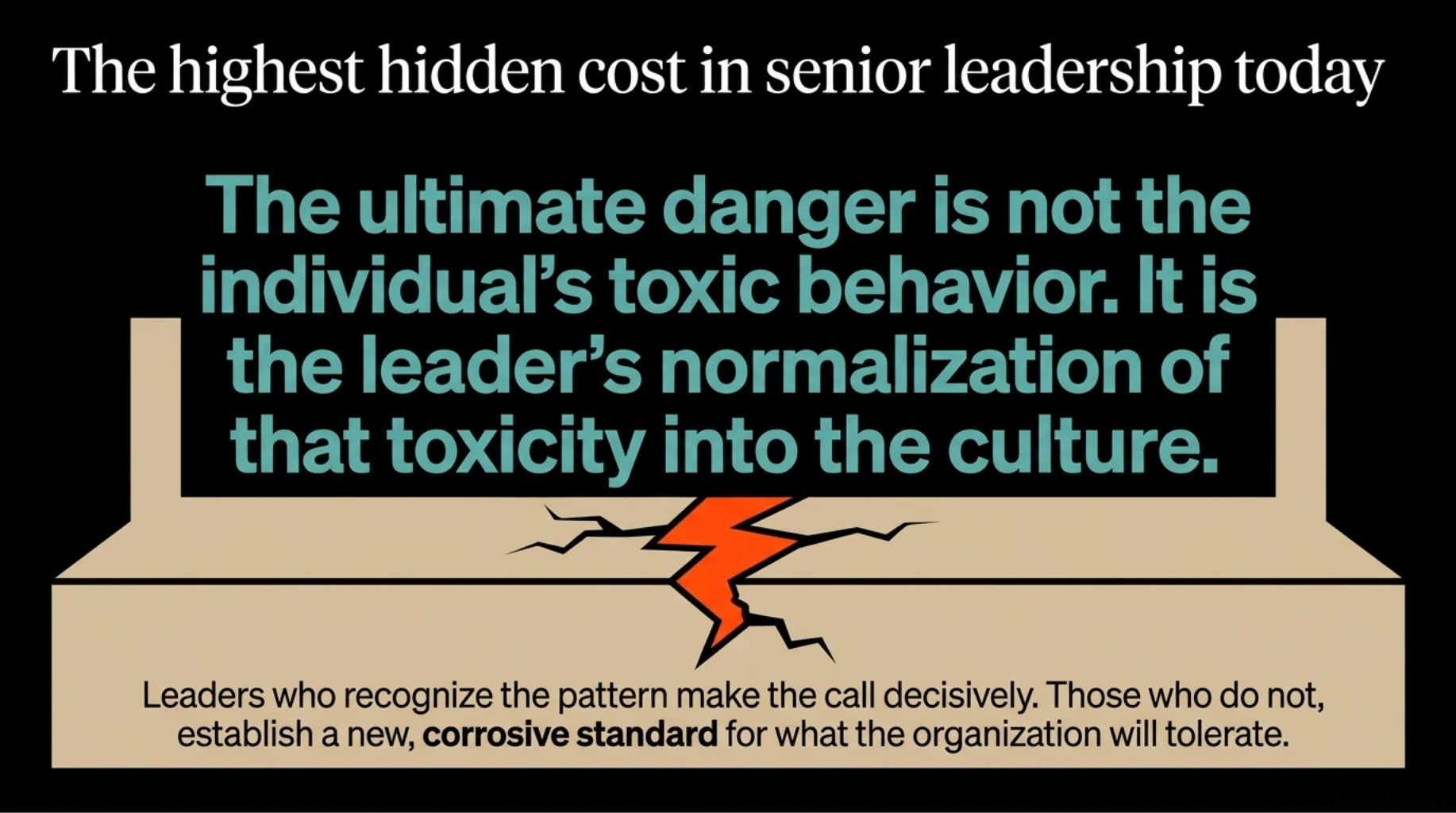
The leaders who recognise the toxic pattern make the call decisively when it is theirs to make. The ones who do not, normalise the toxicity into the culture, and the cost of that normalisation is the highest hidden cost in senior leadership today.
One question, and a reply
The call is yours. The conditions to make it well can be built.
The question to sit with this week is not whether the high-performing toxic person needs to go. You already know, and you have known for months.
The question is:"What is the conversation I have been avoiding, and who is the person at my level I need to have it with first?"
If a name surfaces immediately, that is the signal.
Email me if you have a name in mind reading this, and one sentence about what has been holding you back from making the call. I will write back with one specific observation about what the deferral is costing you that the metrics are not showing.
I read every message, and I will respond to this one personally.