Organisational Energy (Part 1 of 3): What Decides Whether Change Actually Holds
TL;DR
This is a 3-part series that speaks to the role of Organisational Energy in creating Change That Holds. And How Change & transformation could use this to create higher-quality change. Below is Part 1
Organisational energy is the collective state an organisation runs on, and it decides whether change and transformation land.
It shapes five outcomes that hold the organisation up, from the quality of the work to the effort people choose to give.
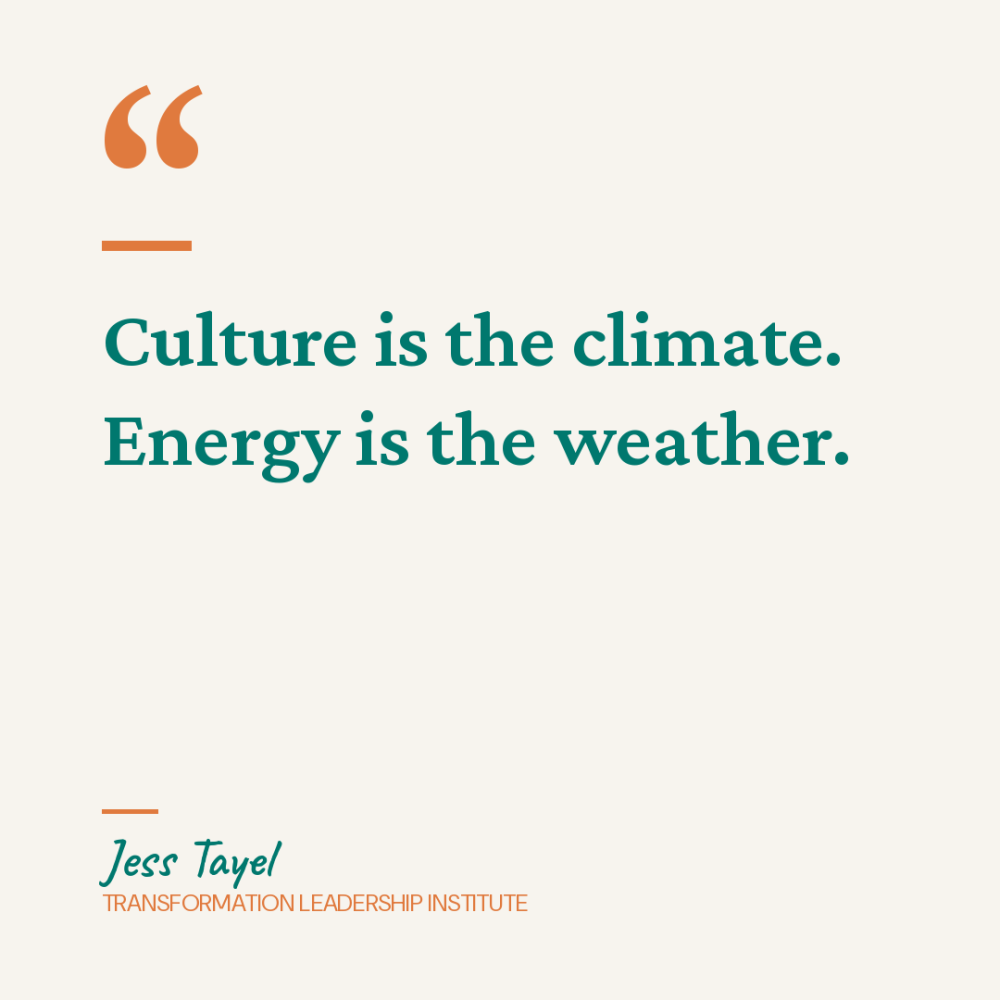
It is not culture by another name. Culture is the climate; energy is the weather.
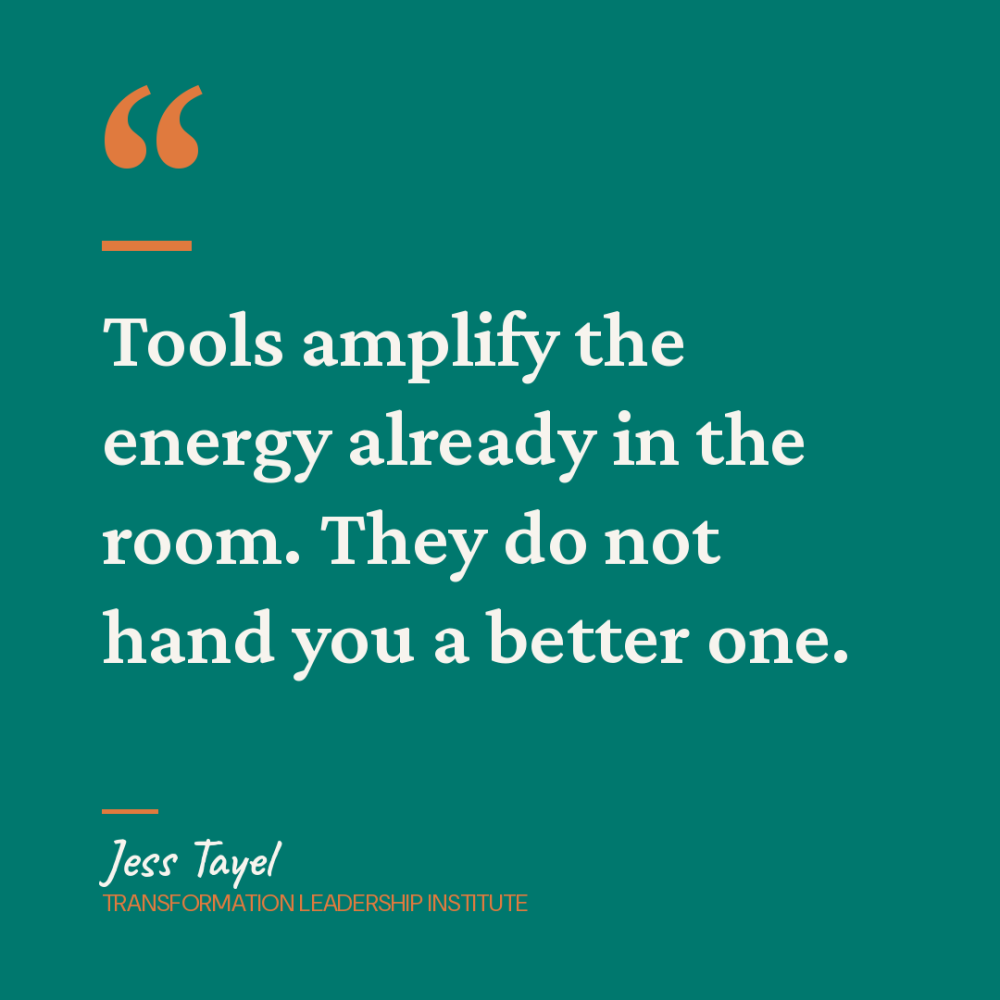
No tool can move it. An ERP, a consultancy or AI amplifies the energy already in the room.
Running more changes at once, with AI on top, makes energy the variable that decides your hit rate.
🎧 I highly recommend you to listen to this audio podcast as a deep dive which is AI-generated based on this edition and Jess' intellectual property:
Organisational energy might be the softest-sounding phrase in this entire field, and I understand the raised eyebrow it earns in a room full of strategy people. Energy is a word we tend to reserve for home, for friends, for good rooms, for off days, and for the general business of being human. So it is reasonable to ask what it is doing in front of a word as consequential as transformation, and what a Chief Strategy or Transformation Officer, a Change Leader or senior practitioner is meant to do with it once it is there. It is a fair challenge, and I would rather earn the answer than assert it.
Here is the observation that tends to change the conversation. Two transformations can be run with the same budget, the same plan and the same calibre of people, and still arrive in entirely different places. One of them takes hold, and the other slowly dissolves into the organisation until no one can say quite where it went.
The usual explanations reach for execution, or sponsorship, or that comfortable catch-all, readiness. The more useful explanation is the one that rarely gets named. The teams these programs landed in were carrying different energy, and that energy had already shaped the outcome before the plan was ever put to work.
And in this series, I want to shed light on a concept that is not talked about or worked with much: Organisational Energy.
What organisational energy actually is
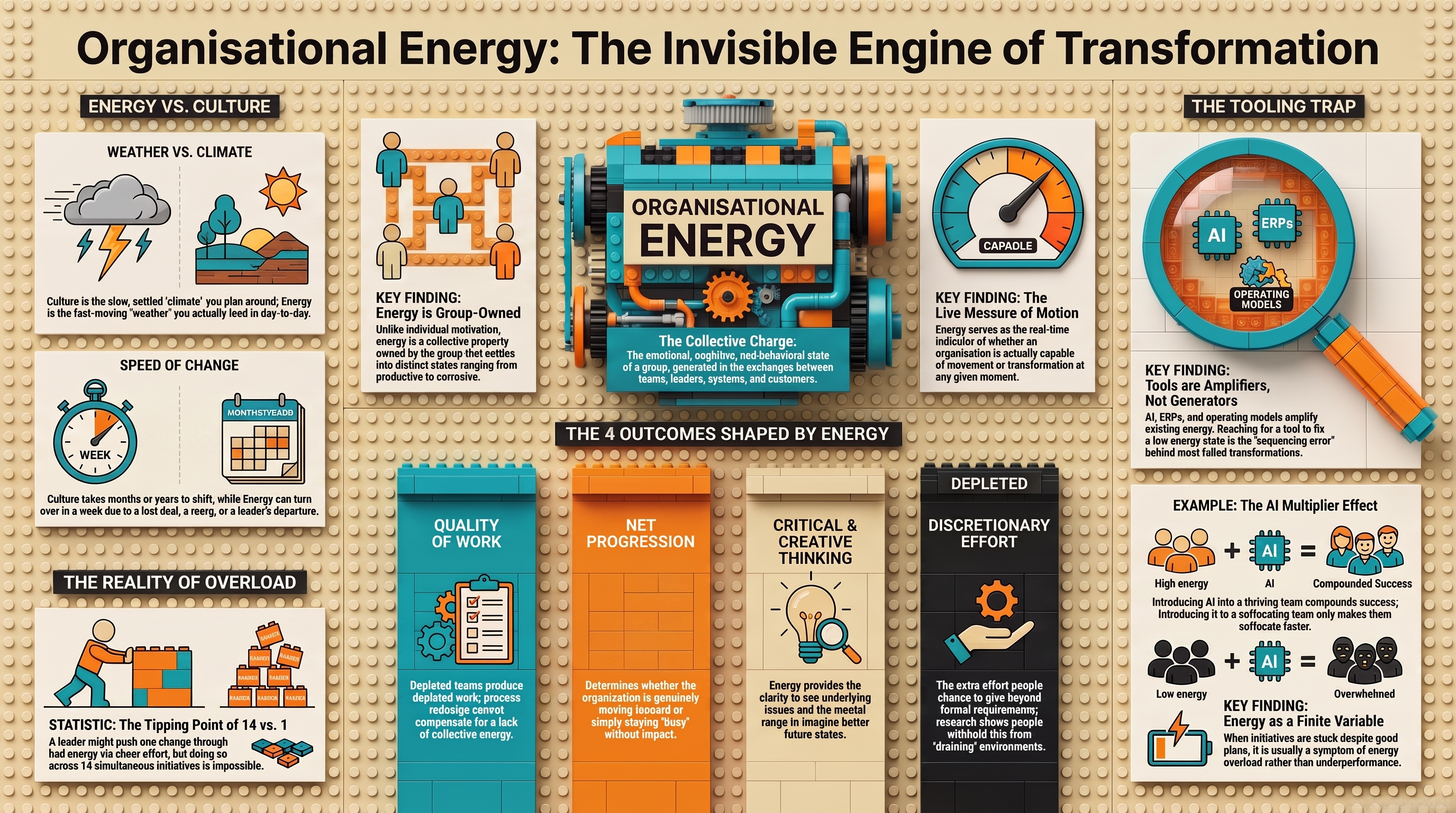
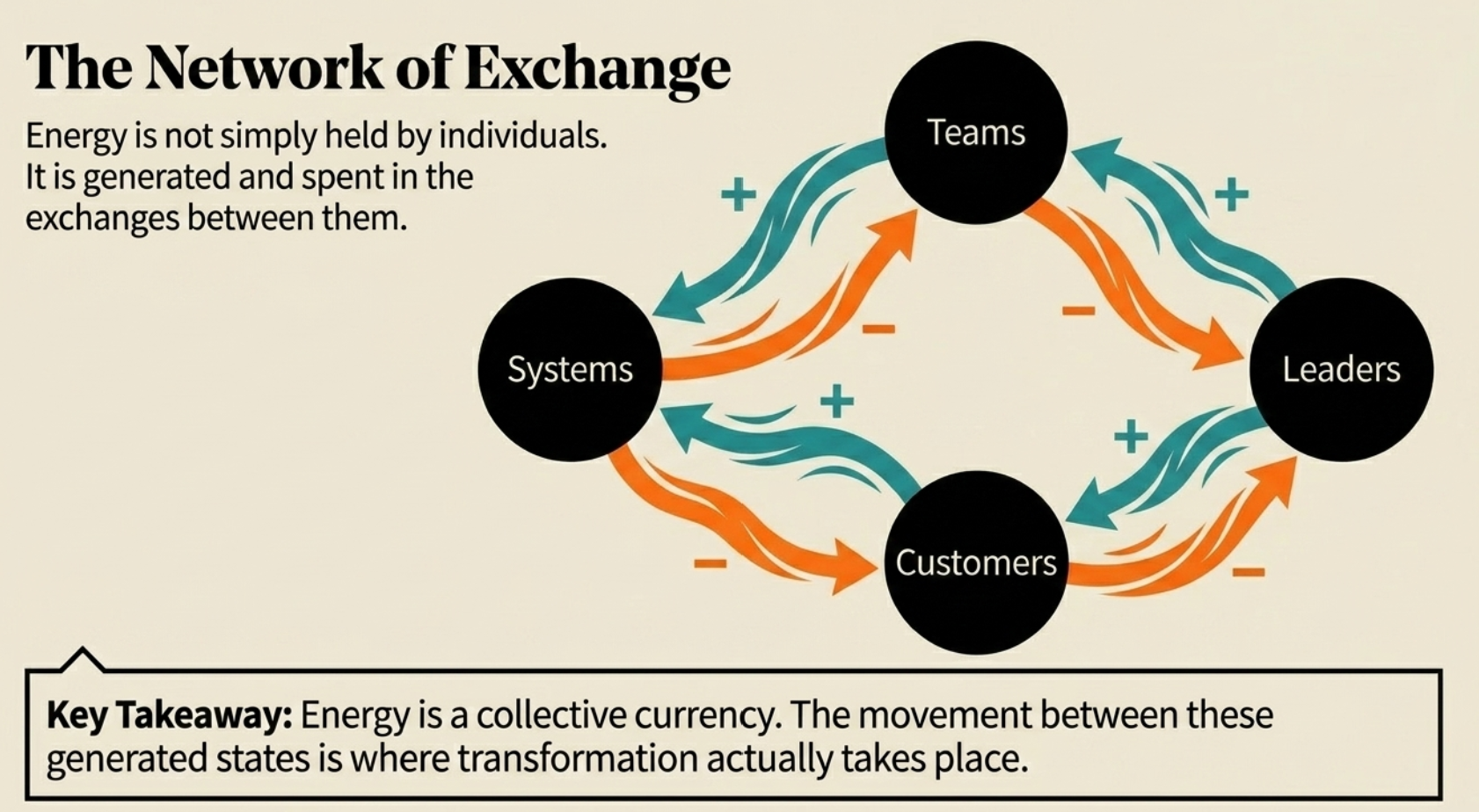
Organisational energy is the collective charge a group of people runs on, the emotional, cognitive and behavioural state they bring to whatever sits in front of them. It is not something individuals simply hold on their own. It is generated and spent in the exchanges between them: between one team and the teams beside it, between people and the rules and systems they work inside, between a workforce and the leaders and the CEO who set the tone, and between the whole organisation and the customers on the receiving end of everything it does.
Each of those exchanges either adds to the collective charge or quietly draws it down. Heike Bruch and Bernd Vogel spent years mapping this in their book Fully Charged (2011), and 2 of their findings are worth holding onto. Energy is collective, owned by the group rather than by any single leader, and it settles into distinct states that run from productive at one end to corrosive at the other. Their work photographs those states with real precision. What it leaves to the rest of us is the movement between them, and that movement is where change and transformation actually take place.
Energy is the live measure of whether an organisation can actually move.
What energy shapes, and why it is not fluff
This is the point at which energy stops being soft. Collective energy is not a mood that comes and goes without consequence. It quietly sets the ceiling for the outcomes a leader is actually measured against, and there are five areas of that Energy that can affect, and together hold, the organisation up.
The quality of the work. Depleted teams produce depleted work, and no amount of process redesign compensates for it.
Net progression. Whether the organisation genuinely moves forward, or merely stays busy.
Critical thinking. The clarity to see what is really happening beneath the reporting.
Creative thinking. The range to imagine something better than what exists today.
Discretionary effort. The effort people choose to give beyond what is formally asked of them, which is where most of the real value in any organisation is created.
This is why energy is where a decision goes to live or die. The same initiative, with the same budget and the same plan, will take hold in one team and be quietly absorbed in another, and the difference between those two outcomes is the energy of the team that received it.
The evidence is clearest on discretionary effort. Rob Cross and Wayne Baker, studying energy across organisations for MIT Sloan Management Review (2003), found that people direct their discretionary effort, their best thinking and their scarce time first towards the colleagues and teams who energise them, and withhold all of it from those who drain them.
Energy produces performance long before performance produces energy.
➡️Put that against your own portfolio, and this becomes uncomfortably concrete.
Consider which of your live initiatives are riding on teams you would honestly describe as depleted, because that is precisely where your returns are leaking without appearing on any report.
Ask your leads where you are securing compliance without discretionary effort, the agreement in the room that produces nothing once the room empties.
Diagnose with care when a capable team's quality drops, and read their energy before you reach for a resourcing or capability explanation.
Why this is not simply culture under a new name
A fair challenge usually arrives at this point. Is energy just a longer way of describing culture, or psychological safety, or high-performing teams, the work most organisations already invest in?
No, it is not, and it is worth being precise about why.
Energy sits alongside a whole family of things leaders already attend to, among them culture, psychological safety, engagement, morale, and motivation, and it differs from each of them on the same two counts. It moves faster, and it belongs to the group rather than the individual. Culture is slow. It is the settled personality of a place, and it shifts very little from one quarter to the next.
The psychological safety that Amy Edmondson has spent her career mapping is real, matters, and accrues over months rather than weeks. Energy, by contrast, turns over week to week, with a reorganisation, a lost deal, a leader who has just walked out the door. A team with a strong culture and genuine psychological safety can still slide into a resigned state the month its program is defunded, with nothing about the culture or the psychological safety having changed at all.
Culture is the climate you plan around, and energy is the weather you actually lead in today. None of this displaces the work on culture or psychological safety. Energy reaches the faster layer that work keeps aiming at and struggling to catch, because those things move on a clock too slow to help you inside a program that is stalling this quarter.
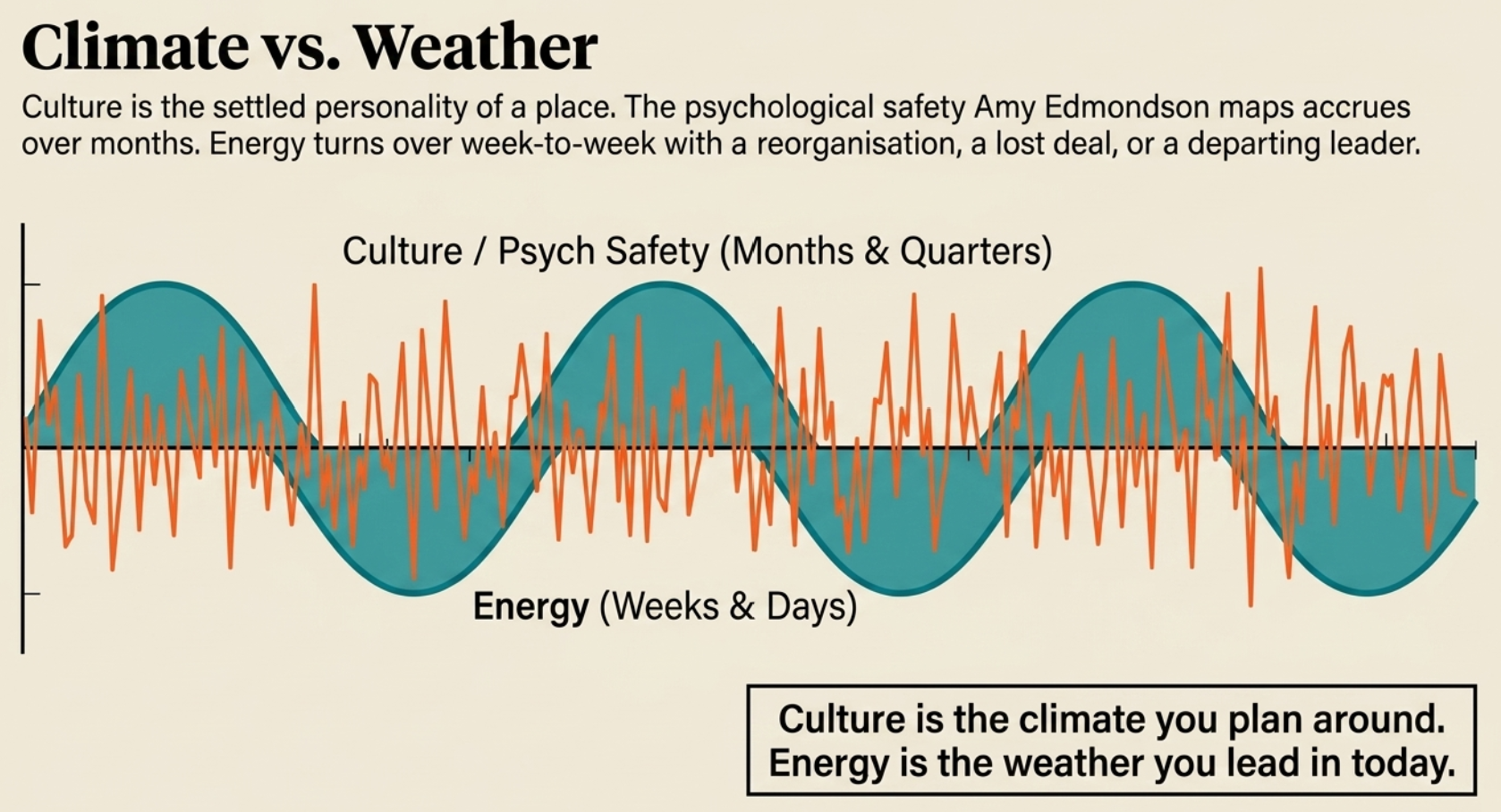
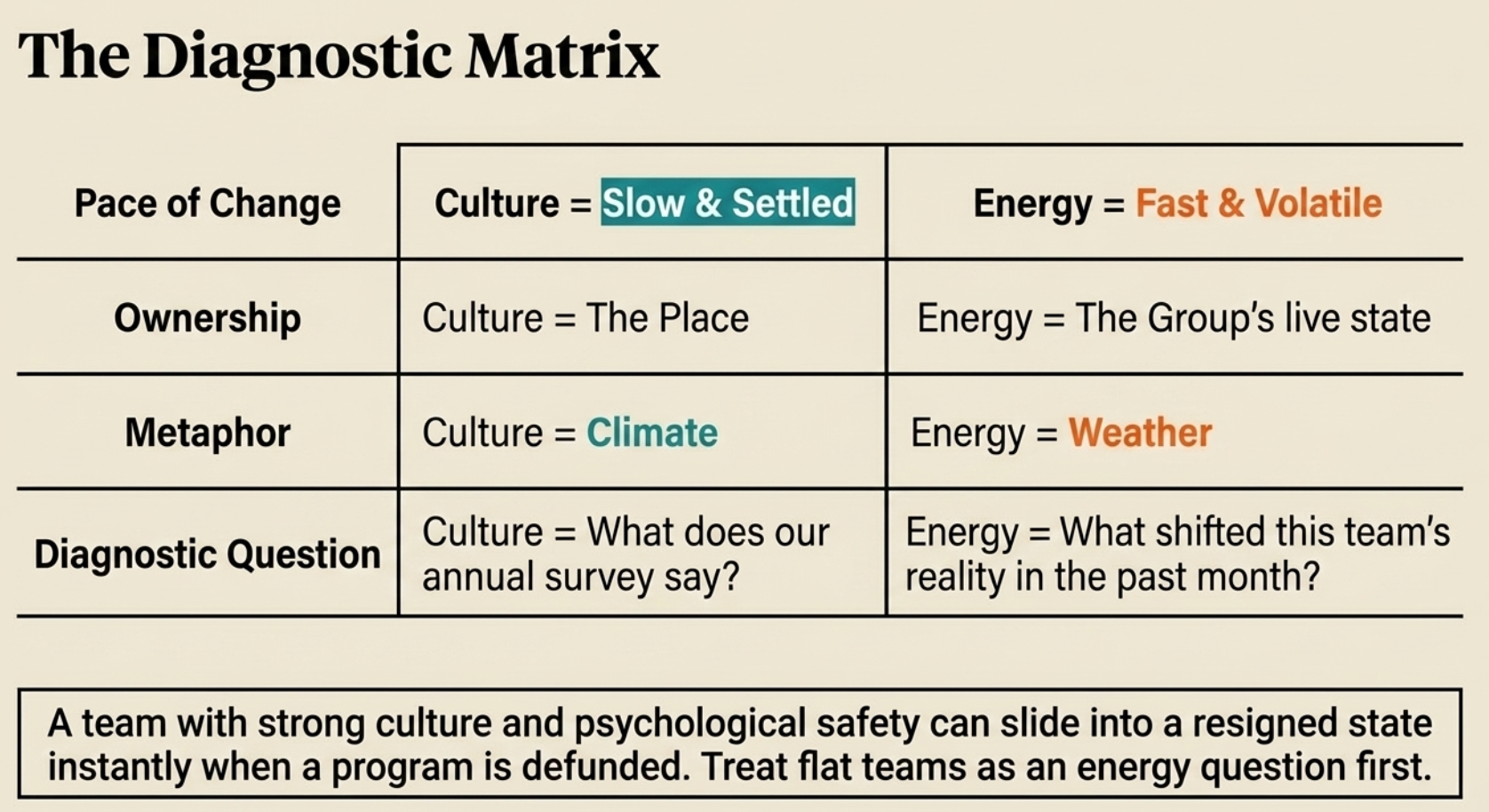
Culture is the climate you plan around, and energy is the weather you lead in today.
➡️2 questions separate the ideas in practice. Ask what has shifted this team's energy in the past month, a departure, a reorganisation, a defunded program, that no culture survey would ever detect. And when a strong-culture team suddenly goes flat, treat it as an energy question first, because it almost always is.
Why no tool can move it
Here is the expensive misunderstanding that sits underneath a great deal of wasted investment. Organisations keep trying to buy their way from surviving to thriving, with a new ERP, a new operating model, a well-known consultancy, and now AI laid across all of it.
The difficulty is that a tool amplifies the energy state it lands in, and it cannot change that state. Introduce AI into a thriving team, and it compounds the thriving. Introduce the same AI into a suffocating one, and it suffocates the team faster, because there is now more to do and the same empty tank to do it from. A tool can be genuinely necessary for capability and entirely beside the point for energy, and reaching for it to move the energy is the sequencing error beneath most transformations that install a great deal and shift almost nothing. A program that only moves the tooling has installed something, and it has not transformed anyone.
A tool amplifies the energy already in the room; it never hands you a better one.
➡️Before the next rollout, it is worth being honest about the ground it will land on.
Consider whether the last platform you introduced to lift performance arrived in teams with the energy to use it, or simply added to the load on teams already running on empty.
Ask which parts of the organisation are ready to receive what is coming, and which one it will quietly tip into overload.
Diagnose stalled adoption of a genuinely good tool as an energy state the rollout plan failed to account for, rather than as user reluctance.
Why this matters now in particular
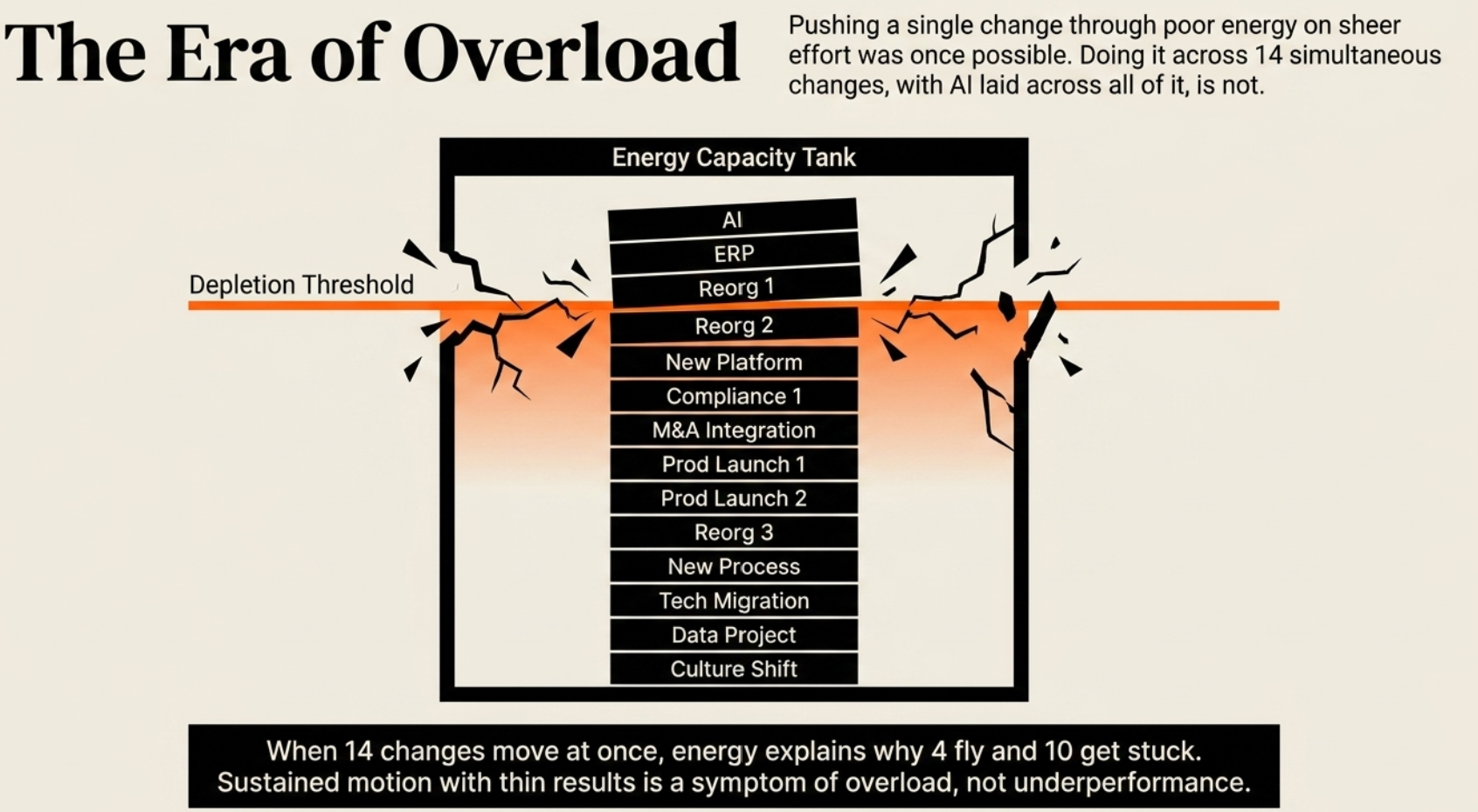
There was a time when a determined leader could push a single change through poor energy on sheer effort. That time has passed. Organisations are now running more simultaneous change than they ever have, and layering AI across all of it at once, which means more initiatives are landing into more teams, in more different states, within the same quarter. That is the precise condition under which an organisation tips into overload. When 14 changes are moving at once, energy is what explains why 4 of them are flying and 10 are stuck. Scarcity is what finally makes the variable impossible to keep ignoring.
Pushing one change through bad energy was always possible; doing it across fourteen at once is not.
➡️The honest exercise here is to count the changes your people are actually carrying this week, rather than the number listed on the roadmap, and then to ask which of them you would stop if you admitted the organisation only has the energy for half. Sustained motion with thin results across many fronts is usually a symptom of overload rather than underperformance.
The reframe worth leaving with
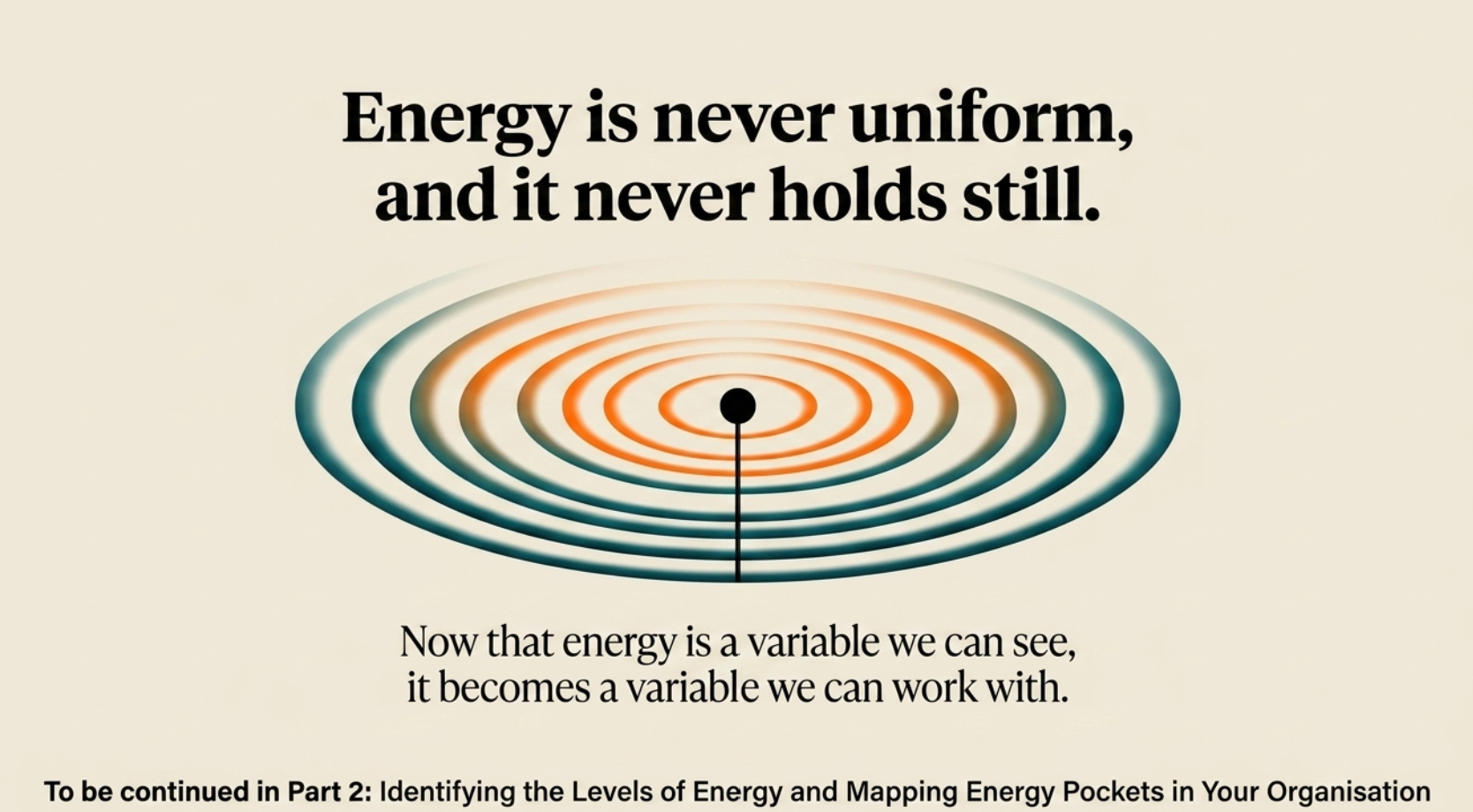
So here is the shift worth sitting with. Change and transformation, approached with any honesty, is the disciplined work of moving a collective's energy towards the outcome. The tooling, the automation, and the process redesign all sit one level below that, as transactional improvements that hope performance will follow. Two rules govern the harder work. Energy does not hold in a single state for long, and it is never one uniform thing across an organisation. Once both of those are clearly in view, energy stops being a concept to nod along to and becomes a variable you can actually work with.
The honest work of transformation is moving energy, and no tool has ever done it for you.
Would love to hear your thoughts
To be continued in Part 2, where we dive deeper into identifying the levels of Energy and the Energy Pockets in organisations and teams
______________________________________________
📣Did you get the recent updates?
The Opportunity for Busy Change & Transformation Professionals to Step Up to the Next Level. I have news for you, and I don’t want you to miss out
📍➡️Visit this link to learn more: