Personal culture and the organisation's culture
Culture matters to change and transformation in two directions. It is an input we need before we design anything, and it is what has to sustain the change once we have delivered it.
I wrote a piece last year about culture and strategy that people still send back to me. It sits in the same territory as today's letter without making the same argument, and it is here if you want it:https://transformationleadership.institute/post/culture-does-not-eat-strategy-for-breakfast
Today I want to put a question in front of you about a layer underneath all of it, so let me be exact about what I mean by it first.
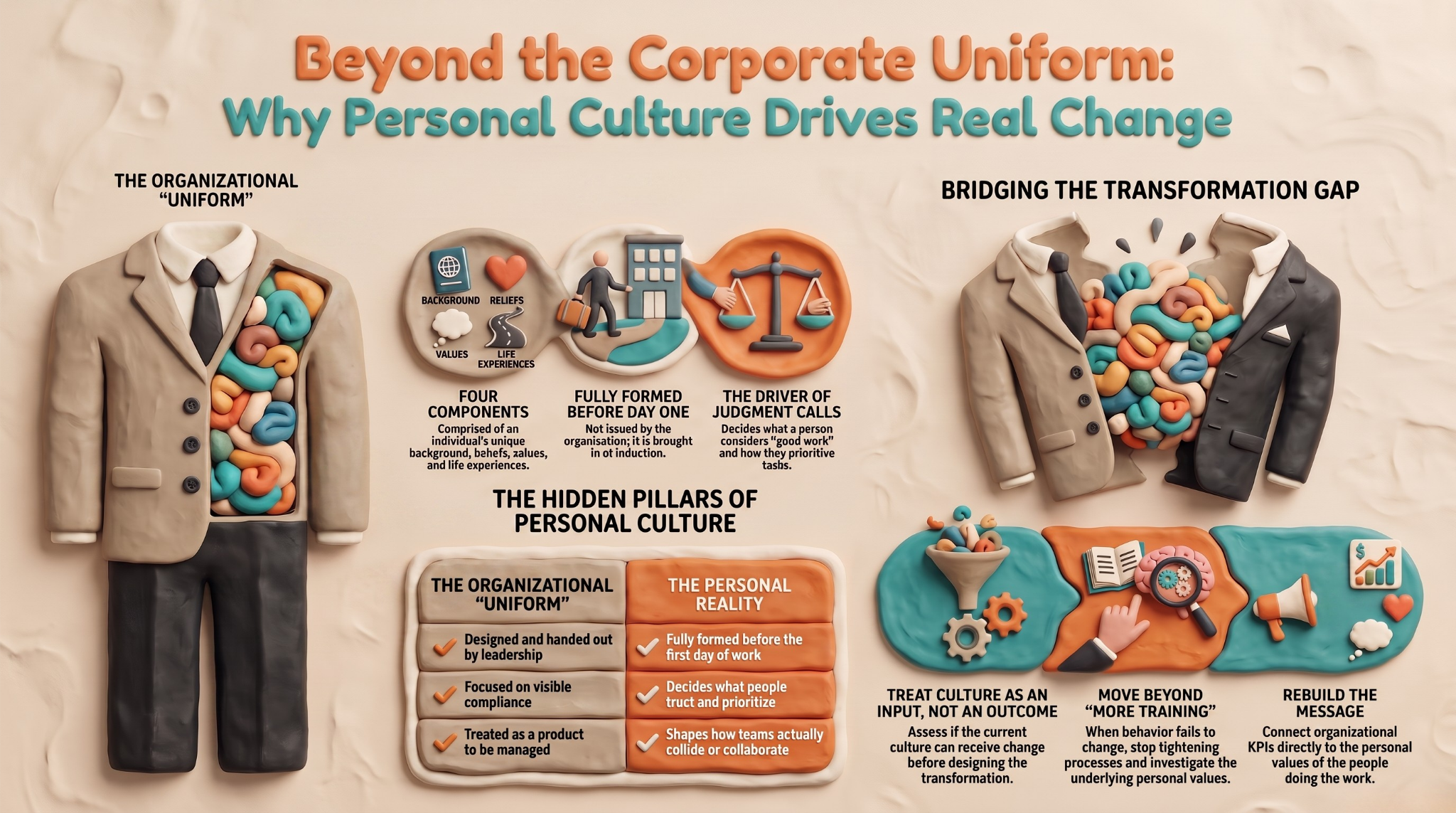
The individual's own personal culture is the culture a person already has when they walk into your organisation. It is made of four things:
Their background, meaning where they are from and how they were raised
Their beliefs, meaning what they hold to be true about people, work and fairness
Their values, meaning what they put weight on when two things compete
Their life experience, meaning what they have lived through and what it taught them
None of that arrives at induction and none of it is issued by the organisation. It was fully formed before the first day, and it stays.
TL;DR
There is a real improvement in how much change and transformation acknowledges culture, and the method has not caught up with it
When an organisation treats culture as a thing it owns, culture becomes a uniform it designs, hands out, and changes every so often
The individual's own personal culture is their background, beliefs, values and life experience, and it is fully formed before they arrive
Personal culture decides what a person considers good work, how they take in information, and what they prioritise
That shapes both how the work gets done and how teams get along with each other
A customer experience program, an order fulfilment problem that outlasted every process fix, and what resolved it
At the end, you will see how you can get ahead in uncovering Stakeholder Psychology to master influence
🎧 If you prefer to listen to this edition instead, I highly recommend listening to this audio podcast as a deep dive which is AI-generated based on this edition and Jess' intellectual property:
Where we actually are with culture
The improvement is in how much we acknowledge culture, and the method has not caught up.
Those of us who do this work are more aware of culture than we were 10 years ago. Serious programs now treat culture as an input rather than a by-product.
Some of us go further and:
Assess whether the culture can receive the change
Track the drift between the culture an organisation had and the culture it has now
Map the unwritten rules that decide how work happens and how outcomes get shaped in that particular organisation
I want to be accurate about the size of that improvement. Awareness has moved and method has not moved with it.
Most change and transformation professionals still have no reliable way to:
Capture what the culture actually is
Break it down into parts they can work with
Use those parts as an input to the design
Decide what needs to change in the culture, and how to change it while the transformation is being delivered
In practice, this is what it means
Ask your sponsor how culture was captured for this program and what was done with the answer
If the answer is an engagement survey and a values statement, treat the culture as unassessed and build the assessment into your design phase
Name what in the current culture will make this specific change hard to absorb, and put it in the risk log where governance can see it
The organisation treats culture as its own product
The organisation designs the uniform, everyone wears it, and every so often the organisation changes it.
Where an organisation does take culture seriously, it usually takes it on as a thing. A product, an asset, sometimes a living thing inside the business, and always something the organisation owns and works on for its own purposes.
Leadership defines it. A program moves it from a current state to a target state. The people who have to live inside it come last.
When the personal culture people already have is left out, what the organisation has built is a uniform. This is the organisation's culture; everyone wears it, and every now and then the organisation changes the uniform.
I put this point to an executive team once, inside an organisation running its own culture transformation. The chief HR officer rolled her eyes at me. They did not have time for this, she said. The culture belongs to the organisation, we dictate what it should be, people follow along, and if they do not follow, they are welcome to leave.
That organisation was running a culture transformation while treating culture as a project.
In practice, this is what it means
Check whether your culture work has any input from people outside the leadership team who defined it
List the behaviours the program asks for and mark the ones that assume everyone shares the same idea of respect, urgency or good service
Treat visible compliance with new behaviours as a question rather than an outcome, then go and find out what people think those behaviours are for
Where the individual's own personal culture fits
Each person brings a personal culture that decides what they treat as good work.
Here is the question I want to leave with you. Where does the individual's own personal culture fit into the culture the organisation is building?
I have worked in 16 countries and with more than 25 cultures, and I come from a diverse background myself, so I watch this closely. What one background treats as completely normal, another treats as offensive. A set of words in a particular order reads as sincere to one group and rude to another.
Personal culture is doing more work than most programs account for:
How a person does the work comes from what their own culture defines as done properly
How a person takes in information, and what they trust when they hear it, runs through their own culture
What a person prioritises when two things compete comes from what their culture puts value on
This is also where friction between teams comes from. Two teams collide over a message, a decision or the way an issue gets raised, and the organisation reads it as attitude, capability or a personality clash.
Underneath, each side is applying its own idea of what respectful, direct and urgent look like, and both sides think they are being reasonable.
Your workforce spans geographies, countries and backgrounds, inside a single site as much as across regions, so the organisation's culture is only half of what decides how the work gets done.
In practice, this is what it means
Before you design, list the distinct groups who have to execute the change and write down what each group treats as a job done properly
When two teams keep colliding, ask what each of them considers respectful and direct before you look at process or capability
Watch word choice and word order when a message lands badly, because sincerity in one background reads as bluntness in another
What it costs, and what works instead
Speak to people inside their own personal culture and connect it to what they are measured on.
I worked on a customer experience transformation inside a very large organisation. The program had everything you would put in place:
SOPs covering every step of the order journey
Process design that went through several rounds of review
Structured training, on the job training, and job shadowing
Design authority sign-off, engaged sponsors, clean reporting
The complaints kept arriving from the same place: the final step of order fulfilment. The people delivering that step could not comply with the process. They were doing what they understood good service to be, consistently and at scale, and it produced the exact outcome the program existed to remove.
Everyone read it as a compliance problem, so the response was more of what had already failed. More reinforcement, tighter supervision, another pass at the SOPs.
The cause sat somewhere else. Most of that workforce shared a background in which one of the strongest values is making sure the customer sees your work rather than assumes it. And they were absolutely avoiding being penalised or having an unfair complaint put against them.
Delivering the package was half of the job as they understood it. The customer seeing that it had been delivered was the other half. So they placed packages where the customer would spot them immediately (no guesswork); this could be in exposed positions visible from the door, at the cost of everything the process said about safe placement, weather, fragility and contents.
They were protecting themselves against a customer who opens the door, sees nothing, and lodges a complaint.
They had already connected their own values to the KPIs they were measured on, and that connection gave them a method for doing the work that owed nothing to the SOP.
The mechanism is simple enough:
A process specifies the steps, and it cannot specify every judgement call inside those steps
The final stage of a service process is mostly judgement calls
People settle those calls using what they already believe good work looks like
Training, shadowing and reinforcement all sit above that, which is why they can run perfectly and change nothing
What worked was speaking to it inside their own personal culture and connecting it to what they were measured on. Once the message arrived in language that matched their values, the link between those values and their KPIs re-formed around the behaviour the program needed.
There was no right or wrong culture here. There was a program designing for a workforce it had never properly met.
In practice, this is what it means
When a behaviour continues after training, shadowing or reinforcement, stop tightening the process and ask what people believe the process is for
Ask what they are protecting themselves against when they deviate, because the deviation is usually protection
Rebuild the message inside their own values, then connect it to the KPIs they are measured on
Culture is not one culture. It is the organisation's culture sitting on top of every personal culture that walks through the door with the people who have to make the change work. Both shape what gets delivered, and only one tends to be designed.
Would love to hear your thoughts; message me or reply. I read every message.
Get ahead in stakeholder psychology and influence
Here is a way to get ahead in uncovering stakeholder psychology and mastering influence. Get the masterclass today.
Who it is for
Change, transformation and delivery leads running programs where stakeholder commitment decides whether the change lands
Consultants who have to win over people they do not manage and have no authority over
Sponsors and business leaders who keep hearing agreement in the SteerCo and seeing something different in the business
What you get out of it
Read what a stakeholder is actually protecting, whether that is control, stability or credibility, instead of taking the stated objection at face value
Move people from compliance to commitment, which are two very different things and only one of them holds
Hyper-personalise your engagement, your communication and your meetings to what each stakeholder needs from you
Handle the different stakeholder levels properly, because the board and C-suite need something different from VP and director level, who need something different again from the teams
Retire the burning platform playbook and replace it with something that works on people who are already exhausted
What is inside
Why the current stakeholder playbook of urgency, education and documentation is producing agreement without commitment
The mindset shifts that have to happen before any tool works, which is why the tools come second in this masterclass and not first
The stakeholder psychology method: what people need in order to get you, back you and move with you
Micro-commitments and how to build real progress out of them
Worked real program examples, including how an engagement was rebuilt around a stakeholder whose actual issue was loss of control
2 AI Agents that will accelerate your delivery and coach you 24x7
What is included
Masterclass replay, the 2-hour full session
Q&A replay, the follow-up session where the questions got worked through
The masterclass resources and tools
Engagement to Momentum Canvas AI tool
Stakeholder Psychology Flywheel, a diagnostic AI tool
📍 You can get access here:
https://www.tl-institute.com/c/stakeholder-psychology-mastery