Robots Existed Before The Robots Existed
Last week I wrote about giving myself permission to stop being superhuman, and a lot of you wrote back. Some of what came into my inbox was more honest than what I had put in the email. Thank you for that.
Here is the link to that article if you missed it:
https://transformationleadership.institute/post/permission-not-to-be-superhuman
This week I want to take it further, because something happened a few days later that showed me what sits underneath it.
🎧 If you prefer to listen to this edition instead, click on the audio image below for an audio podcast as a deep dive which is AI-generated based on this edition and Jess' intellectual property:

The doorway
Once your own state shifts, you start seeing things you looked straight past the first time.
I was rewatching Lioness - A series on Paramount+ about a CIA task force. It follows an operative embedded in a covert military team, and it belongs to a whole category of shows built around elite high performance, where the work is dangerous, and the stakes are absolute, and the people doing it never miss.
First time round I enjoyed most of it. This time I sat there cringing, and it took me a while to work out why the same show was landing so differently.
The show had not changed at all. What had changed was that I had just spent weeks working out what being superhuman actually costs, and now I could see it being sold back to me.
Look at what those characters carry. Work where lives depend on their judgement, and split-second reactions that are always right. Good relationships alongside it. Skin, hair and bodies in a condition that would take hours a day nobody ever appears to spend. They win every conversation they walk into, and they never lose their composure.
Every one of those things is possible on its own, and all of them together in one person is where it stops being a person.
Robots existed before the robots existed
We have been building this version of a human for decades, and only recently started building them out of metal.
Everyone is talking about robots and artificial intelligence now, as though a machine that works without rest, doubt, or limits is a new arrival.
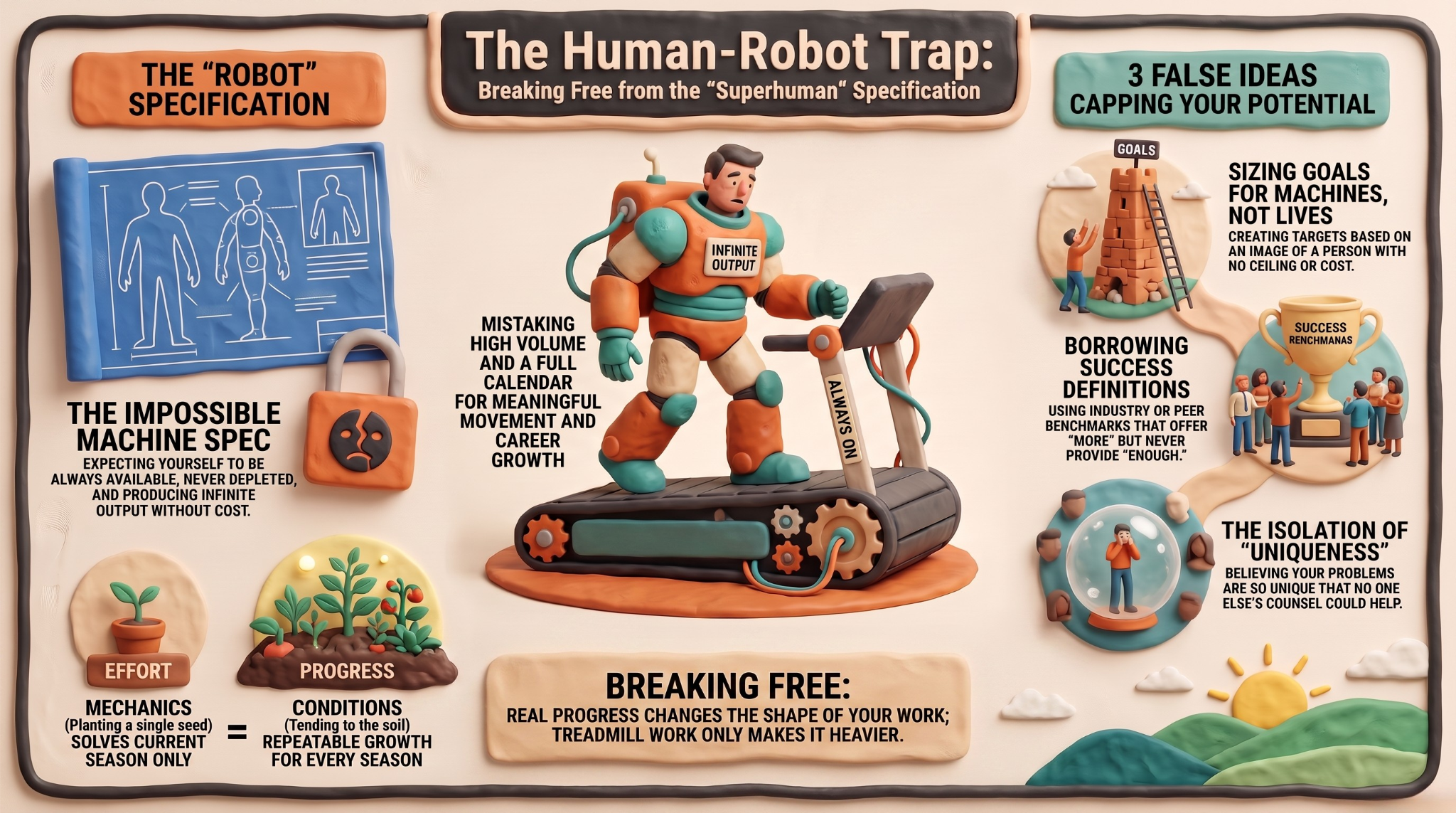
We got there long before the technology did. We built the idea first, and then we asked people to be it. Always available, always sharp, never depleted, no visible cost, output going up in every direction at once. That is a specification for a machine, and we have been handing it to human beings for a very long time.
Entertainment is one of the places it gets reinforced, though it is nowhere near the only one. It shows up in how promotions get talked about, in who gets described as impressive, and in the quiet arithmetic you do about yourself when someone else appears to be managing more than you are.
The reason it works is that it is never presented as a specification. It just becomes what capable looks like.
What it actually costs
The effort is real, the numbers are real, and the distance travelled is 0.
Here is where this stops being an observation about television.
When you are running on that specification, you work extremely hard, and you get very little movement. Your calendar is full, and your output is high. Every measure you have says you are performing, and the gadgets agree with you.
And you have not gone anywhere.
Effort feels so much like progress that it never occurs to you to check whether you are moving, which is how this runs for years without anything interrupting it.
Work that is genuinely taking you somewhere changes shape as you go. It gets different rather than just heavier, and your judgement gets called on for things it was not trusted with before. When the only thing changing is the volume, you are on a treadmill, and a treadmill will let you run on it for as long as you are willing to stay.
I am not talking about stress or burnout here. Those are real, and they get plenty of attention, and they usually arrive with something dramatic enough that you cannot ignore it. I am talking about the years before that, when nothing looks wrong, and nothing is moving either.
The cap on your potential is almost never your capability
In thousands of coaching conversations, I have almost never met someone whose ceiling was their ability.
I have worked with CEOs, senior corporate leaders, and people running social enterprises, … across a lot of countries and cultures, and a lot of different definitions of success. The pattern holds across all of it.
What caps people is a false idea they are running on. They cannot see it because it does not feel like an idea. It feels like reality.
There are 5 of them, and most people are carrying more than 1.
1. A goal that requires you to do far too much
The goal was never sized against an actual life.
Where the goal came from matters. A lot of them get set from that same specification, an image of a person with no ceiling and no cost, and when you build a target around that person you inherit their workload without noticing.
The volume required stays invisible until you are already inside it. Then the shortfall reads as a personal failing rather than as arithmetic, and you respond by pushing harder, which is the one move that guarantees you stay there.
2. You have not thought hard enough about what success looks like for you
Without your own definition, you run on somebody else's, and theirs has no finish line in it.
Most people have a definition of success they have never examined. It got assembled from their industry, their parents, their peer group and whatever they were rewarded for early on.
Borrowed definitions have a specific problem. They tell you what more looks like, and they never tell you what enough looks like, so no amount of achievement registers as arrival. You reach the thing, and it converts immediately into the next thing.
This one takes real work. It means sitting down with the different parts of your life, one at a time, and saying what a good outcome in each of them would actually be for you. Very few people have done it, and it is why so many capable people cannot tell whether they are winning.
3. You are not playing to your strengths, so you are getting good at being average
Good at being average.
I want to say that again, because it lands hard on people who have never thought about it. There are a lot of people who are good at being average.
Attention spent on the things you are naturally weak at will lift you towards the middle. That is what it does, and sometimes the middle is exactly what a situation requires. Attention spent on the things you are genuinely strong at is what makes you distinctive.
Both of those are legitimate. The problem is that time is finite, so it is always a trade, and most people are making that trade without ever seeing it as one. Years of effort go into shoring up weaknesses, and the result is competence everywhere and distinction nowhere.
4. Believing your situation is unique to you
Your circumstances are unique, and the pattern underneath them almost never is.
This one is delicate, so I want to be careful with it.
Your situation is genuinely yours. The specific combination of your role, your organisation, your history and everything happening in your life at once has never occurred in exactly that arrangement before, and I am not going to reduce that or wave it away.
The pattern underneath it is a different matter. Someone has stood roughly where you are standing and come out the other side, and they have something to say about it.
When you decide your situation is unique at that level, you quietly close the door on every one of those people. Nobody could possibly understand, so there is no point explaining it, so you stop explaining it. What you are left with is your own thinking, on a loop, in a cocoon, which is the exact condition in which nothing new arrives.
5. Deciding you will do it alone
The people who go furthest are the ones who worked out early that they could not do it by themselves.
The world has got noisier and more complex, and trust has got harder. I see more people concluding that they will handle it themselves, and it usually gets framed as strength.
I am not talking about your team. Your team is imposed on you and you were always going to work with them, which is exactly why it lets people believe they have this covered. Working with people you were assigned is not the same thing as choosing counsel.
I mean the people you pick. A confidant. A coach. A mentor. Someone you can put the whole unedited situation in front of, including the parts that would not survive being said out loud at work.
To elevate your reality to your potential, you need others to work with.
Not tips and tricks for the situation in front of you. Someone who lifts the level you are operating at.
The difference between being shown how and being able to repeat it
One of them solves this season, and the other one changes what you are capable of growing.
There are people who will show you how to plant the seed. They will give you the mechanics of growing the crop, and you will get the crop, and it works.
There are others who help you create the conditions. They work on the soil, the water, the timing, the things that determine what will grow there at all. What you get from that is a crop you can grow again next season, and the season after, without needing them standing next to you.
It sounds like teach a man to fish, and it goes further than that. Fishing gives you a skill for one thing, and conditions determine what is possible across everything you do. The freedom is in the repeatability. You stop needing the answer because you have built the environment that generates answers.
Most help available is mechanics, and mechanics are easier to sell and easier to measure. The other kind takes longer, and it is worth holding out for.
Where this leaves me
The specification only holds while it goes unnamed.
I am looking at my own work differently since last week. The volume was never the interesting question. What matters is whether it is going anywhere, or whether I have been mistaking a fast pace for a direction, and some of it is going somewhere while some of it is treadmill with excellent numbers attached.
If last week's email landed with you, this is what I would add. Permission to stop is where it starts. What you find when you stop is that the ceiling was never your capability.
You can find last week's edition here if you missed it: https://transformationleadership.institute/post/permission-not-to-be-superhuman