
The 7 Gaps
What Good Looks Like and Why It Depends On Where You're Standing
TL;DR
Large-scale transformations rarely fail because of poor strategy or weak execution plans. They struggle because the people at the top and the people on the ground are living two different versions of the same programme. This article names seven gaps that sit at the heart of that disconnect, with a practical question and one action for both executives and transformation leads at each one.
The seven gaps are:
The Measurement Gap
The Translation Gap
The Expectation Gap
The Leadership Gap
The Accountability Gap
The Pace Gap
The Culture Gap
There's a conversation that happens in almost every transformation I've been part of.
The executive sponsor leaves a steering committee feeling confident. Numbers are tracking. The board deck looks solid. The programme is on schedule.
The transformation lead walks out of the same meeting carrying something heavier. They know what's not in the deck. The quiet resistance is building in middle management. The team that has been running on adrenaline for six months. The adoption numbers look fine on paper but feel fragile on the ground.
Same programme. Same meeting. A completely different experience of what is actually happening.
This is not a failure of communication, and it is not solved by better reporting or a sharper dashboard. It is a leadership gap, and it sits at the heart of why so many transformations that should work do not fully land.
I see 7 gaps consistently. None of them is about fault. All of them are about leadership.
🎤🎧Audio Version of the Article
If you prefer to listen to this AI-generated deep dive that is solely based on this article, you can listen to it here:
The 7 Gaps
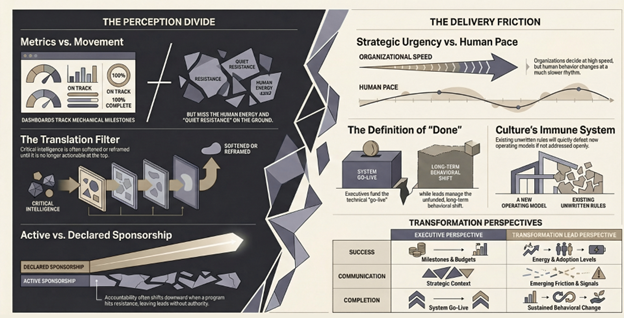
The Measurement Gap
At the top, success is often defined by what is visible and reportable: milestones, budgets, and delivery timelines. These matter enormously. But they tend to capture the mechanics of a transformation rather than the movement inside it.
On the ground, the people leading change day to day are tracking something different. They are watching energy levels, noticing who is leaning in and who has quietly checked out, and feeling the weight of conversations that never make it into a status report.
The gap is not that one set of measures is better than the other. It is when only one set becomes the official definition of progress that the organisation loses sight of half of what is actually happening.
If you are a C-level sponsor or executive,ask yourself whether your current success measures tell you how people are actually moving, not just whether the milestones are landing on time.
If you are a change or transformation lead,ask yourself whether you are surfacing the human indicators with the same confidence and rigour that you report on delivery metrics.
One thing to do next Monday:Bring one behavioural or adoption signal into your next update that is not currently on the dashboard and frame it as a leading indicator, not a risk.
The Translation Gap
Transformation leaders often carry intelligence that organisations urgently need: early signals, emerging friction, and the real reasons a workstream is stalling. The challenge is not that people are staying silent. It is that the information often loses something critical as it travels upward, because the conditions for honest translation do not always exist.
What reads as transparency on the ground can land as escalation at the top. What feels like strategic context to an executive can feel like being managed to someone in the middle of it. Important intelligence gets softened, reframed, or filtered until it is no longer actionable.
If you are a C-level sponsor or executive:Ask yourself whether the people running your transformation feel genuinely safe bringing you the full picture, including the parts that are not yet resolved.
If you are a change or transformation lead:Ask yourself whether you are framing reality in a way that invites action, or whether the way you present it makes it easier for the organisation to dismiss or defer.
One thing to do next Monday:Have one direct, unscheduled conversation with someone on the ground and ask them what is not making it into the formal reporting. Listen without problem-solving.
The Expectation Gap
This one rarely gets named directly. What "done" means varies across levels of the organisation, and that misalignment has significant consequences.
For a C-suite sponsor, done might mean the system is live, the structure is in place, and the programme has delivered against its mandate. For the transformation lead, done is not yet a word that fits, because they are watching people still figuring out how to work in the new way, still reverting under pressure, and still needing support that is no longer formally resourced.
Transformation does not end at go-live. Organisational attention and budget very often do.
If you are a C-level sponsor or executive:Ask yourself what your organisation's definition of "done" actually funds, and whether that definition reflects how long real behavioural change takes to stick.
If you are a change or transformation lead:Ask yourself whether you have had an explicit conversation with your sponsor about what the sustaining phase requires, or whether you have assumed that the need is understood.
One thing to do next Monday:Map out what the programme looks like six months after formal close and bring that picture to your sponsor as a forward-looking conversation, not a problem to solve.
The Leadership Gap
This is the one that underpins all the others.
Transformation asks leaders at every level to do something genuinely difficult: hold strategic clarity and operational reality at the same time. To read the room at the board level and the room where frontline adoption is actually happening. To be decisive while remaining genuinely curious about what they are not yet seeing.
That is not a communications skill. It is a leadership capability, and most organisations do not deliberately develop it. They assume seniority brings it, or hope it emerges under pressure. In practice, it rarely does without intention.
If you are a C-level sponsor or executive:Ask yourself how close you are staying to the real experience of the transformation, not the version that has been prepared for you, and who in the programme is genuinely able to tell you the truth.
If you are a change or transformation lead:Ask yourself whether you have the positioning, the relationships, and the confidence to bring the full picture into the room, not just the version that is easy to hear.
One thing to do next Monday:Identify one relationship at a different level of the organisation that you have been underinvesting in, and make one move to strengthen it this week.
The Accountability Gap
Sponsorship gets declared at the start of a transformation with genuine intention. The challenge is that active sponsorship and declared sponsorship are two very different things, and the distance between them tends to widen as the programme moves through its more challenging phases.
When a transformation is gaining momentum, ownership feels shared. When it hits resistance, accountability tends to shift downward quietly, without anyone formally deciding to do so. The transformation lead absorbs the weight of what is not landing, often without the authority or visibility to address what is actually driving it.
The gap is not about who is to blame when things get difficult. It is about whether the people who hold the power to shift conditions are staying close enough to know when they need to act.
If you are a C-level sponsor or executive:Ask yourself whether your sponsorship has remained active through the difficult phases of this programme, or whether your visible commitment has reduced as other priorities have grown.
If you are a change or transformation lead:Ask yourself whether you have been clear with your sponsor about what active sponsorship looks like at this stage of the programme, and whether you have made it easy for them to show up in the right way.
One thing to do next Monday:Schedule a focused conversation with your sponsor that is not a status update. Make it a conversation about what the programme needs from leadership right now, and come prepared with two or three specific asks.
The Pace Gap
Organisations tend to make decisions at the top at a pace that reflects strategic urgency. The pace at which people can absorb, adapt, and genuinely change their behaviour is a different rhythm entirely, and the two are rarely reconciled explicitly.
The result is a compression that falls on the transformation lead. They are expected to keep pace with decisions being made above them while managing the reality of how long change actually takes for the people living it. The gap between what is being announced and what is being embedded quietly widens, and by the time it is visible, the organisation has often already moved on to the next priority.
This is not about slowing down ambition. It is about understanding the true cost of pace and building the capability to manage it deliberately rather than discovering its consequences later.
If you are a C-level sponsor or executive:Ask yourself whether the speed at which your organisation is making change decisions reflects an honest understanding of the absorption capacity of your people and teams.
If you are a change or transformation lead:Ask yourself whether you are having the pace conversation explicitly with your stakeholders, or managing the consequences of misalignment silently because the conversation feels too difficult to raise.
One thing to do next Monday:Build a simple picture of what is currently landing on your organisation simultaneously and bring it into a conversation with your sponsor as a capacity-and-sequence question, not a complaint.
The Culture Gap
Every transformation is designed with an intended future state. That future state sits inside an existing culture that has its own logic, its own unwritten rules, and its own immune system. When the two are not in active conversation, the culture tends to win quietly while the transformation appears to be progressing on paper.
The gap shows up in specific ways. A new operating model is launched, but decision-making still flows through the old relationships. A new set of values is communicated, but the behaviours that get rewarded remain unchanged. The transformation leader can feel it happening and often struggles to name it in a way that the organisation is ready to hear.
Culture is not separate from transformation. It is either the engine of it or the resistance to it, and which one it becomes depends on whether leaders are willing to look at it honestly from the start.
If you are a C-level sponsor or executive:Ask yourself whether the culture your organisation currently rewards is genuinely aligned with the future state your transformation aims to create, and where the most significant points of tension lie.
If you are a change or transformation lead:Ask yourself whether you are treating culture as a workstream within the programme or as the context that shapes everything else, and whether that distinction is reflected in how you are working.
One thing to do next Monday:Identify one place in the organisation where the existing culture is actively working against the change you are trying to embed, and bring it into the open as a design challenge rather than a behavioural one.
Why This Matters Now
Organisations are running more change, more simultaneously, than at almost any other point in recent history. The cost of these gaps, at scale, is high. Not just in programme outcomes, but in the leaders who carry the weight of it day after day.
The executives who close these gaps do not do it by accident. They stay close, ask different questions, and treat the transformation lead as a strategic partner rather than a delivery function.
The transformation professionals who close them develop the positioning, the practice, and the presence to bring the whole picture into the room, from both sides of the table.
That is what good looks like. And it is available to anyone willing to lead from that place.
Which of these gaps resonates most with where you are right now? Reply and let me know. These are the conversations worth having.