
The Problem with Problem Solving
Problem solvers look for problems. That is the job, and the good ones are relentless at it.
The consequence is rarely examined. An organisation that fills its senior ranks with problem solvers will always have a full problem list, because the capability it has invested in is the capability to find things that are wrong.
TL;DR
Problem solvers find problems. Build a leadership bench of them and the problem list never shortens.
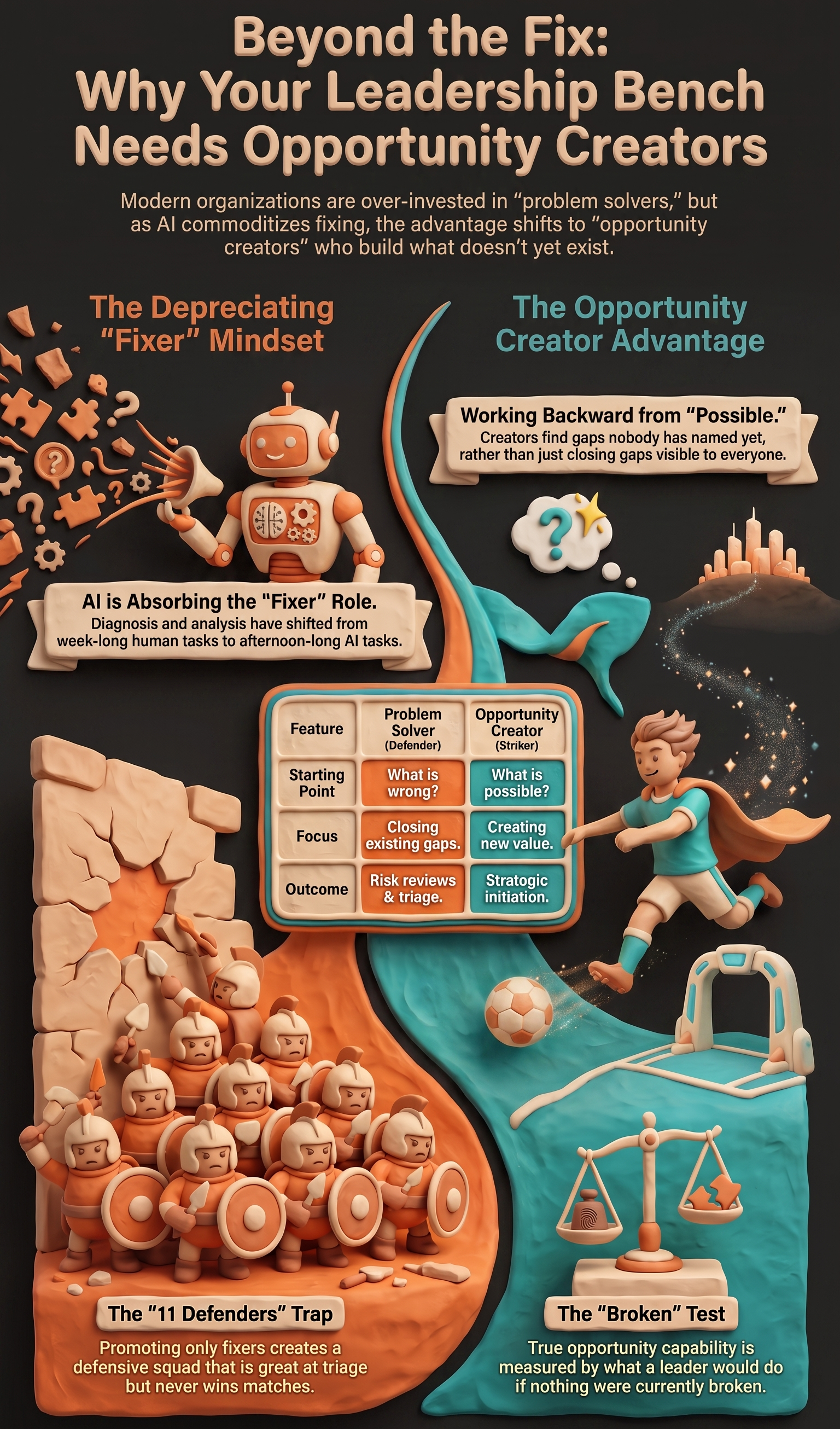
The problem-solver badge is depreciating. AI is absorbing that work quickly, and parts of it at a scale no human will match.
Opportunity creation is a different mindset, not a later stage of problem solving. You do not arrive at it by fixing enough problems first.
There is no organisation on earth without an opportunity waiting to be created. The shortage is in the seeing, not in the situation.
A team of defenders with the occasional striker does not win, however good the defending. Balance has to be built deliberately.
🎧 If you prefer to listen to this edition instead, click on the audio image below for an audio podcast as a deep dive which is AI-generated based on this edition and Jess' intellectual property:

What you promote for is what you get more of
An organisation full of problem solvers will never run out of problems.
Problem solving is a lens before it is a skill. The person who holds it scans continuously for what is broken, what is at risk and what needs fixing, and they are usually right. That is why they get promoted.
Fill your senior bench with that lens and the organisation produces a permanent problem list. Not because more things are going wrong, but because more people are looking for things going wrong, and they are good at finding them.
Watch what happens to the agenda. Strategy sessions turn into risk reviews. Leadership meetings become issue triage. The organisation gets very efficient at responding and loses the habit of initiating.
For the individual, the same lens sets what you get handed. A reputation for fixing things means you are given things to fix, and each assignment confirms the reputation.
🔧In practice.Take your last 3 executive meeting agendas and sort the items into two piles: things to fix, and things to create. If the second pile is thin, you have measured your leadership bench, not your circumstances.
The badge is depreciating
The delivery and problem-solving work that built your career now takes someone with good prompting skills a few hours.
AI is absorbing problem-solving quickly. Diagnosis, analysis, options generation and stress-testing have gone from week-long tasks to afternoon ones inside two years.
Some of that space will move beyond human reach entirely. Pattern detection across data volumes no person can hold, scenario modelling at a scale no team can run. That is not a future scenario, and competing there is not a strategy.
An enterprise whose leadership strength sits in problem solving is holding a depreciating asset, and most have not priced it yet.
The individual version is blunter. If your professional identity is built on being the person who solves the hard ones, the hard ones are getting cheaper by the quarter.
🔧In practice.Answer one question about yourself or anyone on your bench: if diagnosis were free and instant, what would this person still be valuable for? A clear answer is a position. No clear answer is a risk you now have time to fix.
Opportunity creation is a different mindset, not a later stage
You do not arrive at opportunity creation by solving enough problems.
The common framing is sequential: stabilise first, then grow, fix what is broken and then look for what is possible. That framing iswrong, and it is why so many organisations never get there.
The two run on different mechanics.
Problem solving starts with what is wrong and works backwards to a fix. The problem sets the boundary, and success is closing a gap that was already visible to everyone.
Opportunity creation starts with what is possible and works backwards to what would have to be true. Nothing sets the boundary, and success is a gap nobody had named yet. It takes a different tolerance for ambiguity, a different kind of evidence, and a different relationship with being wrong.
Put someone in problem mode into a business that is running well, and they will find nothing impactful to do. Put someone in opportunity mode into the same business, and they will find 3 things worth building.
That is the whole distinction. It has nothing to do with how many problems either of them has solved.
Which leads to the point most leadership teams miss. There is no organisation on Earth without an opportunity waiting to be created. Not one. The shortage is never in the situation; it is in who is looking and what they are looking for.
🔧In practice.Ask one question at your next leadership session: what would we do here if nothing were broken? The quality of the answers tells you how much opportunity-creating capability you actually have, and the silence tells you more.
Defence does not win matches
Build on a strong defence. Do not mistake it for a strategy.
Watch any team that has just won something. The defence is excellent, and nobody wins with defence alone. A soccer team of eleven defenders with the occasional striker does not win a match, no matter how well organised the back line is.
Organisations build exactly that squad by accident. They promote the people who fix things, because fixing things is visible, measurable and immediately valuable. Over a decade, the senior bench fills with defenders, and each appointment was individually correct.
Balance does not emerge on its own, because every short-term incentive runs the other way.It has to be appointed for, given room, and then protected from being pulled back into recovery work the moment something goes wrong.
That last part is where most attempts fail. The organisation identifies someone with an opportunity-creating mindset, and then hands them the next crisis because they are capable.
🔧In practice.Count your top 10 leaders. How many are known for fixing, and how many for creating? If the ratio is worse than four to one, you have a defensive squad, and it will read as a growth problem long before anyone recognises it as an appointment problem.
The problem with problem solving is not that it is wrong. It is that it’s becoming a badge and a strategy, and the dangerous part is that it is unquestionable. You hear problem solving, problem solver, I am all about problem solving,....etc. And you don’t get a reaction that this is not enough; it is a normalised statement and a mindset. It answers its own question thoroughly and never asks the other one.