The Real Work of Change Falls Into the Cracks
I work on large-scale enterprise transformations and smaller-scale transformations that carry high stakes and run deep within organisations. Across both, what I am about to say assumes that your version of the change management practice is working.
As in, it is happening: someone or a group is responsible for change; whether they sit as change managers or within a change practice, they are busy doing the work and following some kind of method, framework, or structure.
One note before we start. The only reason I use the term change management here is that it is how the work is mostly known across the practice, and you know how much I hate the term. I have written about why at https://transformationleadership.institute/post/change-management-is-boring, so I will leave it there and move on.
TL;DR
Change work is happening in most organisations: professionals are responsible for it, busy doing it, and following some method, framework, or structure.
Whether that structure is traditional change management or agile change, the change can still fail to hold, and the reason sits outside either approach.
Whether change holds depends on the organisation's capacity, capability, and culture. I call this work the Conditions of Success Runway, and the runway gets built before the change scope is set.
The runway work is cross-functional, and work that several functions partly own rarely gets resourced as the sole job of any one leader.
The change and transformation leaders who take responsibility for the runway face the same responses when they ask for time, budget and headcount, and building the influence to change those responses is work in its own right.
Change is a discipline within an ecosystem built to transform the organisation at every level.
🎧 If you prefer to listen to this edition instead, I highly recommend listening to this audio podcast as a deep dive which is AI-generated based on this edition and Jess' intellectual property:
The change work is happening
A way of doing can only be as effective as what it operates from.
In most organisations I see, change work is happening, yet the change still does not hold, and neither of the 2 main approaches explains that gap.
If your organisation runs traditional change management, assume the plans are sound, the communication is landing, and the training gets delivered.
If it runs agile change, assume the feedback loops between increments/sprints are real, and that the work adjusts course as the approach intends.
When concerns come up about either, the most common reply is that the implementation was at fault. Here, I am granting the implementation. The change managers are doing their job.
Traditional change management and agile change are both ways of doing, and a way of doing depends on what the organisation has built for it to operate from. The question underneath both approaches is what that base consists of, and who builds it.
What sits before the change scope
The runway gets built before the change scope is set, and the method starts after.
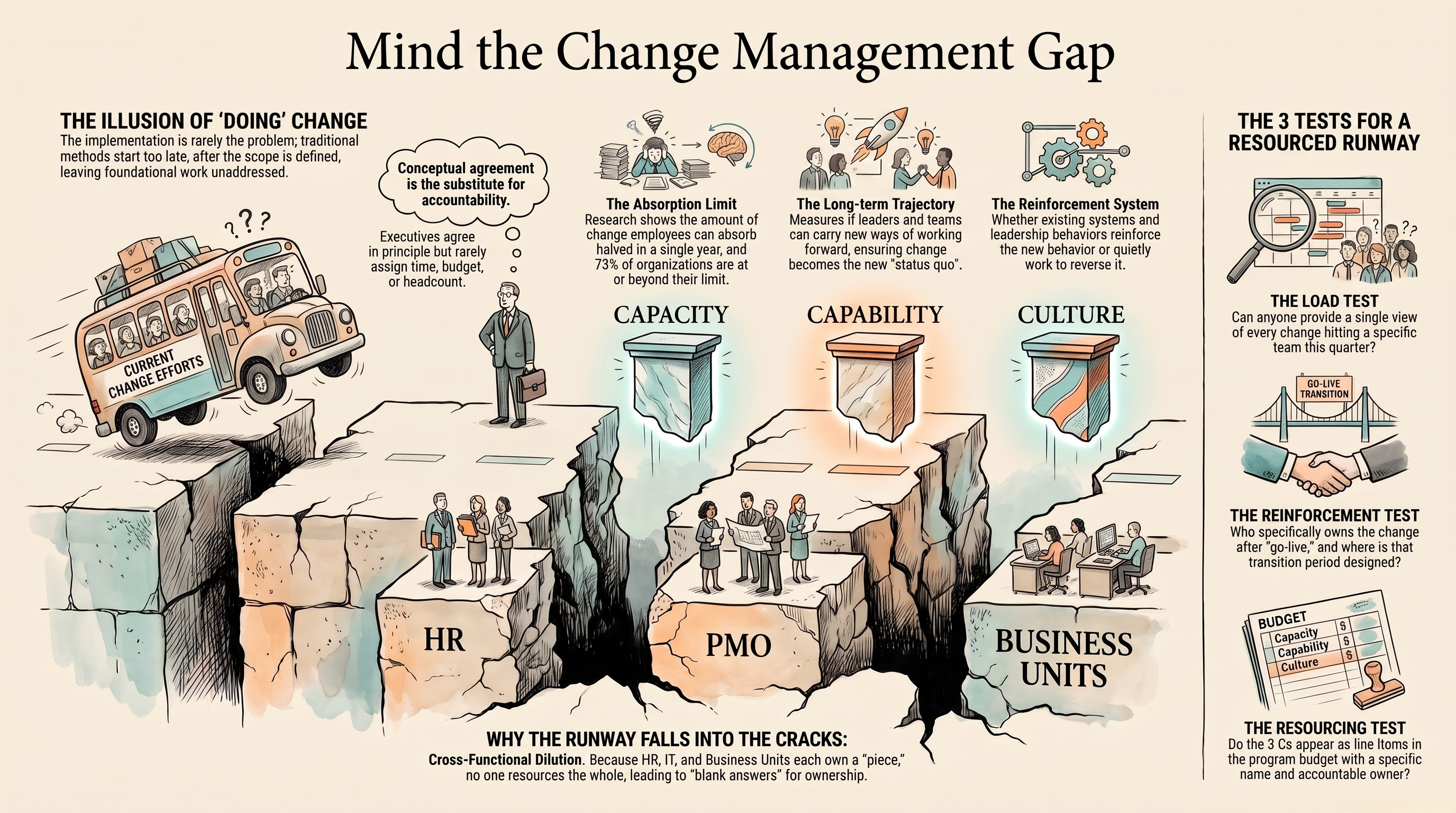
Before the change scope is set, and in many cases before the project scope is signed off, there is work that decides whether the change will hold. I call it the Conditions of Success Runway, and inside the Transformation Leadership Institute it is some of the work we care about most. It rests on 3 Cs:
Capacity. What teams can absorb on top of everything else already in motion.
Capability. Whether leaders and teams can carry the new ways of working forward after go-live, so the change becomes how the organisation operates, and the trajectory shifts the way the change was intended, at whatever intensity that shift carries.
Culture. Whether leaders, the newly created conditions, and systems reinforce the new behaviour or quietly reverse it.
The evidence that the runway decides outcomes keeps accumulating:
Gartner found that the amount of change an average employee can absorb without fatigue halved within a single year.
Gartner also found that employees with high trust in their organisation show a capacity for change that is 2.6x greater than that of employees with low trust.
Prosci's benchmarking research places roughly 73% of organisations near, at, or beyond the point where teams can no longer absorb more change.
A backlog does not capture any of this, and a project plan does not either, because neither was built to.
Change methods inherited their frame from project delivery, so they start once the change scope exists. The runway is built before the change scope exists, which is why it sat outside the frame from the start. That is lineage rather than neglect.
A method governs how change work moves, and the capacity, capability, and culture it depends on are built through other work. The change effort can run well while the runway underneath it was never built.
🛠️ In Practice
3 tests to run before the change scope is set, whether you sit in the sponsor chair or lead the change practice:
The load test. What other change hits the same teams this quarter, and who can answer that in a single view?
The reinforcement test. Who owns reinforcement after go-live, and where is it designed rather than assumed?
The resourcing test. Where do the 3 Cs appear in the program resourcing, on any line, with a name against them? A resourced runway looks like this:
Capacity has someone funded to map the change load across teams and sequence what lands when.
Capability has budget against developing the leaders and teams who will carry the new ways of working after go-live.
Culture has the right conditions for outcomes to be realised and to catch deviations… With an accountable owner assigned.
A blank answer to any of these tells you the runway is missing.
The work that falls between functions
Conceptual agreement is the most common substitute for accountability.
The runway work gets diluted because it iscross-functionalby nature and rarely owned end to end:
The lead change practice holds one piece of it.
HR holds another.
The sponsor, the PMO, the portfolio manager, the business unit and the transformation team each hold theirs.
Each can reasonably assume the others hold the rest.
Ask 5 functions where this work lives, and you will get 5 different answers, each of them partly right.
The mechanism explains why pointing at any single function misses.Work that several functions part-own rarely gets resourced as a single leader's full job.
Executives nod at it in SteerCo and agree with it in principle, and then the same executives fold it into a training module or hand it to each business unit to prepare their own teams. Conceptual agreement stands in foraccountability, and the work that makes or breaks whether change holds, the kind of change that shifts the organisation's trajectory rather than installing a system, carries no thread from start to finish.
What the leaders who do this work keep hearing
The words you are saying carry conviction and influence. You don't have to beg or end up doing the work yourself to prove a point.
When change and transformation leaders ask for the time, budget or headcount to build the runway, the responses that come back from executives and program leadership sound like this:
"Didn't we already do this?"
"Why do we need that many people?"
"There's no budget for that, and it will take time."
"Can we fold it into one of the trainings?"
"That's for each business unit to prepare their own team."
Those responses carry history. Earlier attempts at this work have failed, been frowned upon, been questioned on why they were needed at all, or been offloaded to whoever would take them. So when the senior practitioners I speak with every week, both inside and outside the Transformation Leadership Institute community, describe this as an uphill battle, I would rather be real about it than pretend otherwise.
Being real about it is also why we work on it directly. Inside the Transformation Leadership Institute, we work on creating that runway and on creating theinfluence musclethat earns you the room to do the work: influencing the right way, and showing up from powerful and proven positions of your own positioning, so that the words you are saying carry conviction and influence, and you don't have to beg, or end up doing the work yourself to prove a point.
The clearest evidence that the runway work matters is how consistently organisations that skip it end up paying for it in change that does not hold.
Change is not a standalone practice
Change is one discipline inside an ecosystem built to transform the organisation.
Change management, or change leadership as I describe it in my world, is not a standalone practice. It is one practice inside an ecosystem of transformation, and that ecosystem carries different intensities:
A small change that runs deep.
A change that cuts across the enterprise.
A change that shifts the trajectory of the organisation altogether.
Inside that ecosystem, change is one discipline working alongside others:
Customer experience
Service design
Organizational development
Software development
Strategy execution
Delivery support
Reporting and portfolio, among others
….etc.
The job of that ecosystem stays the same across every intensity: achieving the outcome the strategy was written for, without drama and without burning money, time, and credibility on change that does not hold.
Inside the Transformation Leadership Institute, this is a conversation we keep coming back to with change and transformation leaders: how to bring change into that ecosystem so it plugs in rather than runs alongside it.
The future belongs to those who own the runway
The leaders who can create the runway and secure the support to build it are the ones organisations will keep choosing.
The future of change and transformation belongs to the leaders who know how to create the runway and influence the support it needs.
And this is what business owners and organisational leaders are asking for. The C-levels and senior executives I meet every single week, from different countries, different companies, and different problem situations, are frustrated with how change is being managed: it promises the world and delivers less than it should, while professionals stay busy doing what they are doing. Something needs to be done about that.
I am doing this inside the Transformation Leadership Institute with my corporate clients and with my members. So should you?