The world moved faster than the current change practice
About this series
This is a series of 3 articles about a single idea: change is held, and it holds. It is held by the people carrying it, and it holds the organisation to its next trajectory. Neither meaning works without the other, and the current practice of change was built for a different objective. It was built to move a known population from A to B and to confirm the change landed and stuck, and it does that well. Change that holds starts from the other end: from how much the people carrying the change can hold, and from where the organisation needs the change to take it, and it designs the change to fit both. That is a different job, and it produces a different change.
The idea comes out of 2 years of testing a different way of working with change inside sophisticated organisations that had already tried the traditional approach and the elevated one, with the neuroscience and the psychological safety layer, and found that both left them at the same place. I am sharing it now because it cannot serve as a single practitioner's method. It needs the practitioner, the director, the sponsor, and the C-level to be at the same level of understanding, or it will not hold.
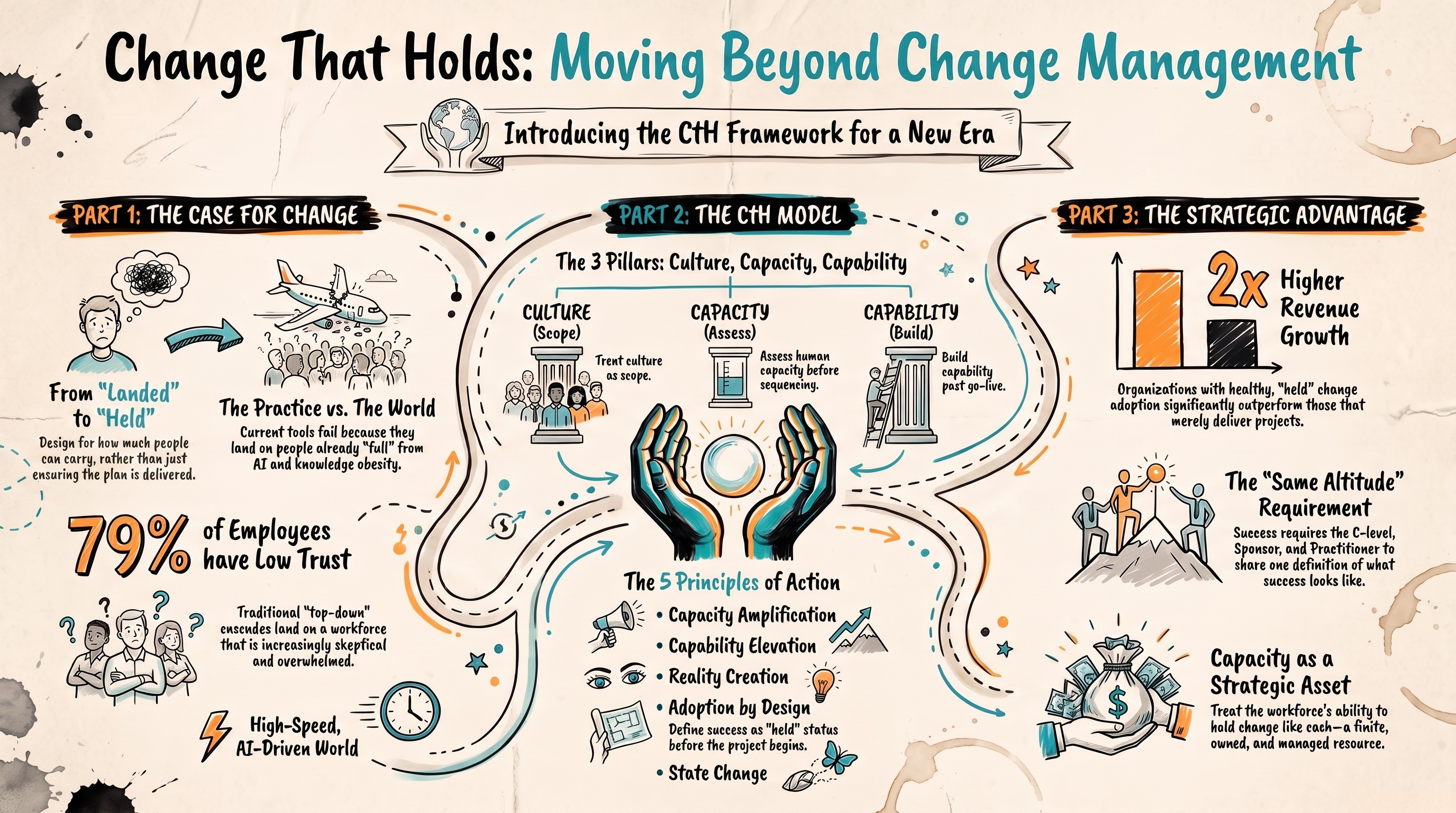
Part 1 makes the case: why the practice of change is landing on people and organisations it was not designed for.
Part 2 sets out what a change that holds is made of: one aim, three pillars, five principles.
Part 3 shows why change that holds is the competitive advantage for organisations that intend to be here and thriving in the next 3 to 5 years.
Why Change Doesn't Stick or Land but Holds
🎧 I highly recommend you to listen to this audio podcast as a deep dive which is AI-generated based on this edition and Jess' intellectual property:
https://gotoleader.s.gy/Why_employees_cannot_hold_more_change
The last 12 to 18 months have been different from anything most of us have worked through. It shows in our families, in the countries we live in, in the climate, in a geopolitical landscape that moves week to week, and in the people around us who are finding it harder to cope with the amount of change, before anyone gets to the intensity of it or the pace of it inside organisations.
Inside organisations, all of that arrives at once. A restructure lands on people who are already carrying the outside world, an operating model changes while the last one is still settling, and artificial intelligence sits on top of both, adding more to know than anyone can hold. The people we are asking to change are not the people the practice of change was designed for, and the environment they are changing in is not the one it was built in.
The word we use for change
The words the profession uses describe change from the plan's side. A change lands. A change sticks. Both are true from the program's perspective, and neither says anything about the person carrying it or the organisation depending on it. The word that describes the two is "held". Design for held and you get landing and sticking on the way. Design for landing and sticking, and you get a change that people comply with and struggle to carry.
📍 In practice, this is what it means
Change the question in your next SteerCo from "has it landed" to "who is holding it, and what did they have to drop to hold it".
Ask what the change is holding the organisation to. If the honest answer is a decision already made, plan for the effort that will take.
The environment change now lands in
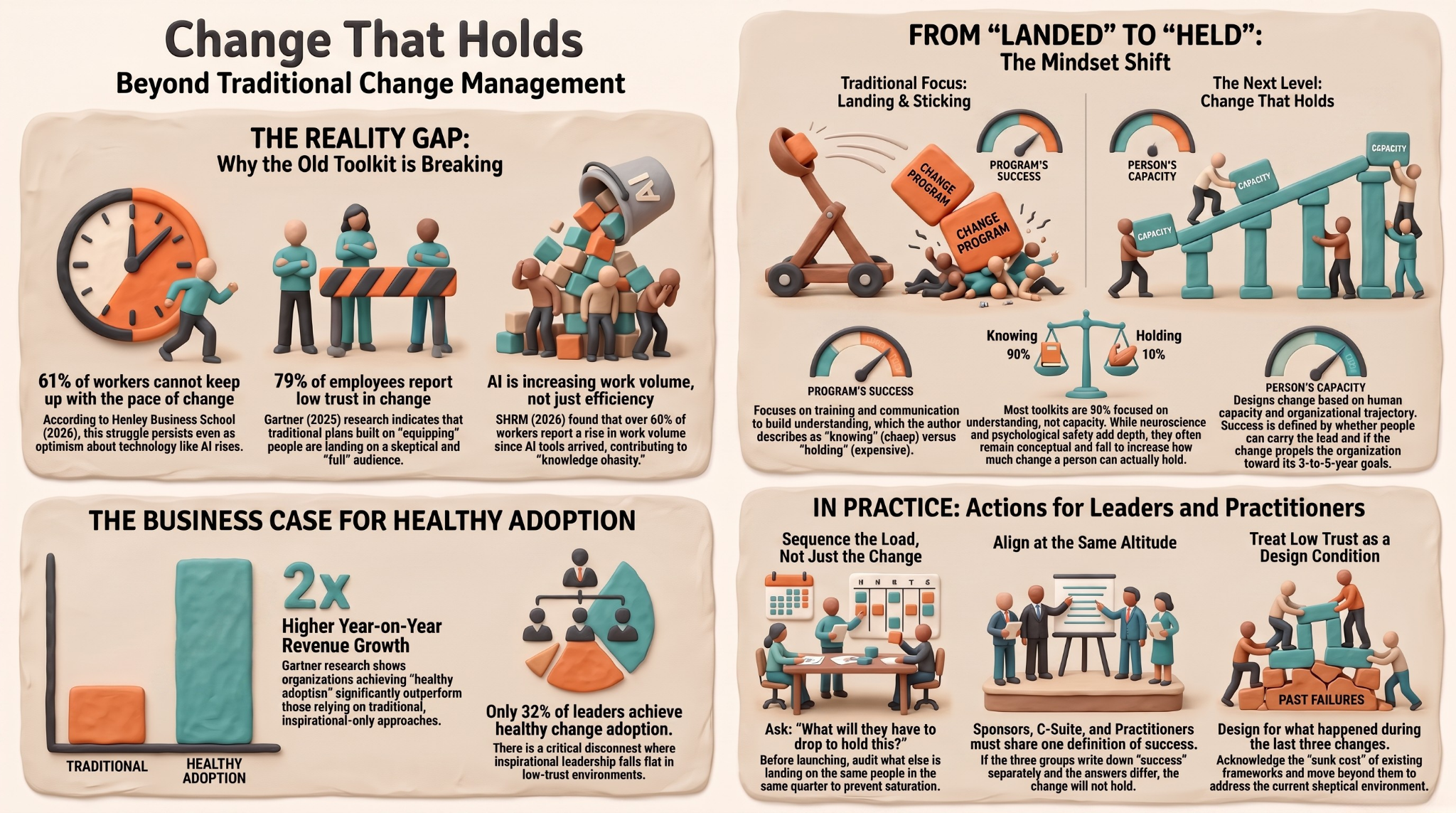
Change is landing in an environment the practice of change was not built for. The environment is faster, more intense, and more competitive than the one the toolkit came from, and it now carries AI and knowledge obesity on top: more information than any person can hold, arriving faster than anyone can process. SHRM's March to April 2026 survey of nearly 6,000 workers found that more than half say the pace of work has increased since AI tools arrived, and more than 3 in 5 report a rise in the volume of their work.
The people are different too. Henley Business School's June 2026 survey of 2,900 workers found 61% unable to keep up with the pace of change, the same proportion as the year before, even as optimism about AI rose. Trust in change has moved in the same direction: Gartner's 2025 research found that 79% of employees have low trust in change. A change plan built on understanding and equipping people is now landing on people who are already full and already sceptical.
Change can't change quick enough to cope with the change in the world. That is the phenomenon, and no one is at fault. The environment moved faster than the practice.
📍 In practice, this is what it means
Before you sequence a change, sequence the load: what else lands on the same people in the same quarter, and what will they have to drop to hold this?
Treat low trust in change as a design condition. Ask what people watched happen to the last 3 changes, and design for that.
If AI is part of the change, ask whether it is removing load or adding it. Both are possible, and only one of them helps.
Change management saturation
Change management has reached the point where the same concepts recycle under new names. Each year produces a fresh model, a new set of stages, a rebranded readiness survey, and much of it is a retro reflection of what is already happening. That is a normal stage in the life of any discipline.
The most recent layer is the elevated one: understanding of the brain, psychological safety, neuroscience. All of it is legitimate, and all of it adds depth of understanding. The limitation is that it stayed conceptual and it still ran the same way, top-down and cascaded. It raised how well people understood the change without changing how much of it they could hold.
The current practice is built around knowing and understanding, and it is very good at both. Training builds skill, communication builds understanding, sponsorship builds permission. Knowing is cheap, and holding is expensive; the practice has very few instruments for holding, so when adoption is thin, it reaches for more of what it already has.
📍 In practice, this is what it means
Audit your change toolkit against one question: which of these builds understanding, and which builds capacity to hold? Most toolkits are 90% the first.
When a new model arrives, ask what it does that the last one did not. If the answer is new vocabulary for the same activity, that is saturation.
Keep the elevated layer. Stop expecting it to hold on its own.
The next level: from managing change to leading it
There is a next level beyond change management, and it starts with a mindset shift among the people who lead it. Managing change moves a known population from A to B and measures whether it landed and stuck. Leading change asks whether the people can hold it and whether the change is holding the organisation to where it is going, and it designs for both from the start.
Gartner's April 2026 research found that only 32% of leaders get employees to adopt change in a healthy way, and that the inspirational approach most of them use falls flat in a low-trust environment. Its 2025 research found organisations with better-than-average healthy adoption report 2 times higher year-on-year revenue growth. Put those together, and you have the duality: the change people can hold is the change that keeps the organisation on its trajectory, and the gap between the two is the next level.
The condition is that everyone is at the same altitude. The practitioner, the director, the sponsor and the C-level need the same understanding of what has to change and what good looks like, or it will not hold. The sponsor and the C-level are the ones who can budget, structure, sequence and prioritise for what people can hold. The practitioner is the one who can design for it. When those two groups work from different definitions of success, the practice defaults back to landing and sticking, because that is what it can measure.
📍 In practice, this is what it means
Get the sponsor, the C-level and the practitioner to write down, separately, what success looks like for the current change. If the 3 answers differ, that is your first piece of work.
Practitioners: report adoption as what people are holding, what they had to drop to hold it, and what is at risk of being dropped next.
The sunk cost of changing how we do change
Most of us have years invested in how we do change. The frameworks were learned properly, the certifications were earned, the templates work, and the clients ask for them by name. That is real, and it does not disappear because the environment changed.
If you are thinking, "This is working, why change?" look at what it is working on. Landing and sticking work, and they still describe a large part of the job. It is no longer the whole of the job, because the people it lands on and the organisations depending on it are not the ones it was built for, and the numbers in this piece are what that looks like from the outside.
If you are thinking "we are not changing our ways", no one is asking you to throw them out. The ways we know are becoming the floor, and the work that gets asked for next sits above them. Everything you already do stays in place. What changes is the definition of success it serves.
If you are thinking "this is a huge change", it is a change of definition before it is a change of method, and it starts with one question in your next SteerCo: who is holding this, and what is it holding the organisation to? This is not a practitioner's crusade, nor a movement. It has to be all of us, at the same altitude, or it will not hold.
Takeaway
Change is held, and it holds. It is held by people whose capacity to hold it is set before the change arrives, and it holds the organisation to its next trajectory only when they are able to. The current practice is very good at knowing and understanding, and that is no longer the whole of the job. The next level asks the practitioner, the sponsor, the director, and the C-level to share a common understanding of what has to change and what good looks like, and to design from there.
Next in the series: Part 2, what a change that holds is made of: one aim, three pillars, five principles, tested over 2 years in organisations that had already tried everything else.