What Leaders Are Running Out Of
As senior leaders, we are deeply capable. That has never been in question. What has quietly become scarce is something else: our own capacity to apply what we know, our focus while we apply it, and the discernment to choose well between the many things competing for our attention. Here is how it is showing up in you, what I think is really going on beneath it, and what I have been testing with a small group of community leaders.
Check out case studies in the article below.
The thing we haven't quite named about ourselves
For the last decade, the conversation about senior leaders has been about capability. Upskilling ourselves, adding frameworks, becoming digitally fluent, and now becoming AI-fluent. We have invested, our organisations have invested in us, and we have personally invested.
Capability is, by and large, no longer what we are stuck on.
What has quietly become the issue is something else, and it is personal. Three things, actually. Our own capacity to apply what we know. Our focus is to think clearly as we apply it. And our discernment to choose well between the many things competing for our attention.
These three are scarce together in us, and the cost is showing up everywhere. In the decisions we are making, the programs we are leading, the teams we are carrying, and the version of ourselves we are bringing home at the end of the day.
Capability was the last conversation. What is scarce now is the capacity to apply it, the focus to think through it, and the discernment to choose well between what is asking for your attention.
How is this showing up in you
If you are a senior leader running a matrixed program with three executive sponsors, a steering committee, and change landing from every direction at the speed of light, this will land close to home. You may also find yourself thinking, “yes, but I cannot exactly walk in tomorrow and remove half my calendar.” I know. Hold that thought. We will come back to it.
Capacity. Your calendar looks full and produces nothing durable. “I'm too busy” has become your default answer to the very things that would restore you. The coaching session you keep deferring. The community you paid to join and have not used. The program content is sitting unopened. You arrive at the strategic meeting you had been preparing for, and realise you have nothing left for the thinking it actually needs. Underneath it, there is a low-grade sense that you are not bringing your best, without being able to see where your best has gone.
Focus. You catch yourself skimming your own team's reports, knowing the section headings without having absorbed the substance. You sit in co-creation sessions, physically present and mentally elsewhere. You postpone the strategic pieces because you know you cannot give them what they deserve. The decisions that used to feel clear now take three times longer and land with less conviction.
Discernment. Advisors, vendors, tools, and decks are competing for slots you do not really have. If you are honest with yourself, you have been deferring to whoever sounds most polished, because weighing the alternatives would cost more than you have to give. The quality of your own discernment, which is the capability that carried you here, is slipping. And you can feel it.
If any of this is familiar, it is not a sign that you are failing. The binding constraint has moved, and most of the way we have been taught to lead has not caught up.
The decisions that used to feel clear now take three times longer and land with less conviction. That is not a capability problem.
The quicksand most of us have been in
I want to name something directly, because it is the part I see most often with the leaders I work with, and the part we are least willing to say out loud about ourselves.
As corporate leaders, we are built to take things on. It is part of our identity, and it is how we got here. Scores on the board, reputation for figuring things out, a track record of delivering when others could not. So when the next hard thing lands, the instinct is the same one that has worked every other time. Let me have a go at this first. I will put the extra hours in; I have done this before.
I used to do exactly the same thing for years. And in two decades of leading transformation programs alongside major firms, I have watched the same sequence play out with senior leaders across more clients than I can count. It is not a personal failing. It is a pattern. And it feels like integrity, like ownership, like the thing a senior leader is supposed to do.
Here is the harder truth. This instinct is the right instinct for a capability problem. It is the wrong instinct for a capacity problem, and most of us have not told ourselves the difference.
What starts as “let me try this for a week or two” quietly becomes a month, then a quarter, then a year. For some of us, it becomes the defining pattern of a decade. The work keeps getting done, the hours keep going in, and the output keeps becoming less proportional to the effort you are pouring in. You are swimming harder and moving slower. You can feel yourself sinking, while the world around you still tells you that you are performing.
The reason it traps intelligent, senior people is that the very traits that built our careers, self-reliance, high standards, and willingness to push through, are the same traits keeping us stuck. We read the struggle as a prompt to try harder. It is actually telling us the constraint has changed.
Capacity cannot be restored through more effort. Effort is what depleted it.
Waiting, hoping, and settling
The quicksand is what happens to the work. There is a second pattern I have been noticing, quieter, happening to the leader underneath the work. I am seeing it in leaders who are genuinely capable, the last people you would expect. It looks like waiting, hoping, and settling.
Waiting for things to get better. Hoping they settle after the next reorg, the next budget cycle, the next promotion, the next whatever. And then, quietly, the settling itself. Not all at once, but in small increments. A dream you used to speak about openly becomes something you mention less often. Then something you think about less often. Then, something you tell yourself you will get to one day.
The dreams that fade first are often the ones that mattered most. The hope of one day branching out of corporate and starting your own thing. Moving out of the doer role into the executive role. Shifting career or shifting discipline within your career. And the smaller ones, which are not small at all. Running your own workshop. Having a speaking gig. Being looked at with the kind of respect where people come to you for advice. Becoming the go-to in your team. Being the one full of ideas and not afraid to articulate them. Being the one who says the thing everyone feels and no one wants to name.
One by one, they get quietly put down. “I'm all right for now” becomes the sentence. And that is the start of the descent.
I am not suggesting you are failing yourself. I am saying the slow drain of capacity costs more than performance. It quietly trades your bigger ambitions for smaller comforts, and it does it so gradually that you only notice once a lot of ground has already been given up.
When capacity runs low for long enough, your bigger ambitions get traded for smaller comforts. And it happens so slowly, you miss it until a lot of ground is gone.
What actually works
Sit with the last two sections for a moment, because together they contradict almost everything that has worked for you until now. If it feels uncomfortable, you are reading it correctly.
The sequence that follows is gentler than the instinct wants, and it is designed to be doable even when you are already depleted.
It starts with recognition. Naming that capacity is the real issue: you are not under-skilled, under-committed, or losing your edge. You are operating on depleted reserves, and the first move is simply to see it clearly.
Then, stop trying to solve this one alone. This is the move corporate leaders resist the hardest, and it is the one that breaks the pattern. If you have a community, lean into it. If you have a coach, book the session. If there is a peer leader who understands what you are carrying, talk to them. Shared thinking restores momentum faster than anything I have seen.
Carve out space that need not be filled. Time that is not pre-committed to an output. Journal, write, empty out what has been sitting in the part of you that you have been treating like a hard drive. Most of us have convinced ourselves that this is an indulgence. It is the precondition for the kind of thinking you are being paid to do.
Subtract, and hold healthy boundaries. Take things off your plate that do not need to be there. Let the work that remains take what it actually needs, and no more. In a matrixed environment, subtraction is almost always a conversation before it is a decision. Starting the conversation with a sponsor, with a peer, with your team, is itself the first move. You do not need permission to begin it.
And then, build the capability and systems that compound your time. This is the one most leaders underuse, and it is the move that changes everything downstream. Capacity is not restored by stretching further, adding hours, or doing more. It is restored by building the capability to move faster through what you already do, with a better structure around you. In the work I do with leaders one-to-one, this is where the real shift happens:
Do it faster: What used to take a week happens in a couple of days
Expensive mistakes stop happening, because structure catches them before they become decisions
Clarity enters the work, and the meandering stops
The right conversations happen, the ones that open doors and opportunities
Losing battles are avoided, the ones that would have drained months without moving you forward
Performance breakthroughs become possible, not because you are trying harder, but because the system around you is built to deliver them
This is my way of working through your capacity, and it is not generic. It is what I do, tested in the fire of complex programs and senior careers. The Show Up and Lean In challenge I described is a small, public version of the same principle. The one-to-one work is where it compounds.
You do not free up capacity by adding more. You free it up by subtracting what doesn't need to be there and by building the capabilities and systems that let you move faster through what does.
I have been testing this. Here are some real case studies.
A few weeks ago, I ran a small experiment with some of my members, leaders drawn from both the Elevate and Inner Circle programs. I chose them deliberately. They were capable, senior, well-resourced, and every one of them had been postponing the thing most likely to help them. I had watched each of them use busyness, real busyness, I fully understand, as the reason for not leaning into what was already available to them.
I called the challenge Show Up and Lean In. The invitation was straightforward. For a defined period, refuse to let real busyness do the work of an excuse. Stop trying to turn your square wheels into round wheels on your own, and lean into the content, community, and coaching already available to you.
This is not a program that claims to solve everything. It is a small, deliberate experiment in what happens when a leader agrees to lean in and harness the power of co-creation, rather than pushing through alone.
Here are three real case studies from what became possible once capacity was addressed, capability was built, and the mindset shifted. None of this took ages.(3 screenshot images below - hit download if you can not see them)
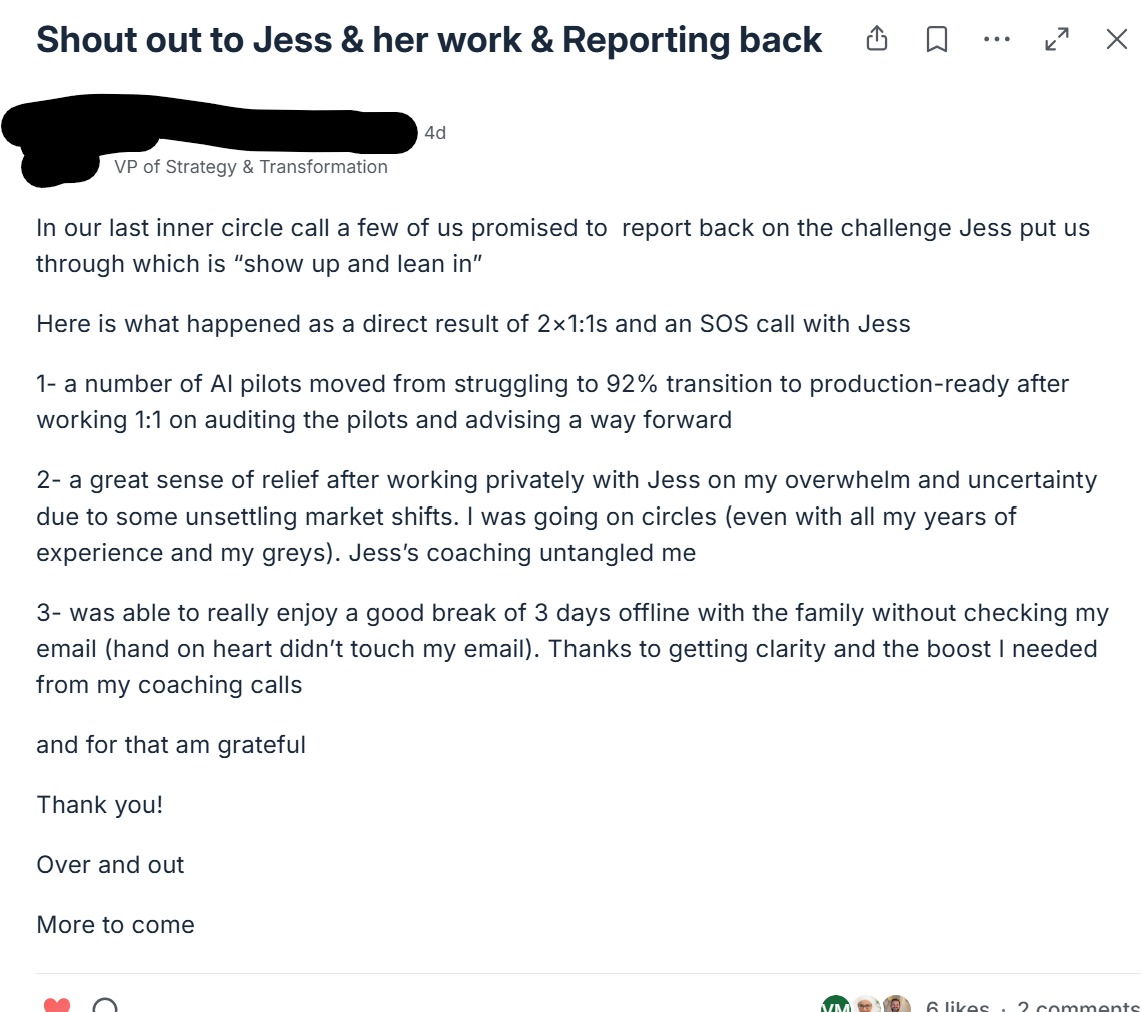
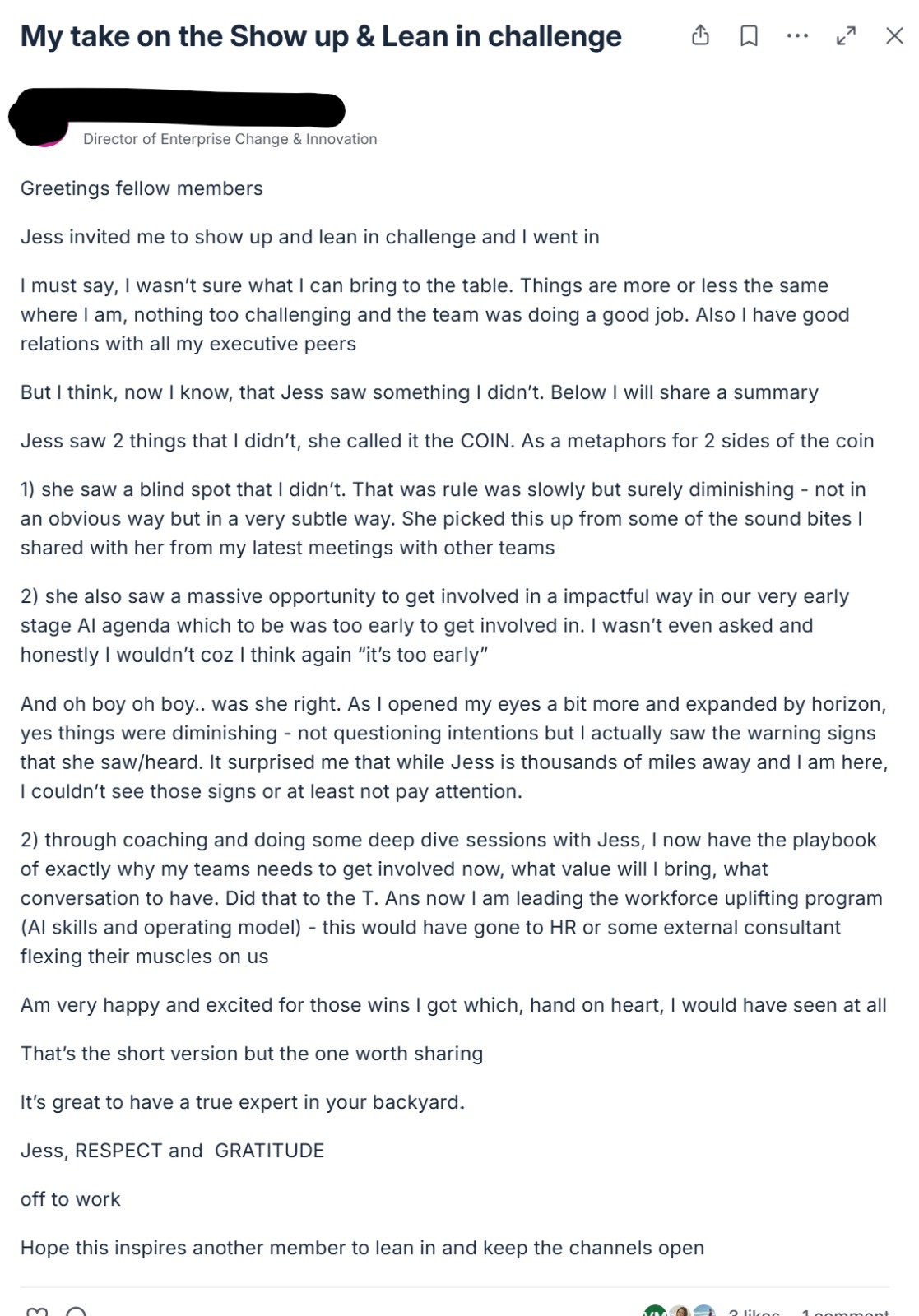
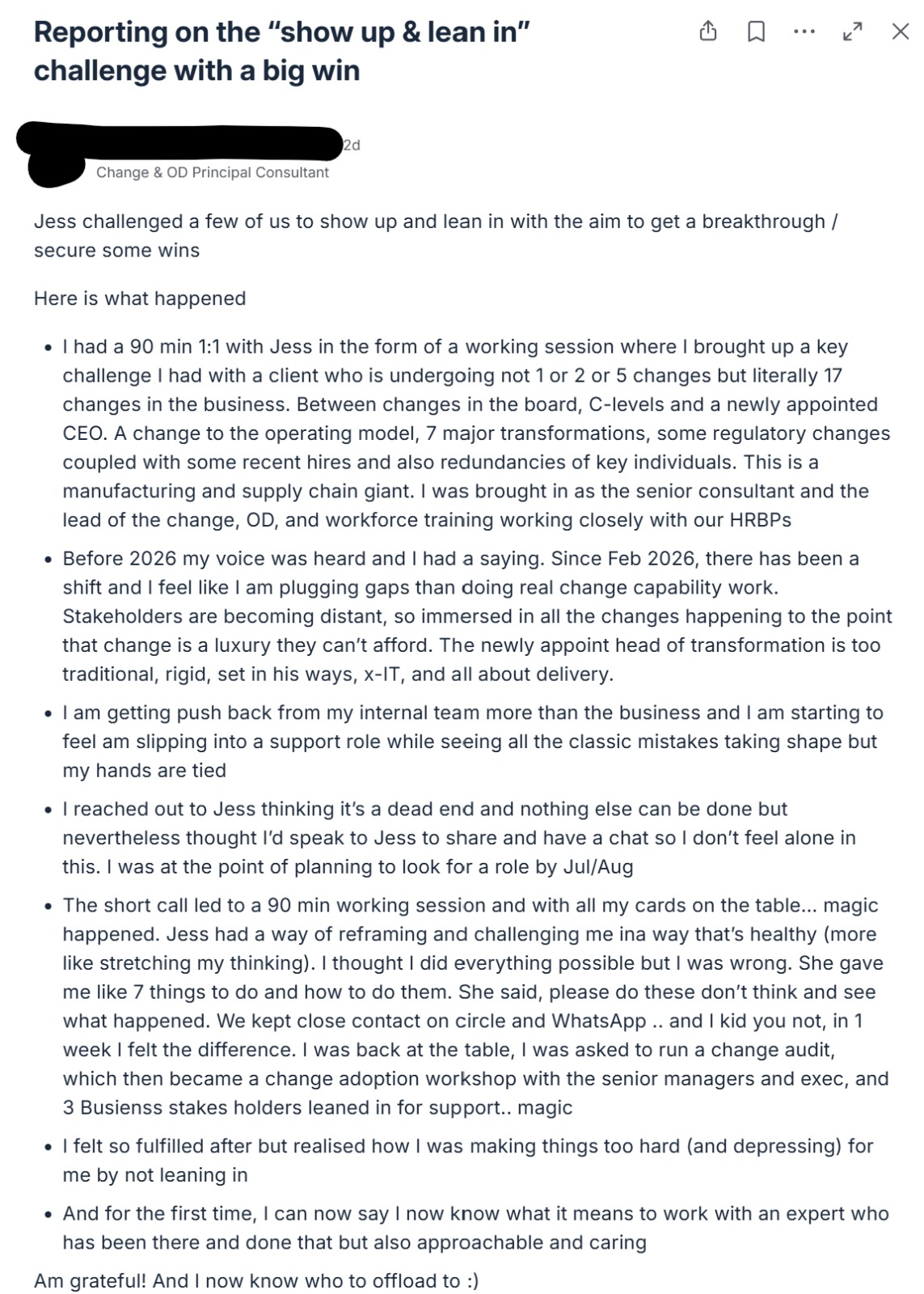
The leaders who recover capacity fastest are the ones who let themselves be helped, earlier than their pride would normally allow.
A final thought
If you recognised yourself somewhere in this, I will say one last thing plainly.
The move is not to push harder through it. The instinct that built your career is the same instinct keeping you in the quicksand. And the quiet settling is the cost of leaving that instinct unchecked for too long. What is already around you, in your community, with your coach, in the peer relationships you have built over a lifetime, is not a luxury for when things calm down. It is the route back to capacity, and to the version of yourself you were always going to become.
The calm comes after you lean in, not before.
THIS MONTH'S MASTERCLASS INSIDE THE TRANSFORMATION LEADERSHIP INSTITUTE
AI Transformation Masterclass for Strategy, Change and Transformation Leaders
AI transformation has either landed on your desk or you can see it coming. Either way, it is different from every transformation you have led before, and the skills you already have need an additional layer.
On Friday, 1 May 2026, I am running a live masterclass built around the three questions I am hearing most often from senior practitioners:
Where do I start? What is different about AI transformation, where are the common failures, and where should I focus first.
Which of my skills apply? What transfers directly, what needs recalibrating for AI, and what is genuinely new territory.
How do I have the conversations that matter? When it is vendor-led, technology-led, or when leadership asks what we need to make AI work.
To be clear: this masterclass is not an end-to-end explainer of AI transformation. That needs far more than 2.5 hours. What I am doing in this session is answering those three pressing questions directly, with structured tools you can apply the week after the class.
Logistics. Friday 1 May 2026, 2:00 to 4:30 PM AEST, live on Zoom. If you cannot make it live, the full recording is included so you can watch it in your own time. You also get the materials pack and access to the Change Makers Corner community.
Before you come, take the AI Transformation Leader Quiz. It will tell you where you actually stand, personally and organisationally, across nine critical dimensions, so you arrive with a clear picture of your own starting point.
→ Secure your seat at the masterclass → https://transformationleadership.institute/masterclass
→ Take the AI Transformation Leader Quiz →
https://www.futurefitleader.com/ai-transformation-leader