Who Says We Want More Productivity?
The AI Vortex is a 4-part series on how organisations move fast on AI and end up short on return, and what organisations that get it right do differently. Part 2, you can read it here, covered how deciding what AI is for, and how much of the work to hand to it, changes the whole design of an AI program. This part stands on its own.
Most AI business cases I read make the same promise: employees will achieve more in less time. It is a promise that is hard to say no to, and it is half the truth.
Vendors are right that AI can do more in less time. The promise does not specify what the organisation will do with the time employees gain, nor does it ask whether AI could do something more useful than simply speeding up the work as employees do it today.
It is easy to sell AI that promises productivity. It is on us, as leaders and organisations, to ask the critical questions that make AI useful rather than repeating the slogan.
TL;DR
Productivity is the AI promise that is hard to say no to, and it is half the truth. Measured on day-to-day work inside organisations, the gains are small, and the people in the organisation hear a message about themselves that leadership did not intend.
Critical question 1: what will we do with the time gained? Time with no assigned use becomes more of the same work.
Critical question 2: is there a different case for AI? AI that improves the foundational business capability, the conditions employees work in, operations and decision-making, and takes the routine admin part of jobs so employees do what they do best.
The case we want from AI is the ability to absorb broader context, reason over it, and assist people in the organisation in doing what they do best. A broader context means the market, competitors, finances, and workforce, read together. Decisions get richer, and priorities surface faster and better than at competitors.
Deliberately deciding that absorbing, reasoning, and assisting are what the organisation wants from AI changes which vendors to bring, which tools, in what order, with what budget, what to do, and what change effort the organisation needs.
🎧 Listen to this audio podcast as a deep dive which is AI-generated based on this edition and Jess' intellectual property:
https://gotoleader.s.gy/who-says-we-want-more-productivity
Productivity is the promise that is hard to say no to, and it is half the truth
AI can do more in less time. The critical questions start where that promise stops.
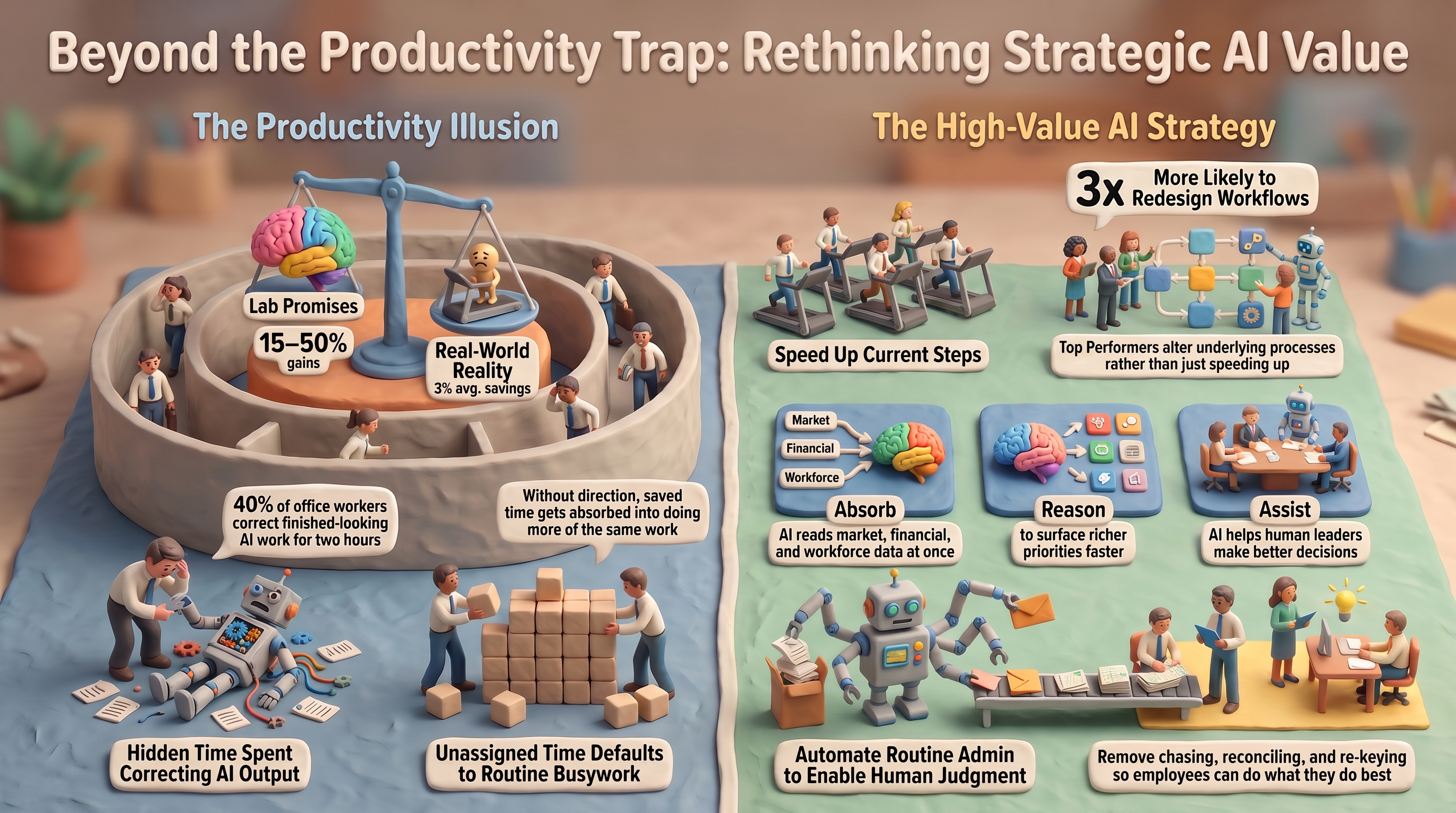
The productivity promise is accurate within limits. Controlled experiments on single tasks, where an employee uses AI on a defined piece of writing, coding or customer support, have reported gains between 15% and 50% for the employees taking part. Humlum and Vestergaard's 2025 study for the National Bureau of Economic Research summarises that range.
Vendors build their demonstrations around those gains, and an executive team that expects the same in its own organisation is drawing a reasonable conclusion from what the vendors showed it.
Measured on day-to-day work inside organisations, the gains are far lower. The same Humlum and Vestergaard study linked surveys of 25,000 Danish employees across 11 occupations to payroll records and found average time savings of 3%, with no significant effect on earnings or hours. Upwork's 2024 survey found that 77% of employees using AI said it had added to their workload, mostly through reviewing AI output and learning the tools.
A 2025 survey of 1,150 full-time office employees by BetterUp Labs and Stanford's Social Media Lab found 40% had received AI-generated work in the previous month that looked finished, and each piece took close to 2 hours to correct.
In plain terms: AI saves some time on some tasks; the amount is small, it varies from role to role, and part of the time saved goes back into checking and fixing what AI produced. The vendor demonstration does not show that part.
What the people in the organisation hear
The vendor demonstration also does not show how the people in the organisation receive the productivity message. When the whole message is "AI will make you more productive," what they hear is this: I know you have other issues in this organisation, I know your work is not ideal, and the conditions are not the best, and I bought you a very expensive tool because I want you to do more of what you are doing. It lands the wrong way.
Leadership did not mean it that way, and employees, most of whom already have more work than hours to do it in, are not being unreasonable in hearing it that way.
📍 In Practice
Open the business case for your largest AI initiative and find the productivity figure. Write down what kind of work the study behind that figure measured, and whether that matches the day-to-day work in your program.
Read the announcement for the program as an employee who will use the tool. Write down what it says the organisation wants from them. If the answer is "more," the message is incomplete because it does not say what the organisation will do with the time.
Critical question 1: what will we do with the time gained?
If AI saves a person 3 hours a week, the business case has to say where those 3 hours go.
The first question the productivity promise does not answer is what the organisation will do with the time gained. There are 3 places the time can go, and each one leads to a different AI program.
More of the same work. The person absorbs the time into the existing workload. Absorbing it is what happens when leadership does not say otherwise, and it is what employees expect. Humlum and Vestergaard's study found a version of this: the 3% of time saved changed neither hours nor earnings.
Fewer people doing the same work. The time gained becomes a headcount reduction, which is a legitimate aim for some organisations. Employees will assume it is the aim unless leadership specifies the aim.
Different higher value work. The time gained goes to work the organisation is short of: time with customers, time on decisions, time on the problems that keep coming back, and time on the work only a person can do. Different work only happens when leadership writes down which work, in advance.
If no decision is made, more of the same work happens on its own.
📍 In Practice
Put the question to your executive team and time how long it takes to get an answer. If the answer is "the teams will absorb it," the program is asking for speed and nothing more, and employees already know it.
For your largest AI initiative, write 1 sentence that says where the time gain will be used. If the sentence does not exist yet, that is the part of the business case still to write.
Critical question 2: Is there a different case for AI?
AI that takes the current process as input makes it faster. AI that improves the process and capabilities changes what the organisation can do.
The second critical question is whether the organisation is asking AI to speed up the work as employees do it today, or to improve the work itself. Most AI implementations I see take the current process, with its problems, as the input. The approvals that take longer than the work stay in place, the duplicate reporting stays in place, and AI produces the reports faster.
Employees still work inside the conditions that made the work hard, at a higher pace. An AI that improved business capabilities (and I'm not talking about the laundry list of what we already know doesn't work that should have been fixed before AI came into the picture). I'm talking about a deeper improvement that works on the business capability from the ground up)
There is a different case for AI, and it is the one I build for. AI that improves the foundational business capability, the conditions in which people in the organisation work, and the way operations and decision-making run, so that both become easier, faster and better.
AI that takes the routine admin part of a person's job, the reporting, the reconciling, the chasing, the re-keying, and does that part itself. AI does not take the job away. It automates the part of the job that was not the reason the organisation hired them, so they can do what they do best.
A productivity quest asks employees to use the tool. A program built to improve the work asks employees which parts of their work AI should remove and which conditions AI should change, and employees are usually the first to answer.
The evidence favours AI that improves the work over AI that speeds it up. McKinsey's 2025 State of AI survey found that the organisations reporting the largest returns from AI are nearly 3 times as likely as the rest to have redesigned their workflows when they deployed it. Asking employees which parts of their work AI should remove also conveys the message they hear when the aim is productivity: leadership has seen the conditions employees work in and is addressing them.
📍 In Practice
Ask 5 employees who do the work which 3 steps in their process they would remove if they could. Check how many of those steps your AI initiative removes, and how many it only speeds up.
For each use case in your program, write down whether it takes the current process as the input or changes the process. If each use case takes the current process as the input, the program is a productivity program, whatever the business case calls it.
The case we want from AI: absorb a bigger context for superior high-level use cases
The organisations that get the most from AI use it to see more, reason over what they see, and free their people to do what they do best.
Back to the question in the title: who said we want more productivity? In the absence of AI that improves the foundational business capability, the decision-making dynamics, and the organisation's ability to observe, productivity is what remains to ask for. The ability to observe is what we most want from AI.
The ability to observe has 3 parts. AI absorbs a broader context than people in the organisation can take in (quicker), reading across the operation, the market, the customers, and the risks simultaneously. AI reasons through that context and shows leadership and the teams what each decision means.
And AI assists people in the organisation in acting on what it shows, so they can spend their time on judgement and the relationships that only a person can bring.
The organisation then identifies priorities faster and more effectively than competitors that are still working from last month's report.
Case Study: executive priorities, absorbed from the market, the competitors, the finances and the workforce at once
🎯 The problem
On a program I worked on last year, the executive team reset its priorities from a priorities pack assembled over weeks.
The finance figures came from last month, the market view came from a strategy analyst's report, and workforce capacity came from each function head's slides.
A different team read each of those 3 inputs, and the executive team saw them together only in the meeting.
🛠️ What we built
AI that reads the market, the competitors, the finance figures and the workforce capacity at the same time, and brings the executive team a set of priorities, the priority set, with the reasoning behind each one.
The executive team reconsiders those priorities every 6 months. Every year, the AI reads more sources of market, competitor, financial, and workforce information than the year before, so the executive team sees where the organisation stands differently each time.
🔍 How the AI reads a bigger context than the executive team could on its own
It reads the market and what competitors are doing, from recent competitor analysis, and it reads the organisation's own workforce: who is available, what projects they are on, and what capacity remains.
It reasons across the market, competitor moves, and workforce capacity, and shows which priorities the organisation can resource and which now conflict for the same people.
⚙️ How the AI is designed to reason and think
Guide rails and clear business rules that set what the AI may and may not recommend.
Different AI models for different problems.
Loop engineering, governed by a shadow AI. The main AI runs its reasoning in cycles. A second AI, the shadow AI, checks each cycle: is the reasoning following the business rules, is it using the sources the organisation has approved, and is the output the kind of recommendation this organisation would act on.
Source scrutiny before the AI uses anything. The AI filters the sources it reads, using those the organisation has already checked and approved, and dropping those it has not. It weighs each source by whether it makes sense for this organisation and by how meaningful its information has proven to be.
Stress testing before the AI presents anything. The AI tests the priority set against what makes sense for this organisation, its market, its capacity, and its rules before it reaches the executive team.
A human check at the end. A small number of people approve the reasoning behind the priority set, in a few hours, and the priority set is ready.
⏱️ How long it took
6 months to refine the guide rails, reasoning rules, models, and data sources until the priority set was meaningful for this organisation.
During those 6 months, the AI Tool was learning from each of the leaders by having a chat with each leader (voice-enabled for speed with whiteboard explanation) to learn how they reason, how they decide, what matters to them,…etc. So this was for the AI to learn, for the leader to learn how the AI tool works, and how the models and programming need to evolve to match with the Org need while keep the edge of challenging the status quo.
📈 The outcome
The priority set is now one of the organisation's gold mines, strengthening its competitive edge.
A version of this AI tool set was rolled out across every department, reading the market, customer, finance, or workforce information that each department needs for its own priorities.
The executive team and the departments work from the same priorities (much higher alignment), and what remains is the decision itself and the human judgement that goes with it.
Deciding deliberately that this ability, to absorb, reason and assist, is what the organisation wants from AI is 180° different from the productivity promise in what the organisation does next. It changes which vendors the organisation brings in, which tools it buys, in what order, with what budget, and what it does. It changes what kind of transformation and change effort the organisation needs, horizontally across functions and vertically from the executive team to the front line.
📍 In Practice
Write 1 sentence that says what your organisation wants from AI, without the word productivity. If the sentence is hard to write, the organisation has not yet decided what it wants from AI.
Take that sentence to the vendor shortlist, the tool list and the budget for your AI program, and check whether each one would look the same if productivity were the aim. Anything that would look the same is there for productivity, whatever the business case says.
The takeaway
The productivity promise is accurate within limits, and it is half the truth. It is easy to sell AI that promises productivity, and it is on us, as leaders and organisations, to ask the critical questions that make AI useful.
Question 1: What will we do with the time gained? More of the same work, fewer people, or different work. The executive team chooses and says so.
Question 2: Is there a different case for AI? AI that improves foundational business capabilities and the conditions employees work in, and takes the routine admin out of jobs so employees can do what they do best.
The case we want from AI is the ability to absorb broader context, reason over it, and assist people in the organisation in doing what they do best. A bigger context means the market, competitors, finances, and workforce, read at once. Deciding that deliberately changes the vendors, tools, order, budget, work, and the change effort the organisation needs.
What does your organisation want from AI, in 1 sentence, without the word productivity?
Next in the series: Part 4 covers the mistakes that are most expensive to unwind, and what happens to the thinking in an organisation that has been in the vortex for long enough.
Find out where your AI transformation stands across 10 areas
The AI Transformation Leader Scorecard assesses you across AI strategy, proof-of-concept design, governance design, stakeholder navigation, vendor navigation, adoption and workforce, your own AI transformation skill set, your professional positioning, and AI maturity.
The AI strategy and the adoption and workforce areas are where a productivity-only aim appears first, and the scored read shows where your program stands on both.
https://www.futurefitleader.com/ai-transformation-leader
My invitation to you: go deeper into AI transformation, so you are equipped with the right thinking and tools
The AI Transformation Masterclass is the practical version of what 5 years of being embedded in AI transformation have taught me.
It covers what AI is and is not, and the use cases that hold up over time. It also covers how to be in the AI conversation in your business as the person who can say what the organisation wants from AI, rather than the person who received the tool and a productivity target.