Organisational Energy Part 2: One Team Surviving, One Thriving, and It's Not About Capability
TL;DR
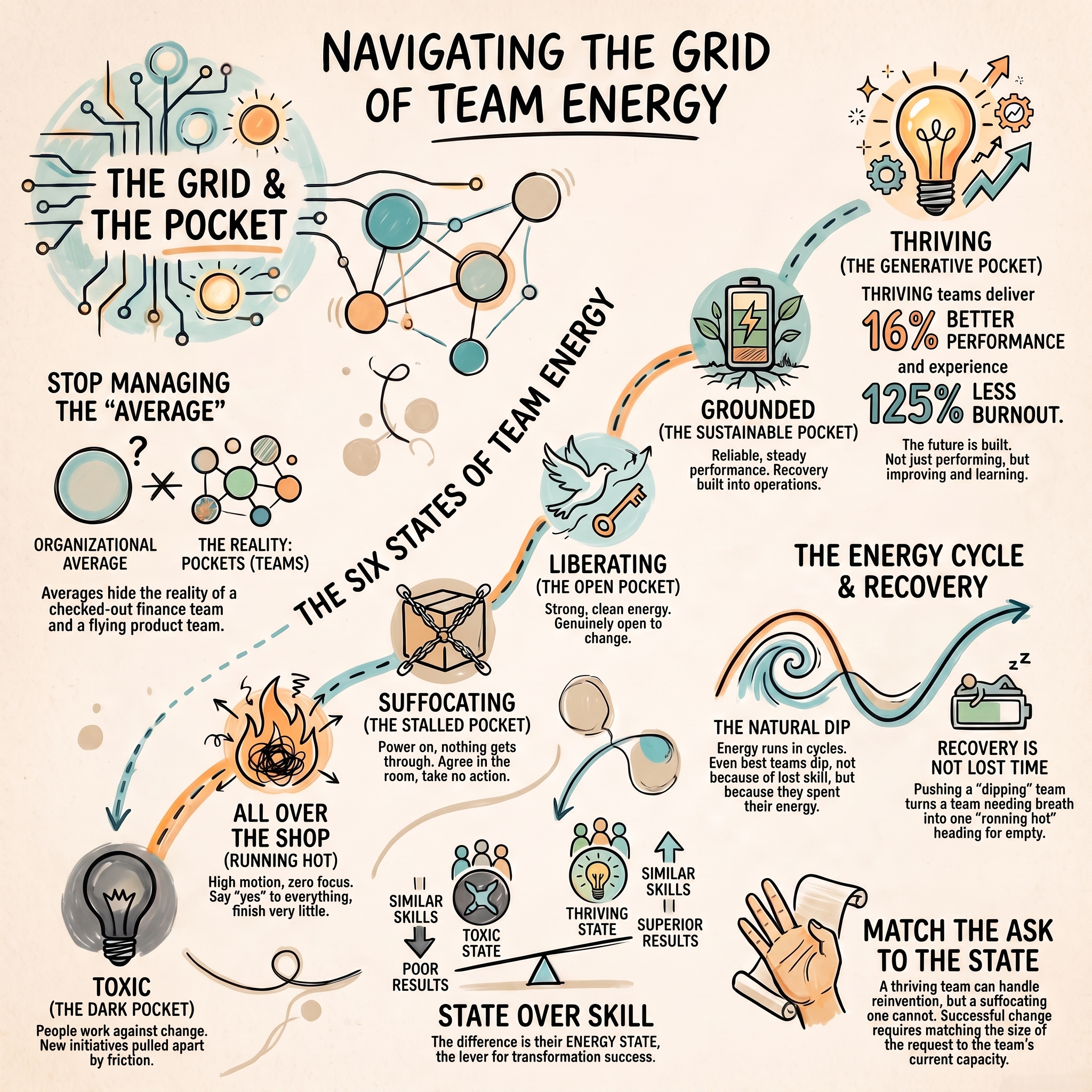
Organisational energy is not one reading for the whole organisation. It lives in different teams, in different states, at the same time.
That is why the same change holds in one team and slips in another, because the team's state, not its skill, decides the outcome.
A simple way to see it is to picture the organisation as a grid, with each team a pocket carrying its own charge.
Six states recur, from toxic through to thriving, and each one sets the ceiling on what a team can take on right now.
No team holds a state on its own. The strong ones dip because they were pushed hardest, and the fix is recovery rather than more pressure.
This is part of a series and you can find part 1 here: https://transformationleadership.institute/post/organisational-energy-part-1-of-3-what-decides-whether-change-actually-holds
🎧 I highly recommend you to listen to this audio podcast as a deep dive which is AI-generated based on this edition and Jess' intellectual property:
You have watched this happen, even if you never had a name for it. The same announcement, the same town hall, the same well-built plan lands as real momentum for one team and passes straight through another without leaving a mark. Two teams with similar people and similar targets, handed the same thing on the same day, and weeks later one has run with it while the other has quietly let it go. The usual instinct is to reach for capability, to assume the second team needed more skill or more direction. Most of the time, that instinct is wrong, and this piece is about what is actually happening instead.
From Part 1
In Part 1, I made the case that organisational energy, the collective charge a group of people runs on, is what decides whether change and transformation hold. It shapes the quality of the work, whether the organisation moves forward, how clearly people think, and how much effort they choose to give. Here I want to go one level down, into where that energy actually sits, because the answer is the thing most leaders get wrong about it. Energy is not one reading for the whole organisation. It lives in different places, in genuinely different states, all at the same time, and that is the reason two teams respond to the same change so differently.
This is also why energy is the point of leverage that a change and transformation sponsor can actually work with. Culture and engagement are real, and they matter, but they are slow-forming measures that shift over years, on a clock far too slow to help a program that is landing this quarter. Energy is the faster, collective layer beneath them, close enough to the work to move inside the timeframe a leader is accountable for. It is the lever available now, and the one most sponsors never think to reach for.
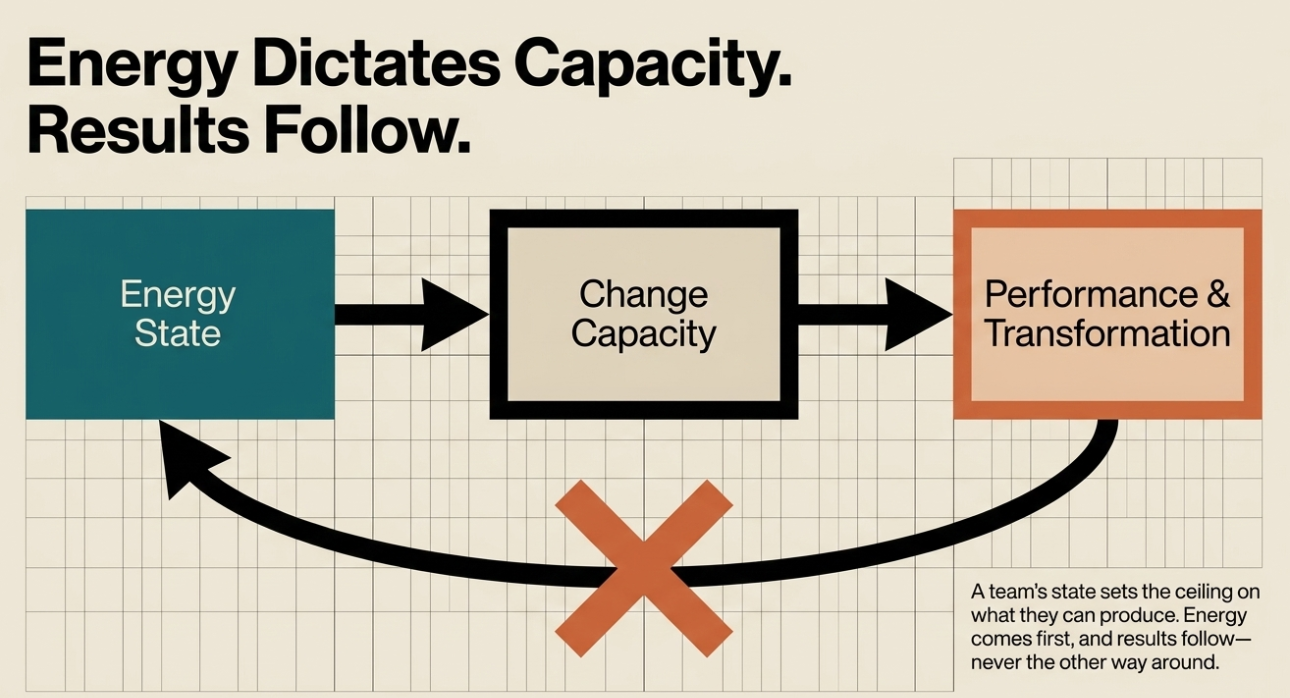
There was a second point from Part 1 worth carrying in here. Energy produces performance long before performance produces energy. A team's state sets the ceiling on what they can produce; energy comes first, and results follow, never the other way around.
Your organisation does not have one energy; it has many
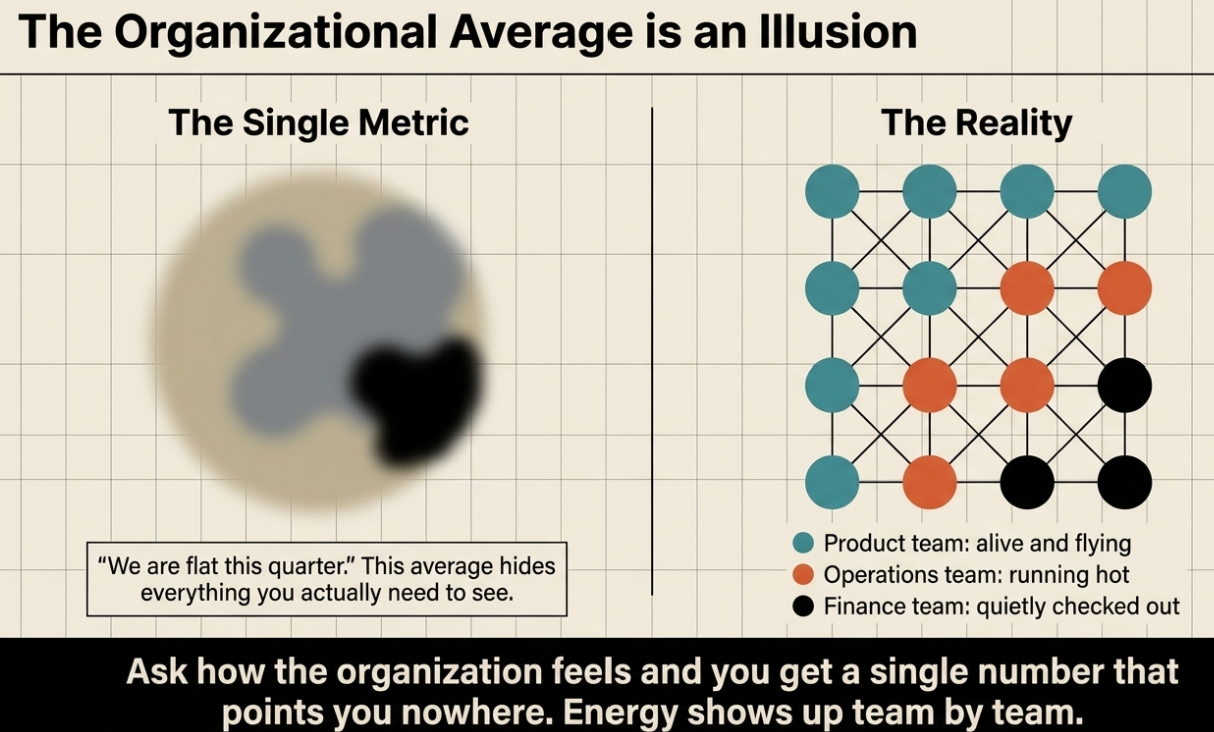
Ask a leader how the energy in their organisation feels, and you tend to get a single answer. We are flat this quarter, we are flying, we are exhausted. Whatever the word, it is an average, and the average hides everything you actually need to see. Underneath that one word sits a finance team that has quietly checked out, a product team more alive than it has been in years, and an operations team somewhere in the middle, all in the same building, in the same week. The single number describes none of them, and it points you nowhere.
This is the real answer to the question in the title. When one team is thriving, and the team beside it is barely surviving, the gap is rarely about how good the people are. The two teams are in different energy states, and the state is doing the work that skill usually gets credit or blame for. Read the organisation as a single number, and the difference is invisible. Read it, team by team, and it is the most useful thing on the page.
Energy shows up team by team, and the average is where that detail goes missing.
What this means for your change and transformation
You do not run a change into an organisation. You run it through specific teams, and each one receives it in its current state. The same rollout meets a team with room to take it on and a team already running on empty, and it lands completely differently in each. Before you launch the next one, the useful question is not whether the plan is good. It is which teams you are about to hand it to, and what state each of them is in right now.
➡️ In practice
Consider the single team carrying the outcome that matters most to you this quarter, and be honest about the state they are actually in today.
Ask whether your read on organisational energy is anything more than a company-wide score that feels roughly right and changes nothing you do on Monday.
Diagnose a struggling team by their energy state before you reach for a capability or resourcing explanation, because the state is usually the real story.
A way to see it: the grid and the pocket
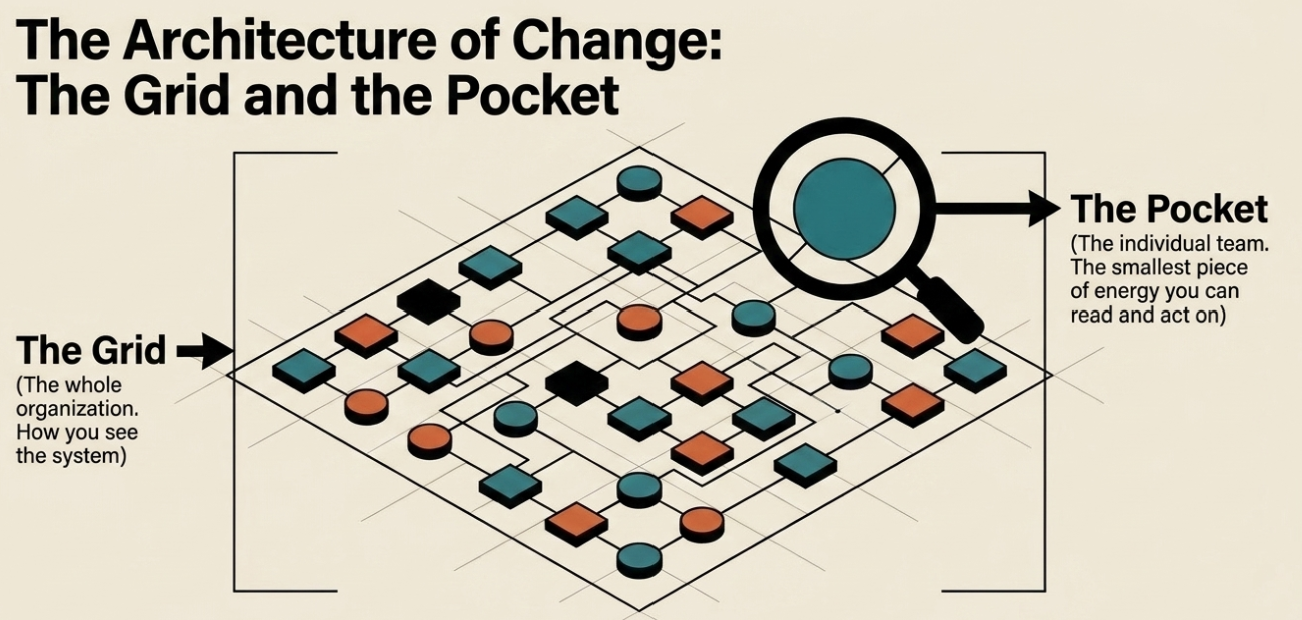
If energy is distributed across many places at once, you need a way to see it all, and the picture that works is an electrical grid. A grid does not carry current everywhere. It moves power across many points, and at any moment, some are running steady, some are overloaded and running hot, some are dimming, and a few have gone dark. An organisation works the same way, and the grid gives you a way to hold the whole of it in view rather than a single blurred average.
Each team on that grid is what I call a pocket. It is a word people in this work already reach for when they talk about a pocket of resistance or a pocket of excellence, so it carries its meaning without explanation. A pocket is the smallest piece of energy you can actually read and act on. The grid is how you see the whole organisation. The pocket is where you do the work. You think at the level of the grid, and you act at the level of the pocket.
The grid is the whole picture, and a pocket is the one team you can act on, so you see the organisation as a grid and change it a pocket at a time.
What this means for your change and transformation
A change never meets the organisation as a whole. It meets one pocket at a time, and each pocket receives it differently. That is why a single message, sent to everyone, lands as encouragement in one team and as pressure in another. Mapping your teams as pockets is the difference between broadcasting one instruction to twelve different states and reading each state before you decide what it needs.
➡️ In practice
Consider drawing your own grid, the teams that matter to your program, and the state you would put each of them in today.
Ask which single pocket stands between you and the outcome you have committed to, because that is where your attention belongs first.
Diagnose a change that is working in some teams and stalling in others as a difference of pocket, not a flaw in the plan itself.
The six states a team can be in
Over the years of this work, the same six states come up again and again, and the grid gives each one a behaviour you can recognise at a glance. They run from the most draining to the most generative, and the value of naming them is simple: once you can see which one a team is in, you know what that team can actually take on right now.
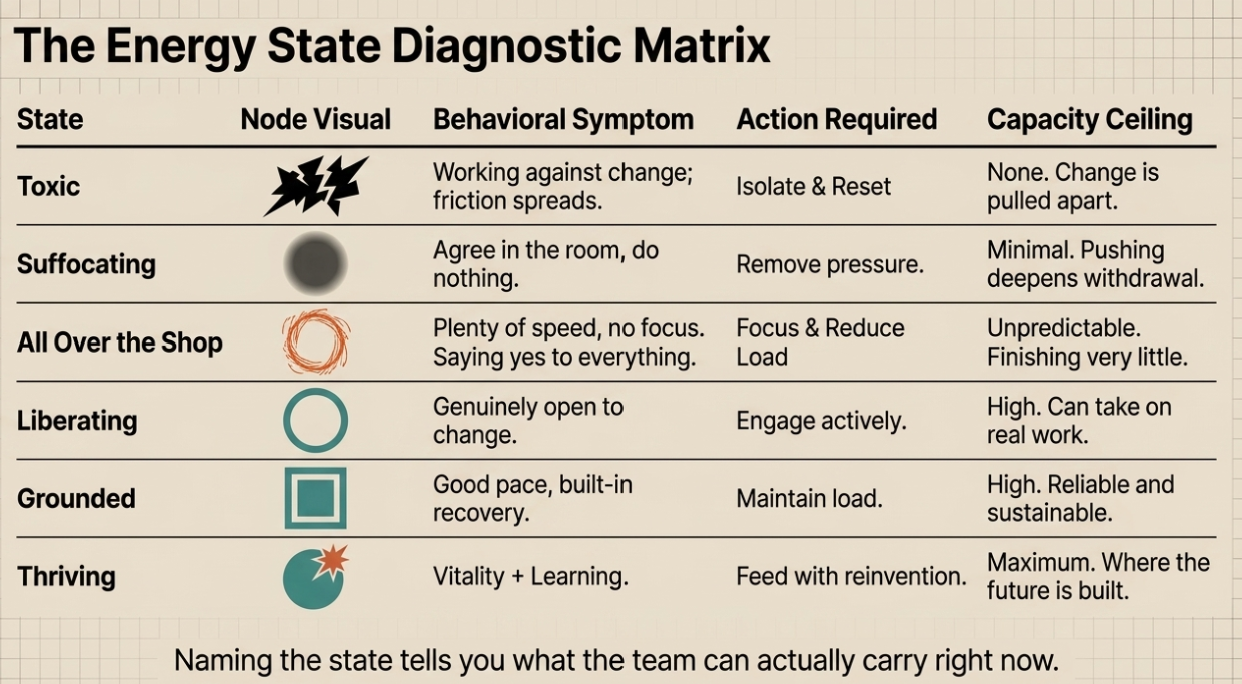
🔳 Toxic. The team has gone dark. People are working against the change and against each other, and the friction spreads to the teams around them. Anything you introduce here gets pulled apart.
🔳 All over the shop. The team is running hot. Plenty of motion, plenty of speed, no focus, usually because they are carrying more change than they have room to hold. They will say yes to everything and finish very little.
🔳 Suffocating. The power is on, but almost nothing is getting through. People have pulled back to the minimum and are waiting for it to pass. They agree in the room, and nothing moves afterwards.
🔳 Liberating. Strong, clean energy. The team is engaged and genuinely open to the change rather than braced against it. This is a team that can take on real work.
🔳 Grounded. Steady and sustainable. The team works at a good pace without burning down because recovery is built into their operations. Reliable and able to hold change well.
🔳 Thriving. The state that adds something the others do not. The team carries energy and learning, so they are not only performing but also improving as they go. This is where new things actually get built.
That last state has real evidence to back it up. Gretchen Spreitzer and Christine Porath, writing in Harvard Business Review (2012), found that people who were thriving delivered 16% better performance and 125% less burnout than their peers. They described thriving as vitality and learning arriving together, energy that feels good and compounds into growth, which is why it is the state where the future gets built, and the one most organisations look after least. The research names the state well. What it does not tell you is how a team moves into it and back out again, and that movement is the part you have to lead.
Name the state a team is in, and you know what that team can carry right now.
What this means for your change and transformation
The state a team is in sets the ceiling on what you can ask of them. As I put it in Part 1, energy produces performance long before performance produces energy, which is why the state comes first and the results follow it. A thriving team can take on genuine reinvention. A suffocating one cannot, and pushing hard only deepens the withdrawal. Matching the size of the ask to the state of the team is most of the difference between a change that holds and a change that stalls.
➡️ In practice
Consider naming the state of your 3 most important teams right now, one word each, before you plan the next thing you send them.
Ask whether the change you are running assumes a state your teams are not actually in, because two teams with the same skills and the same targets producing different results is a difference of state.
Diagnose a team that keeps agreeing and never delivering as a suffocating one, and understand that the fix for it looks nothing like the fix for a team running hot.
Your best team will dip, and that is not the problem it looks like
Here is the part that surprises people. A team in a strong state does not stay there on its own. The team that was flying three months ago and feels flat today has not lost its ability. It has run its energy down, which is what energy does when it is used hard and never given room to recover. The strongest teams dip precisely because they were pushed hardest, and the dip is not a sign that something is broken.
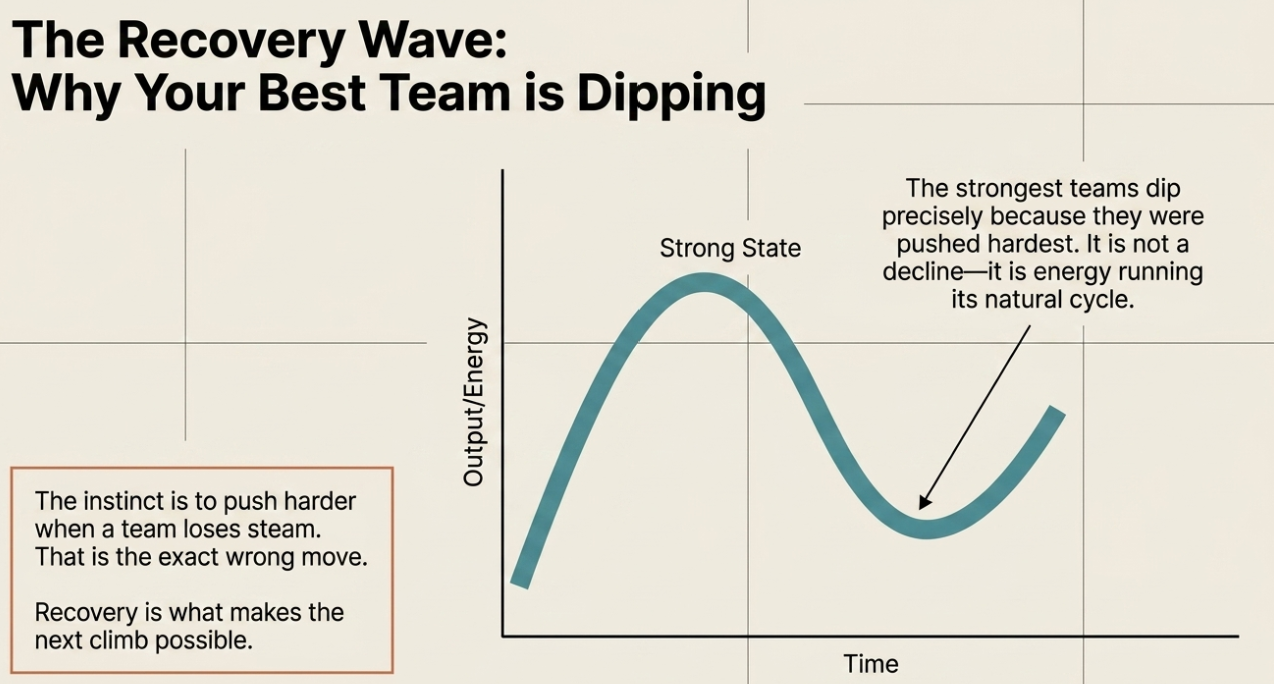
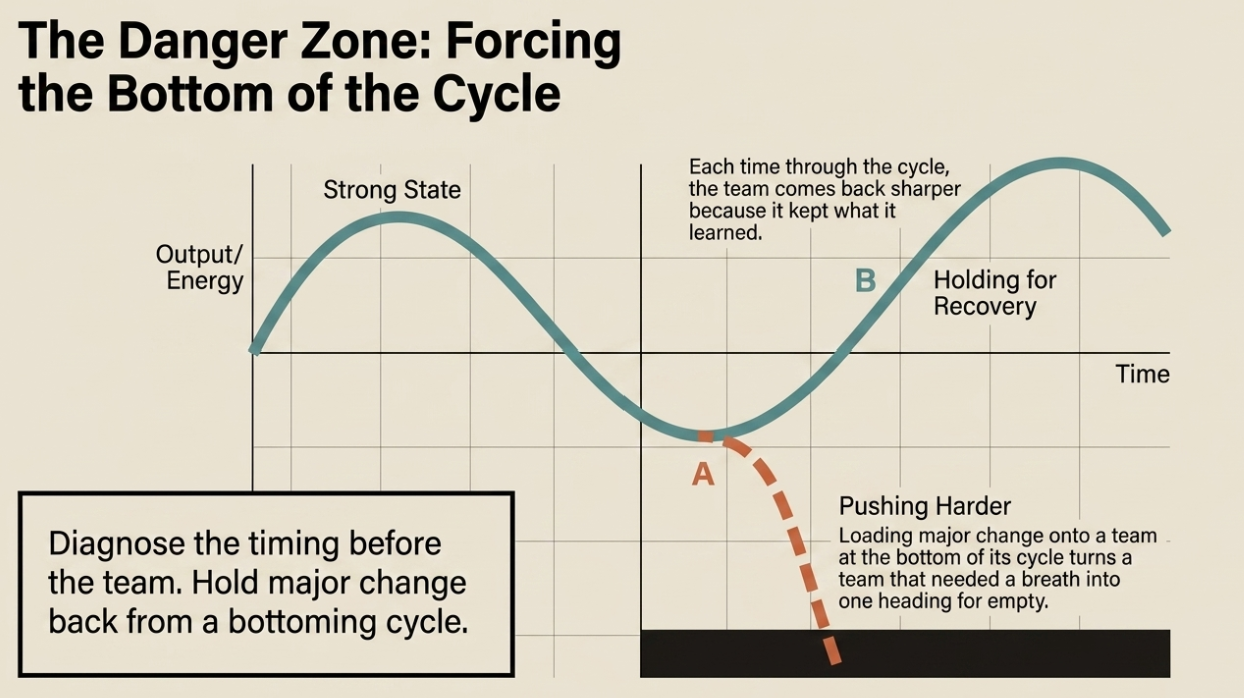
This matters because the instinct, when a good team loses steam, is to push harder. That is usually the exact wrong move, because energy runs in a cycle. A team rises into a strong state, comes back down to recover, and rises again, and each time through, it comes back a little sharper because it kept what it learned. The recovery is not lost time. It is what makes the next climb possible. Read the dip as a decline and drive through it, and you turn a team that needed a breath into one that is running hot and heading for empty.
A strong team that dips has not weakened. It has spent what it needs to get back.
What this means for your change and transformation
If energy cycles, then timing is part of the plan. Loading a major change onto a team at the bottom of its cycle is asking them to spend energy they do not have, which is why some changes fail for reasons unrelated to the change itself. Watching where your key teams sit in that cycle tells you when to push and when to hold.
➡️ In practice
Consider which of your strongest teams has gone longest at high intensity without recovery, because that is the one closest to running out.
Ask whether a recent drop in a good team is a genuine decline or a team that needs recovery before the next push.
Diagnose the timing before the team, and hold a major change back from a team that is at the bottom of its cycle rather than forcing it through.
What all of this means for leading change and transformation
Pulling it together, the shift is this. You are not moving a change into an organisation. You are moving it into a grid of teams, each in its own state, each of which will hold that change or let it go depending on its state when the change arrives. That is why identical programs, run with equal skill, land so differently across the same company, and it is the thing a single plan and a single message can never account for on their own.
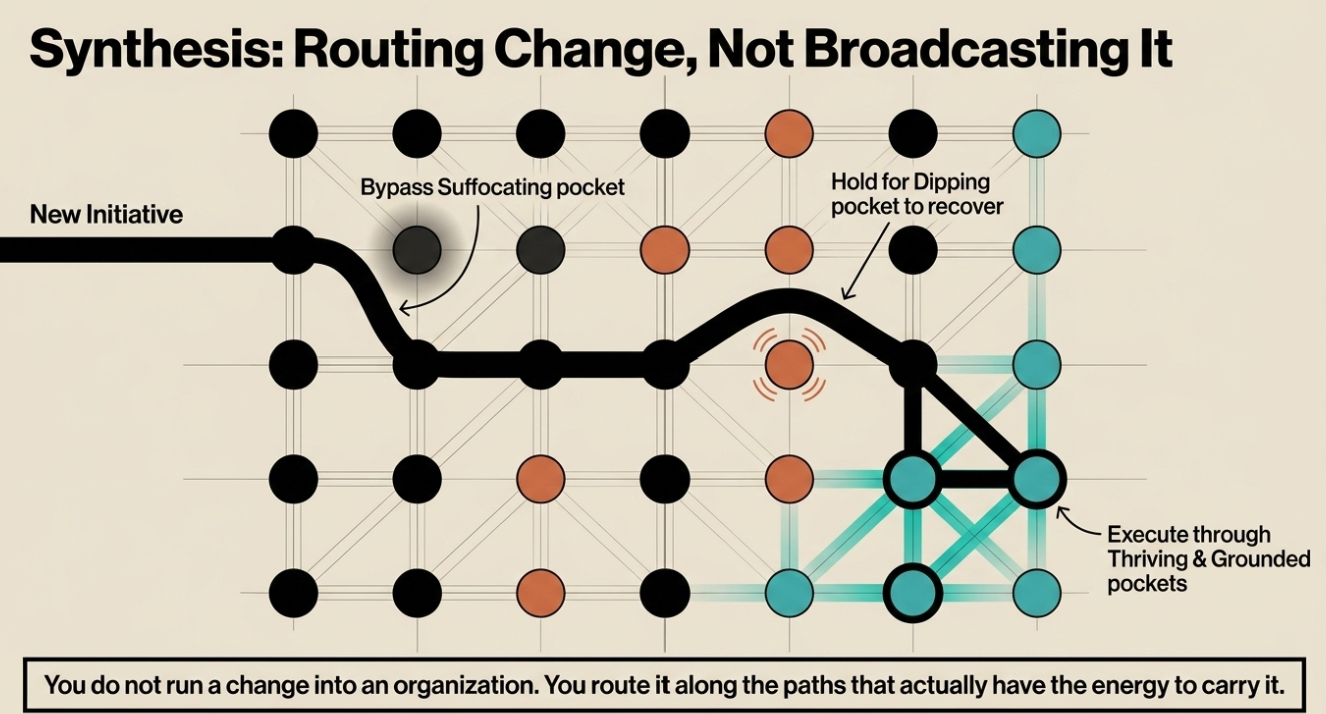
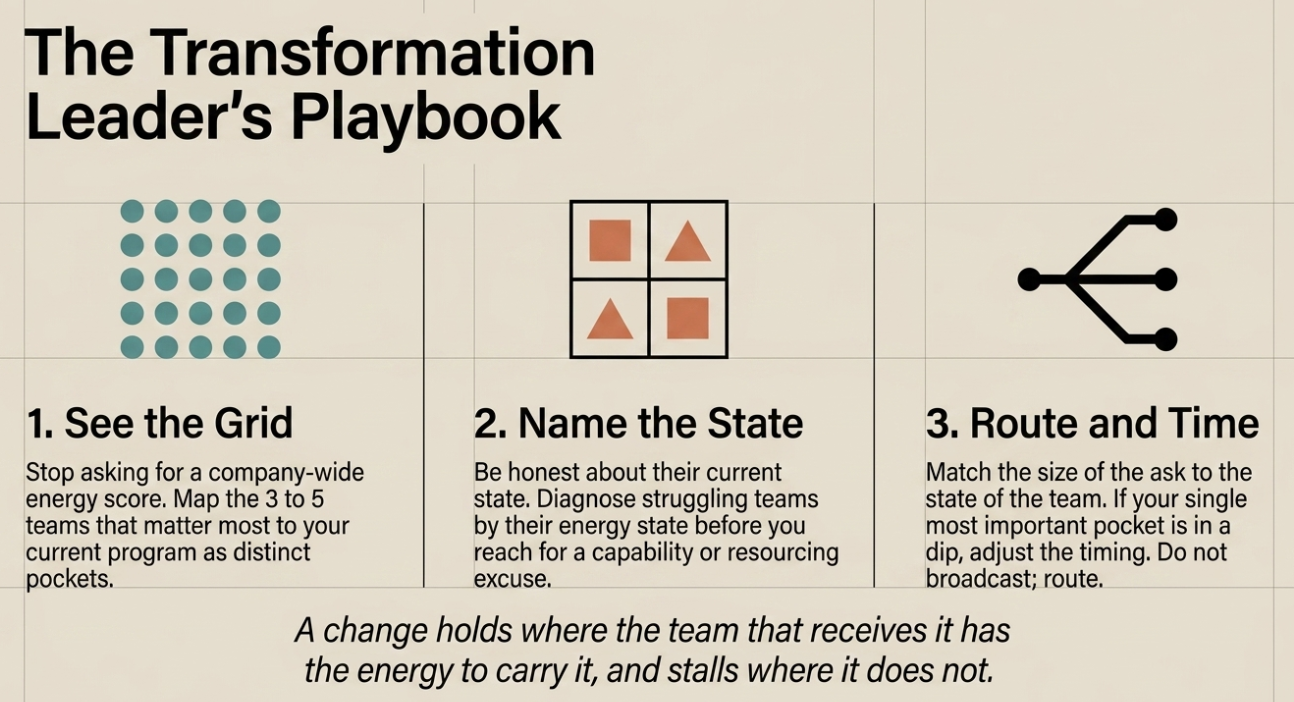
So the work is closer to reading than broadcasting. See the grid, name the state each team is in, match what you ask of them to what that state can carry, and time it to where they sit in their cycle. Do that, and a change stops being something you push at people and becomes something you route through the organisation along the paths that can actually carry it. That reading, team by team, is where Part 3 goes, into what a leader actually does to move a team from one state to another.
A change holds where the team that receives it has the energy to carry it, and stalls where it does not.
Thank you for taking the time
Would love to hear your thoughts and feedback
Next week, its part 3 and the last in this series on organizational energy and how it relates to change and transformation