What a change that holds is made of
Part 1 made the case: the practice of change was built to move a known population from A to B and confirm the change landed and stuck, and it does that well. It is now landing on people who are already full and on organisations that need the change to take them somewhere, and it has very few instruments for either. This part sets out what a change that holds is made of, so the practitioner, the director, the sponsor and the C-level can look at the same picture.
One caution before the model. Everything here will sound familiar in parts, because good leaders of change already know that culture decides whether a change survives, that people have limits, and that personalised change works better than a blanket cascade. The difference between knowing this and running change on it sits in what the organisation defines as success, what it budgets for, and what it designs in from the start rather than adds when adoption is thin. That is where the current practice and change that holds part ways.
Link to part 1 here: https://transformationleadership.institute/post/the-world-moved-faster-than-the-current-change-practice
🎧 I highly recommend you to listen to this audio podcast as a deep dive which is AI-generated based on this edition and Jess' intellectual property:
https://gotoleader.s.gy/what-a-change-that-holds-is-made-of
What a change that holds is made of
The aim
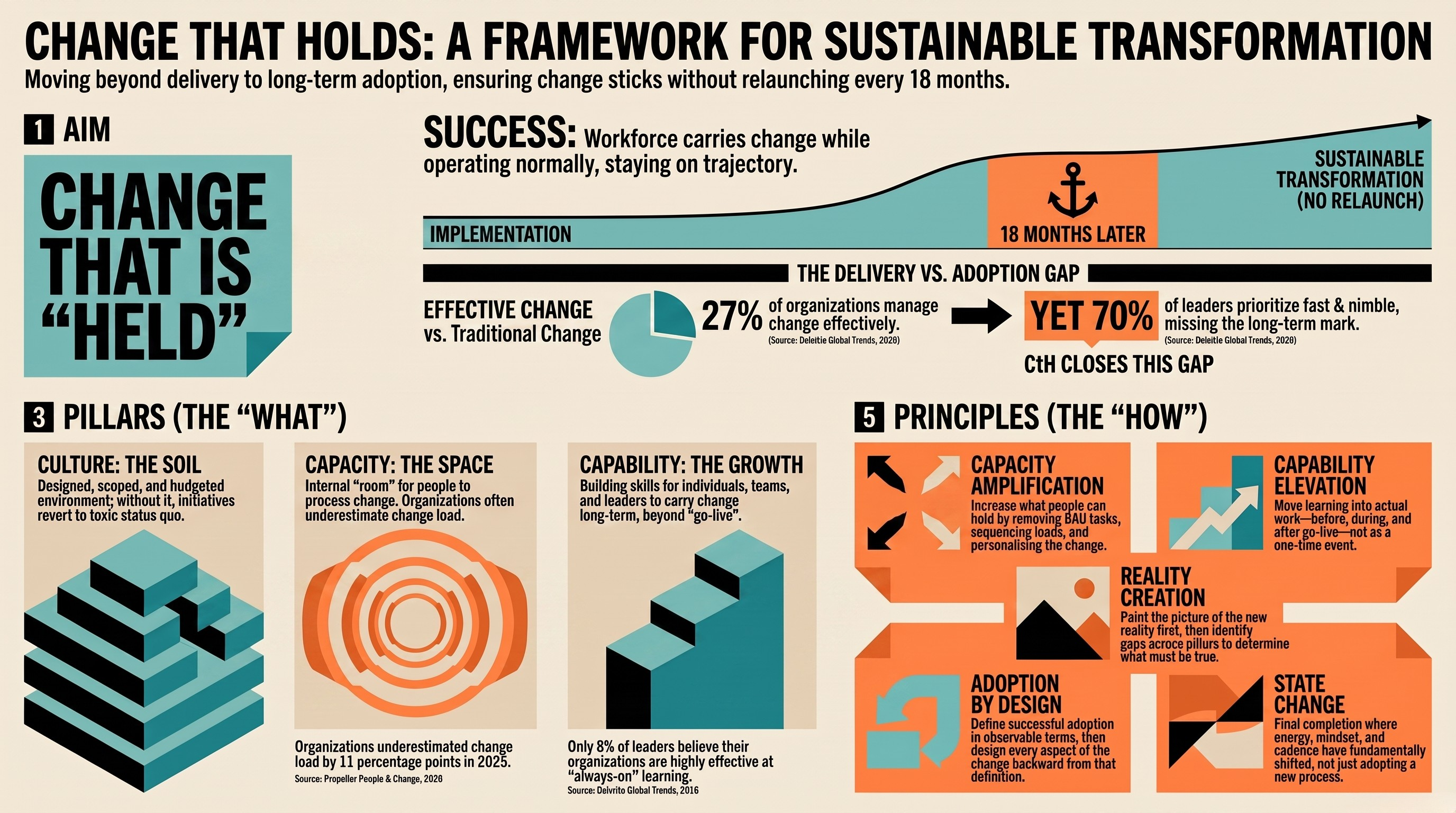
A change that holds is held by the people carrying it, because they have the capacity, the capability and a culture that lets them, and it holds the organisation to the trajectory the change was created for. Good looks like a workforce that can carry the change and keep operating, and an organisation that arrives where the change was meant to take it: without the relaunch 18 months later, without compliance in place of adoption, and without the change quietly turning into the next status quo someone has to undo.
That is the whole aim, and it is deliberately not a delivery aim. Deloitte's 2026 Global Human Capital Trends survey found that only 27% of respondents believe their organisations manage change effectively, in the same year that 7 in 10 business leaders named being fast and nimble as their primary competitive strategy for the next 3 years. The gap between those two numbers is the gap between change that is delivered and change that is held, and this model exists to close it.
"The gap between change that is delivered and change that is held is the gap this model exists to close."
📍 In practice, this is what it means
Write the aim for your current change in these terms: held by whom, holding the organisation to what. If you can only fill in the second half, you have designed the change to be delivered, and no one has designed it to be held.
Put "what would this look like 18 months after go-live" into the design conversation now, and treat the answer as scope.
3 pillars: culture, capacity, capability
Culture is the soil in which change is planted. It decides whether the change takes hold, is sustained and grows into the reason it was created, or dies and becomes the next toxic status quo that shows up in 3 years and has to be dealt with all over again. The current practice treats culture as context: it assesses it, describes it and works around it. Change that holds puts designing the culture inside the change, in scope and budgeted, because a change planted in soil that cannot carry it fails later, at a higher cost.
Capacity is the internal space people have to process, deal with, and make sense of change. They also need space to think, to run BAU, and to keep the lights on, and the practice already plans for that. The part it rarely plans for is the deeper one: whether a person has room to hold this change, over and above understanding it, nodding at it and completing the training.
Perceptyx's 2026 research puts the mechanism plainly: even changes employees support deplete their capacity to absorb the next one, and Propeller's 2026 People and Change report found organisations underestimated their total change load by 11 percentage points in 2025. The practice measures readiness and impact, both of which measure knowing. It has almost no instrument to measure capacity to hold, per person or per team, and that is why the same change stretches one person, overwhelms a second, and shuts a third down.
Capability is dealing with the change and building the capability to do so, for the individual, for the team and for the leader of the team. It is wider than the change scope requires. It includes the capability to continue carrying the change after go-live, which is why watering continues after the launch date rather than handing it over at that point. The practice funds capability up to the go-live line. Change that holds funds it until the new state is the state.
"The same change stretches one person, overwhelms a second and shuts a third one down."
📍 In practice, this is what it means
Put culture in scope: name the 3 cultural conditions this change needs to survive, and design work to address each, with a budget line for each.
Assess the capacity to hold per team before sequencing. Ask what else they are carrying, what they had to drop for the last change, and what they would have to drop for this one.
Extend the capability plan past go-live on the plan itself: who continues to build capability, for how long, and who is accountable for the leader of the team having it, not only the team.
5 principles: how you work on the pillars
Pillars are what a change that holds is made of. Principles are how you work on them. There are 5, and 2 of them share their names with the pillars they act on, on purpose.
Capacity amplification works on the capacity pillar. Amplify what people can hold before you add to it: sequence the load, remove BAU while the change is landing, and personalise the change to the person and the team rather than cascading a blanket change. Every good leader of change knows personalisation matters, and it lives on the nice-to-have line, funded with change agents and champions half the time and a cascade the other half. Change that holds makes personalisation the plan.
Capability elevation works on the capability pillar. Elevate capability for the individual, the team and the leader of the team, before, through and after go-live, in the work rather than beside it. The 2026 Deloitte research found only 8% of leaders believe their organisations are highly effective at always-on learning; this principle aims at exactly that gap.
Reality creation treats change as an exercise in creating a new reality rather than delivering a set of outputs. Look at the reality now, paint the picture of what the new reality looks like, then find the gaps at all three pillars, then go deeper to know what has to be true for that reality to be created through the change. It reverses the order the practice works in, which starts from deliverables and assesses their impact.
Adoption by design decides what adoption looks like first, as the definition of success, and designs everything back from it. You hold the end in mind from day one, and that is what stops the plan defaulting back to landing and sticking when the pressure comes on.
State change comes after the others and completes them. The state of the individual and the team has changed across energy, mindset, perception, cadence, and practice, so the state has changed, not just a change delivered. Their perception has shifted, their capacity has been amplified, and their capability has been elevated. When you can say the state has changed, the change is being held.
"The state has changed, and not only a change delivered."
📍 In practice, this is what it means
Reality creation first: write one page on what the new reality looks like at the culture, capacity, and capability levels, then derive the gaps and the plan from it, not the other way round.
Adoption by design: define adoption in observable terms before scope is signed, and put it in the business case as the success measure.
State change: 3 months after go-live, ask 5 people how their energy, mindset and cadence have changed. If the answer is "we do the new process", the state has not changed yet.
Where this comes from
I have been evolving my craft and testing this way of working over the last 2 years, within sophisticated organisations that had been advised left, right and centre by consulting companies, change institutes and gurus. They had tried the traditional approach and the elevated one, with the neuroscience and the psychological safety layer, and found that both stayed conceptual and still ran top-down and cascaded. This approach works, and it does not transfer as-is to every organisation or every part. Which parts matter most depends on where the organisation stands, its collective mindset and the leadership maturity running it.
The pillars and principles above rest on a set of practices, tactics, tools, and skills that make them workable day to day. Those are not in this series. What is here is enough to see how the model fits together and to test it against your current change.
The sunk cost of changing how we do change
If you are thinking "we already do this", you are partly right, and that is the point. You know culture decides, you know people have limits, and you know personalised change works better than a cascade. What you rarely have is the budget, the measurement instrument, the depth of tools and methods to create breakthroughs fast, the mandate or definition of success that lets you design for it from the start, so it gets done in the gaps by the champions, half the time.
If you are thinking "this is working, why change", it is working on landed and stuck. Ask what proportion of your last 3 changes are still in place 18 months later without enforcement, and what state the people are in. If both answers are good, keep going. If either is not, the frameworks are fine, and the definition of success they serve is where the sunk cost sits.
If you are thinking "this is a huge change", it is 3 moves rather than a rebuild. Put culture in scope. Read capacity to hold per team before you sequence. Extend capability past go-live on the plan. The rest of the model builds on those, and each one can start on your current change this month. Moving the definition of success sits with the sponsor and the C-level as much as with the practitioner, which is why this series speaks to all of them.
Takeaway
A change that holds is held by people, because they have the capacity, the capability and a culture that lets them, and it holds the organisation to the trajectory it was created for. Three pillars: culture, capacity, capability. Five principles: capacity amplification, capability elevation, reality creation, adoption by design, and state change to complete them. Tested for 2 years where everything else had been tried, and it works, applied to where the organisation stands.
Next in the series: Part 3, why change that holds is the competitive advantage for the organisations that intend to be here and thriving in the next 3 to 5 years.